


Back to the Future
Ben Wildsmith
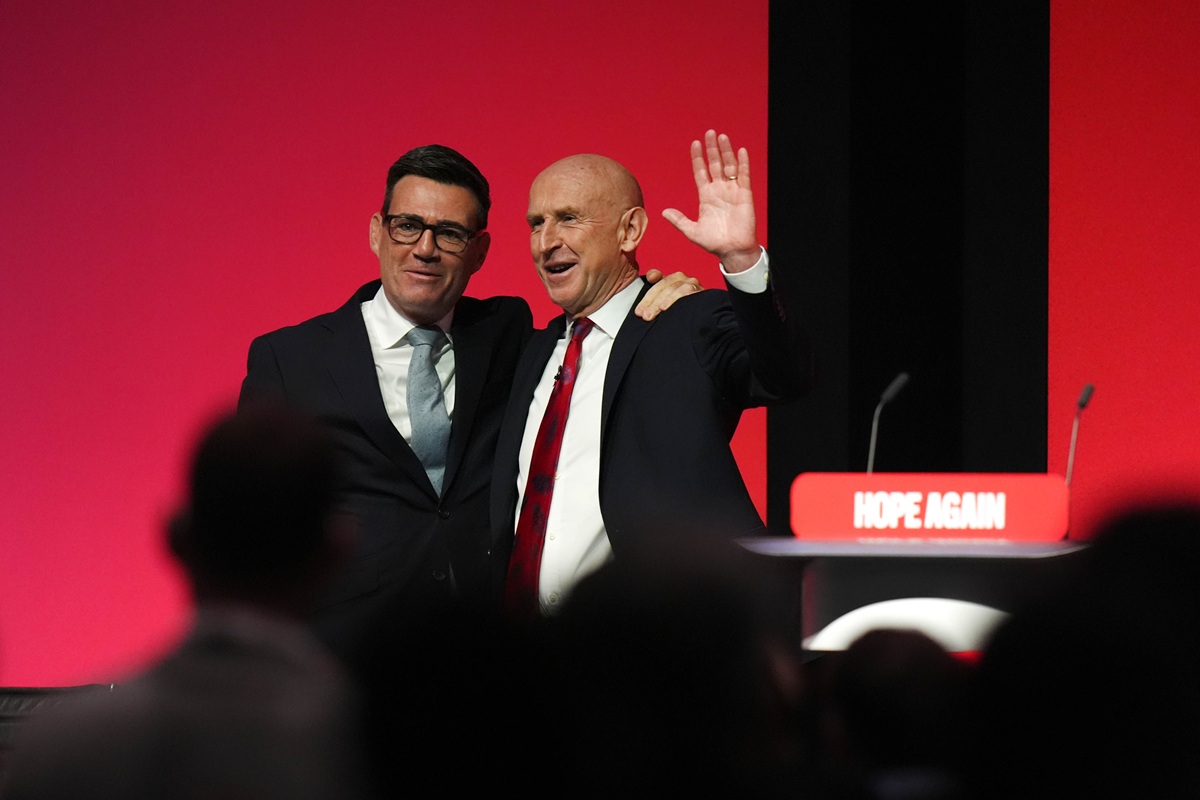
Andy Burnham’s opening weeks in Downing Street have seen him trying to sketch out a vision for how the UK should change.
From public ownership, expanded public services and oversight of business to a foreign policy driven by ethical concerns, it’s a broad picture of what many mistakenly expected Tony Blair to deliver back in 1997.
Understandably light on detail so far, the core mission seems to be rolling back the excesses of neoliberalism in favour of a mixed economy in which life’s necessities are guaranteed by state regulation or intervention as necessary.
Rather than pursuing nationalisation as an end in itself, Burnham has hinted that it will be used as a threat to ensure compliance with tighter regulation in areas like water and energy, presumably seeking to hedge financial risk with the private sector without leaving consumers at the mercy of shareholders.
The brainstorming and check-my-feels rebranding processes will meet reality at the end of the month when John Healey delivers his first budget as Chancellor.
Keir Starmer’s failure to command respect in the country has produced a unique scenario in which a sitting government is expected to demonstrate an authentic change of direction but without a fresh mandate on which to stand. Rumours persist that another election might be scheduled in May and it’s fair to speculate that the perceived success of the budget will decide that.
So, the budget could well be as much an election manifesto as a statement of policy. The challenge for Healey and Burnham is to deviate enough from the status quo to justify the change in leadership without appearing to act without consent from the electorate.
The recent statement of intent on the pensions triple lock expressly promised no change before 2030, after the latest date an election can be held. That trick isn’t going to hold over what promises to be a choppy three years of holding things together as the world descends into proliferating conflicts and resultant economic chaos.
Real, immediate decisions will need to be made sooner rather than later.
One proposal reportedly under discussion is the Institute for Public Policy Research’s idea for an ‘Amazon tax’ that would levy £1.5 billion per year on larger online retail platforms. The idea is that this money would be used to reduce business rates for smaller high street businesses, levelling the playing field and encouraging regeneration of town centres.
Social cohesion
For me, this sounds like common sense. The social cohesion that once flourished in our public spaces has been threatened by the isolation of life online, and the atomisation of society is beginning to produce unhealthy relations between people who rarely meet anybody new outside of work.
I’m sure Tommy Robinson used to shop in Woolworths too, but he knew not to start espousing the Great Replacement Theory in the pick ‘n’ mix line.
So, this appeals to me. It’s the sort of thing I grew up believing government was for. That, however, might be its inherent problem.
I’m the same age as Burnham, bar a couple of years, and I’ve begun to wonder if the things that appeal to me in his politics are as much about nostalgia as ideology. I remember Saturday mornings in bustling town centres, where you could randomly meet friends on the way to buy a pair of Farahs or a Thompson Twins picture disc. I miss all that, but I also miss being able to bound up a flight of stairs and that ain’t coming back either.
Neoliberalism
Behind Gen X, in its brief moment of political power, stand two generations whose lives were never like that, and who have adapted to the environment they found themselves in. Their lives haven’t been changed by neoliberalism and the digital economy; they have been shaped by them.
If it becomes cost-effective to go into Ponty and buy a quarter-inch jack plug from a resurrected Tandy’s, that might appeal to me, but would seem like an almighty waste of time to my son.
A renewed social contract with business and increased mindfulness about the social effects of technological change are noble ambitions, but they must work for the population to come, rather than serve as a comfortable pipe dream for those of us with more memories than ambitions.
The upcoming budget might set a blueprint for a different UK, but Healey and Burnham should beware of looking back for inspiration. Whatever the future holds, you can be certain that it won’t resemble the past, no matter how much we yearn and legislate for it.
Support our Nation today
For the price of a cup of coffee a month you can help us create an independent, not-for-profit, national news service for the people of Wales, by the people of Wales.
Get more trusted Welsh news
Choose Nation.Cymru as a preferred source in Google News to see more of our journalism.


