


Bakery owner criticises glyphosate spraying after wildflower path left blackened
Amelia Jones
A bakery owner has raised concerns after a path once filled with wildflowers was left blackened by glyphosate spraying, which the local council has denied was carried out by them.
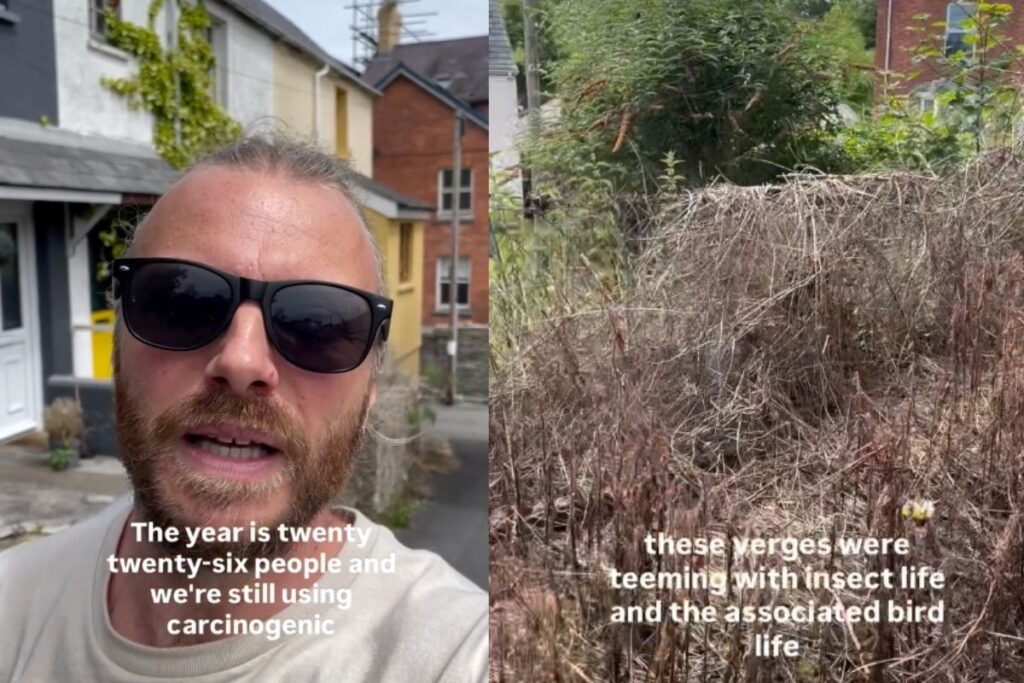
Jack Smylie Wild, owner of bakery Bara Menyn in Cardigan, posted the video on Facebook, showing a path of wildflowers that had been destroyed on his walk to work.
While showing the path to his followers, he described the scene as “quite shocking” and questioned why wildflowers had been sprayed during what he called a time of ecological collapse.
Glyphosate is a herbicide. It is applied to the leaves of plants to kill both broadleaf plants and grasses. It is commonly used by the council to clear unwanted plants from streets, parks, and pavements.
While glyphosate is widely used, it has raised concerns among environmental groups and some residents. The chemical has been linked to potential health and environmental risks. As a result, many councils are actively testing pesticide-free alternatives like hot foam or manual weeding to reduce their chemical footprint.
Ceredigion County Council have since denied claims that they carried out this spraying.
In the caption, Wild said: “Have we gone mad? Look at this. This verge was full of wildflowers until a couple of days ago, when the council decided to spray glyphosate on this area.
“It’s 2026 – and we are still using carcinogenic, brutal chemicals to destroy the natural world in a time of ecological collapse. The pollinators are having a hard enough time as it is – and yet we see fit to eradicate a small strip of wildflowers, leaving it looking like this. It’s truly shocking.
“If we look at the area that hasn’t been sprayed yet, we can deduce what has just been killed: white clover, self-heal, herb-robert, ragwort, thistles, buttercups , hedge mustard, common mallow – the list goes on. Each of these plants supplies insects with food; and in turn the insects are food for the birds such as swifts and swallows, whose numbers are rapidly declining.
“And it’s not just about the invertebrates and birds – what happens to the glyphosate once it’s killed everything off? Rain will carry it.”
Wild expanded on his concerns, describing the affected area as a habitat that had recently supported insects, birds and a variety of wildflowers. He also raised concerns about where the herbicide could end up after rainfall, claiming it could enter nearby drains and waterways.
In the video, he says: ” I just wanted to show you the glyphosate treatment that’s been done on my walk to work between my house and Bara Menyn on this footpath that cuts through this little area. It’s quite shocking.The year is 2026 people and we’re still using carcinogenic brutal substances in public spaces and in nature generally and I can’t believe it.
“A few days ago these verges were teeming with insect life and the associated bird life. It’s scorched earth now, all of the grasses have died too, the wildflowers and it’s just quite shocking to be honest. This little area up here hasn’t been done yet, so we can kind of deduce what’s been lost down here from what’s still living up here.
“We’ve got gorgeous white clover, we’ve got thistles, we’ve got common mallow. There’s a little hoverfly right here, on this hedge mustard. I mean the pollinators are having a hard enough time as it is at the moment and we’re using these chemicals like glyphosate to strip these areas and what happens once the glyphosate that they’ve sprayed here has killed all of these things? What happens?
“Well some of you will recognise this area, it’s all running straight down into that drain down there and straight into the Teifi, so aquatic life is suffering.
“The glyphosate is going into the oceans and this isn’t just about humans, right? It’s about the intrinsic right and rights of nature to go about its business unhindered and unpoisoned.”
The post received praise from his followers, who expressed their concerns about the pesticides. One commenter said: “So well said Jack. Same here in some areas of Llandudoch and we’re Pembrokeshire.”
Another added: “Totally agree, we can do better. Thanks for speaking out and speaking up.”
Wild followed the video with a second post, where he said he was taking the matter further. He wrote: “Follow @pesticidefreeaberteifi – read the letter I’ve posted on there; if you’re local & concerned, DM your name and address to me via @pesticidefreeaberteifi , and I will add them to the letter which is being sent to @caruceredigion tomorrow. Let’s kick these filthy, toxic chemicals out of our town and our county.”
When asked for comment, Ceredigion County Council said: “Ceredigion County Council are not responsible for the use of pesticides/weedkiller on the path identified in the video on Facebook. The Council uses weedkillers sparingly, mainly to control Invasive Non-Native Species like Japanese Knotweed, and do not use weedkiller on public footpaths.”
You can watch the full video here and sign the letter here.
Support our Nation today
For the price of a cup of coffee a month you can help us create an independent, not-for-profit, national news service for the people of Wales, by the people of Wales.
Get more trusted Welsh news
Choose Nation.Cymru as a preferred source in Google News to see more of our journalism.




This is absolutely dreadful and whoever did it should be prosecuted. Look at it! It now looks a right mess. I completely agree with what Jack said. He said it all. Good on him for highlighting this.
Are the National Park using ‘Glyphosate’ to eradicate the Rododendrons around the Mawddach?
Only a lot of Honey is made around here…
One would hope, it’s the only effective way of eradicating it, honey made from Rhododendron is toxic and should not be eaten.
So it wasn’t the council then. A clue to the culprit can be seen in the video where the bramble growing over the retaining wall from a neighbouring property appears desecrated. This gives us a clue as to who sprayed. It appears to only affect this small section of the verge. Has he spoken to the landowner, perhaps volunteer like the alternative method like a strim in July ? Put your phone away and talk to people. Arm yourself with helpful words, education, and gift of a loaf.
Wise words. I would add that church grounds should be allowed to be havens of wild flowers rather than mowing them during spring and summer.
Quite. Not leaping to conclusions without fully considering evidence would also be a good idea. Wonder is he has/will change the assumption that it must have been the council