


Benefit spending rises more slowly in Wales than in every English region
Mark Mansfield
Spending on six major benefits has risen more slowly in Wales than in every English region, according to an analysis which puts the annual Welsh total at £7.84 billion.
The research was published by the TaxPayers’ Alliance, a political pressure group that campaigns for lower taxes and cuts to public spending.
It uses the findings to argue for tighter benefit rules, including means-testing Personal Independence Payment (PIP) and restoring the two-child limit on Universal Credit.
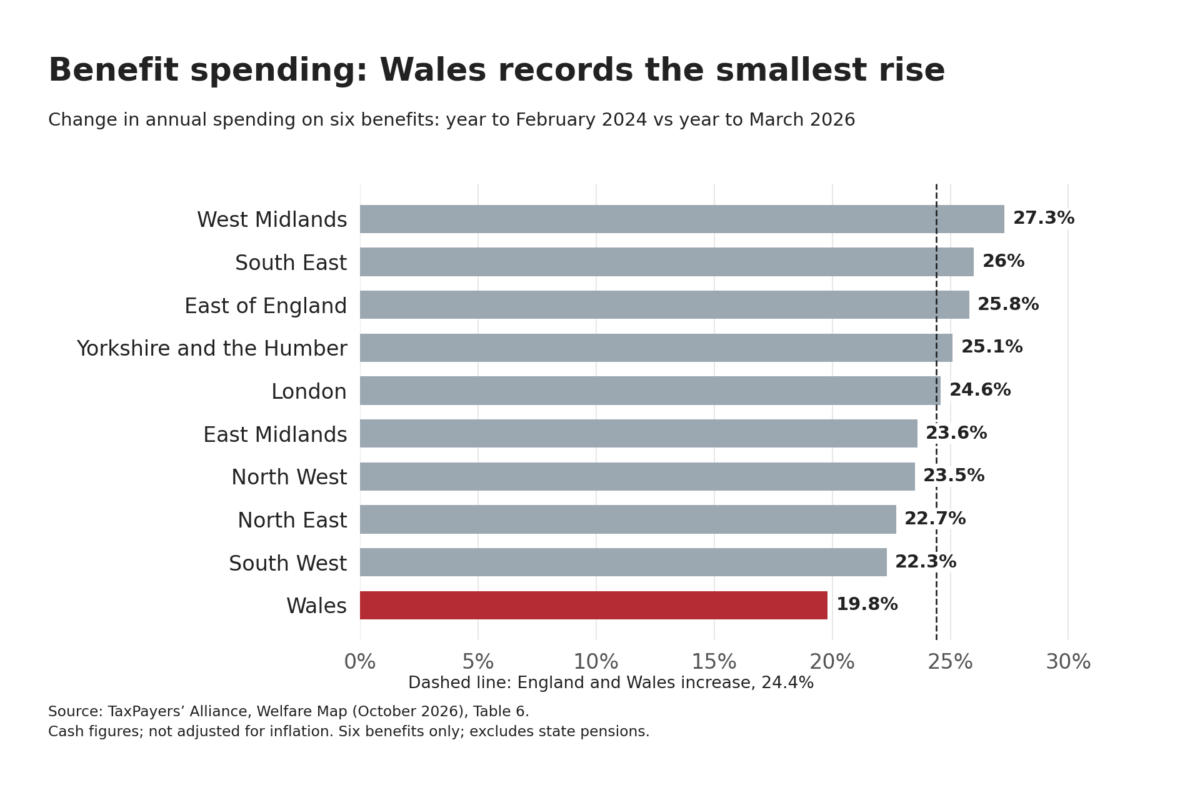
Annual spending on the six benefits in Wales increased from £6.55 billion in the year to February 2024 to £7.84 billion in the year to March 2026.
That represents a rise of £1.29 billion, or 19.8%, compared with 24.4% across England and Wales. The West Midlands recorded the largest increase, at 27.3%.
The report covers Universal Credit, PIP, Housing Benefit, Disability Living Allowance, Carer’s Allowance and Employment and Support Allowance (ESA) across 575 Westminster constituencies.
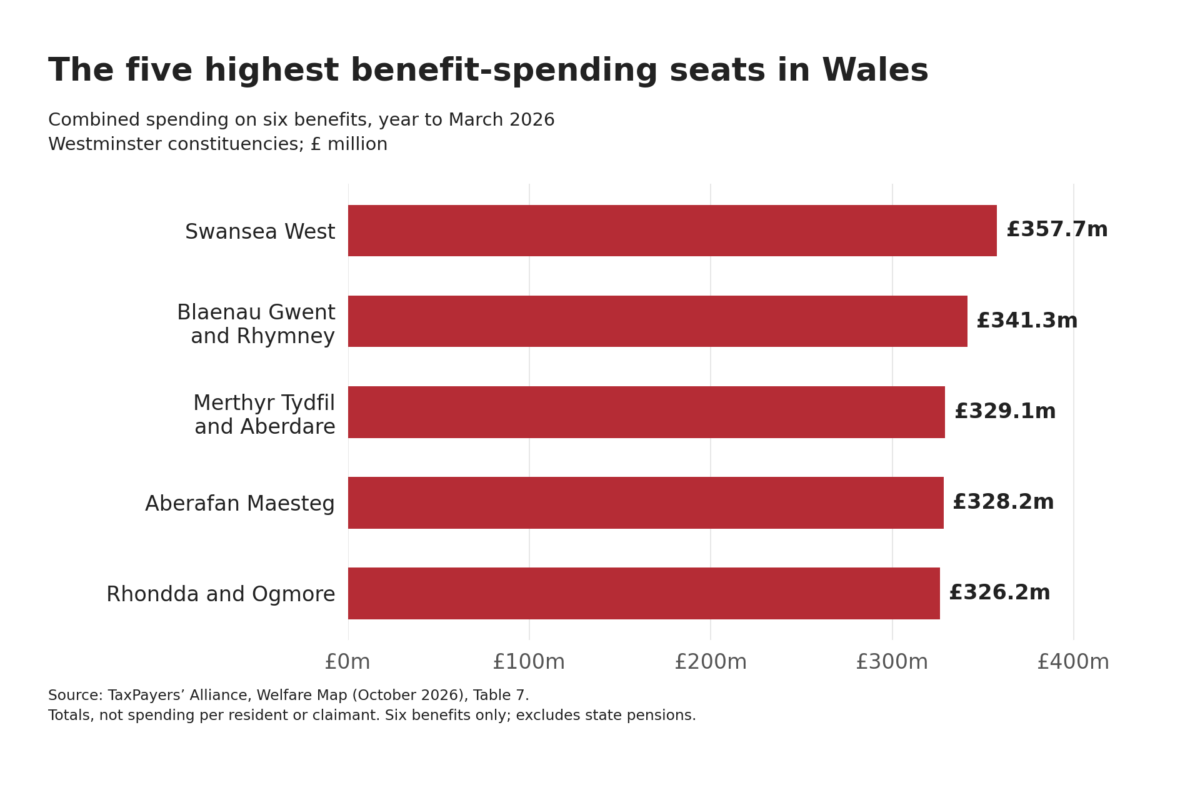
Swansea West recorded the highest combined spending of any Welsh constituency, at £357.7 million, although its increase of 17.1% was below the Welsh average.
It was followed by Blaenau Gwent and Rhymney at £341.3 million, Merthyr Tydfil and Aberdare at £329.1 million, Aberafan Maesteg at £328.2 million, and Rhondda and Ogmore at £326.2 million.
Welsh constituencies also occupied the four highest positions for ESA spending across England and Wales.
Blaenau Gwent and Rhymney recorded £19.4 million, followed by Rhondda and Ogmore at £18.5 million, Merthyr Tydfil and Aberdare at £17.6 million, and Aberafan Maesteg at £17.3 million.
Blaenau Gwent and Rhymney also had the fourth-highest PIP spending, at £98.3 million.
The figures measure total payments rather than spending per resident or claimant. They are not adjusted for inflation and exclude state pensions and some other benefits.
Restrictions
The TaxPayers’ Alliance’s proposals include more face-to-face PIP assessments and requiring claimants to demonstrate the additional costs associated with their disability.
It also wants to remove the exemption from the benefit cap for households receiving PIP and restrict eligibility for some mental health conditions.
Its report says anxiety and depression “could be excluded from eligibility where treatment or other forms of support are considered more appropriate than ongoing cash payments”, while retaining access for people with more severe conditions.
The group argues that opposition from Labour MPs has frustrated efforts to curb spending, leaving the system “even more complex and poorly targeted”.
Those proposals come at a time when many Welsh households are struggling to afford essentials.
An analysis published by Senedd Research in September cites Citizens Advice Cymru findings that 30% of households sometimes do not have enough money to meet those costs, while 31% of people have cut back on energy use.
It also highlights Institute for Fiscal Studies research showing that median household incomes in Wales have grown by just 0.7% a year after inflation since the early 2010s.
Private rents in Wales have risen by 38% since mid-2021, a larger increase than in England or Scotland, according to Office for National Statistics figures cited in the analysis.
The spending increases do not necessarily mean equivalent growth in the number of people receiving support. Universal Credit has expanded partly because existing claimants have transferred from older benefits.
Some of that support, including tax credits, falls outside the six benefits counted. Moving payments into Universal Credit can therefore increase the reported total without the whole amount representing additional support. The report does not isolate that effect in Wales.
Welfare powers
Decisions on the rules and payment rates for the benefits examined rest with Westminster, and the spending does not come from the Welsh Government’s budget.
First Minister Rhun ap Iorwerth told Plaid Cymru’s conference on Friday that he had written to Prime Minister Andy Burnham seeking a “New Deal for Wales”, including powers over welfare.
He described it as a bid to “redress the historic unfairness of our fiscal and constitutional settlement and to put Wales on an equal footing with Scotland as a bare minimum”.
Plaid’s election manifesto pledged to press for the devolution of social security while improving access to existing Welsh support, including council tax reductions, free school meals and the School Essentials Grant.
It also promised to review eligibility and payment levels and make automatic delivery to eligible households a statutory duty.
In his conference speech, Mr ap Iorwerth said: “Tackling poverty is one of my government’s guiding missions, and I will not shy away from that challenge because of a difficult economic and fiscal backdrop.”
He acknowledged the need to improve efficiency and find savings, but added: “We’ll always be about delivering the best value for every pound of public spending and demanding excellence across the public sector.”
Support our Nation today
For the price of a cup of coffee a month you can help us create an independent, not-for-profit, national news service for the people of Wales, by the people of Wales.
Get more trusted Welsh news
Choose Nation.Cymru as a preferred source in Google News to see more of our journalism.


