


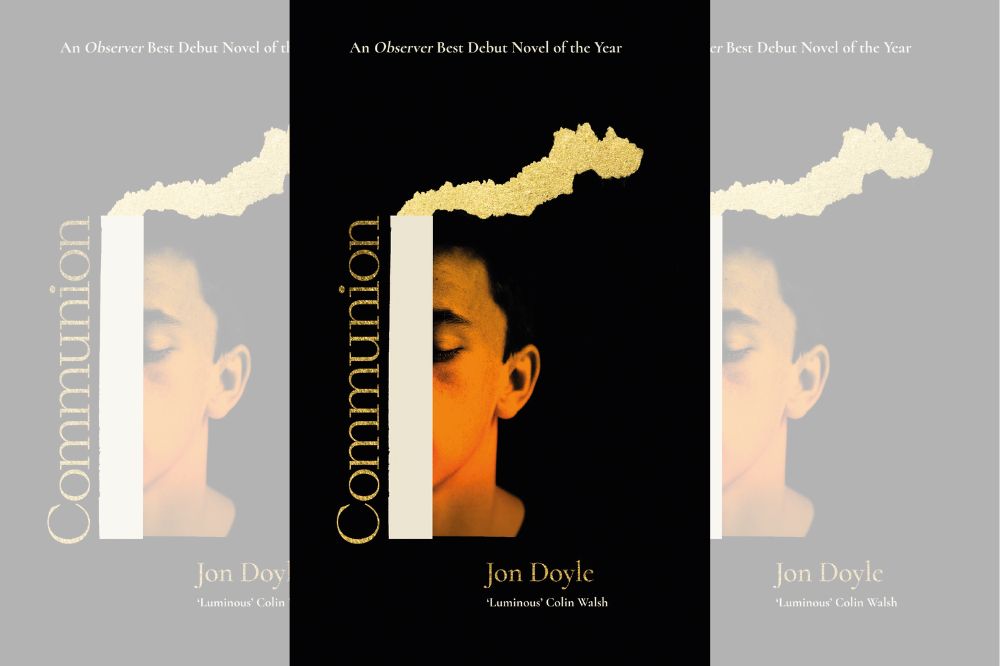
Book Review: Communion by Jon Doyle
Carole Hailey
Given the subject matter of the novel Communion, it is fitting that I start this review with a confession.
I have known the author, Jon Doyle, for some years. We studied together for our PhDs in Creative Writing at Swansea University where his immense talent as a writer was obvious from the start.
The only surprise about the reception that his debut novel has received is that his success did not come sooner.
And yet, perhaps, it is fitting that it was this novel rather than his previous (unpublished) novels that landed Doyle his first book deal. He was born, brought up and still resides in Port Talbot and this novel both celebrates and laments what it means to live in a town so often defined by its industry.
Doyle’s hometown is as significant a presence in Communion as any of the characters and the events takes place as the people of Port Talbot are coming together for two significant events: a strike protesting job losses at the steelworks which dominates the landscape and lives of the town’s residents, and a large-scale, public staging of a Passion play.
At the novel’s centre is Mack, a young man who has returned, un-ordained, to Port Talbot after ten years away at a seminary. Unmoored from what he had once believed to be his life’s calling, he is also adrift in the town of his birth, where for generations men like his father are anchored by their jobs at the steelworks.
For want of other options, Mack takes a temporary job as a security guard at the steelworks. And because he is not, or not yet, a member of the union, when the strike is called, he once again finds himself required to make decisions framed by ideology.
Although the novel’s action takes place almost entirely in the period leading up to the play and the strike, an encounter with an old school friend, Siwan, in a working men’s club causes him to recall a visit she made to the seminary at a time when his vocation was already being questioned.
Siwan’s appearance at the seminary had been a surprise as was her demand that he hear her make a confession. Despite the fact that Mack was not a priest so was unqualified to hear confession, he agrees that she may tell him her secret. What this secret is and the choices it requires Mack to make, is one of the narrative threads leading us through the novel.
So too is the preparation being made for The Passion. Although this is recognisably the 72-hour National Theatre Wales production that took place over Easter weekend in 2011, Doyle has chosen to blunt its reality somewhat (for example, the Hollywood star remains unnamed) which allows him to mirror the play’s preparations – the coming together and celebration of a community – with the looming strike action.
The deft interweaving of these two strands of the novel are particularly effective at illuminating themes of ritual, tradition, betrayal and doubt.
Doyle’s writing is deceptively simple. His words are unpretentious and yet each one is vital, the style tending towards shorter sentences which accumulate in elegant layers to build a wholly immersive world. The descriptions are wonderful and frequently memorable: A tall man. Shoulders like he’d left the hanger in his jacket.
The word ‘communion’ comes from the Latin communio, meaning fellowship, mutual participation, sharing and Doyle leaves space for the reader to bring their own interpretations to his characters’ actions and inactions. Communion invites the reader to participate in its own creation and in a world increasingly dominated by infantilising soundbites, it is a joy to find a writer who trusts his readers to fill the spaces that he leaves.
A notable strength of this hugely impressive novel is how superbly Doyle manages to describe the solitude that we each carry within us. No matter how large our community or how voluble our personalities, no-one else can ever know what it is to be us. Any attempt to describe our thoughts and emotions is designed to fall short.
For many writers, this is why we write – to try and understand what it is like to be inside another’s head. And for many readers, it is why we read – to try and know what it is to be someone else. With his forensic observation of human interactions, Doyle has superbly captured our enforced solitude. Mack laughed. A habit he’d picked up years ago on work experience. Teen Mack unable to tell when the men were yanking his chain so instead just laughing at everything.
At the heart of this novel is our relationship with each other and with our community, and to quote the author himself, it ‘asks questions about what it means to live a good life’ in the world as it is today. To some, the end may feel like a beginning, or a reversion. To others, it may feel like a question, or an answer. Ultimately, each ending is as valid as our own thoughts.
I could write more about my admiration for Communion. Instead, I commend it to you and encourage you to read it for yourself, and to revel in the joy of enjoying a novel that began 2026 by garnering Doyle the accolade of an Observer Debut Novelist of the Year and, I am certain, will find itself celebrated in many more lists in the months to come.
Communion by Jon Doyle is published by Atlantic Books and is available to purchase from all good bookshops.
Support our Nation today
For the price of a cup of coffee a month you can help us create an independent, not-for-profit, national news service for the people of Wales, by the people of Wales.
Get more trusted Welsh news
Choose Nation.Cymru as a preferred source in Google News to see more of our journalism.


