


Boulders reintroduced to Welsh river to improve salmon habitat
Nation.Cymru Staff
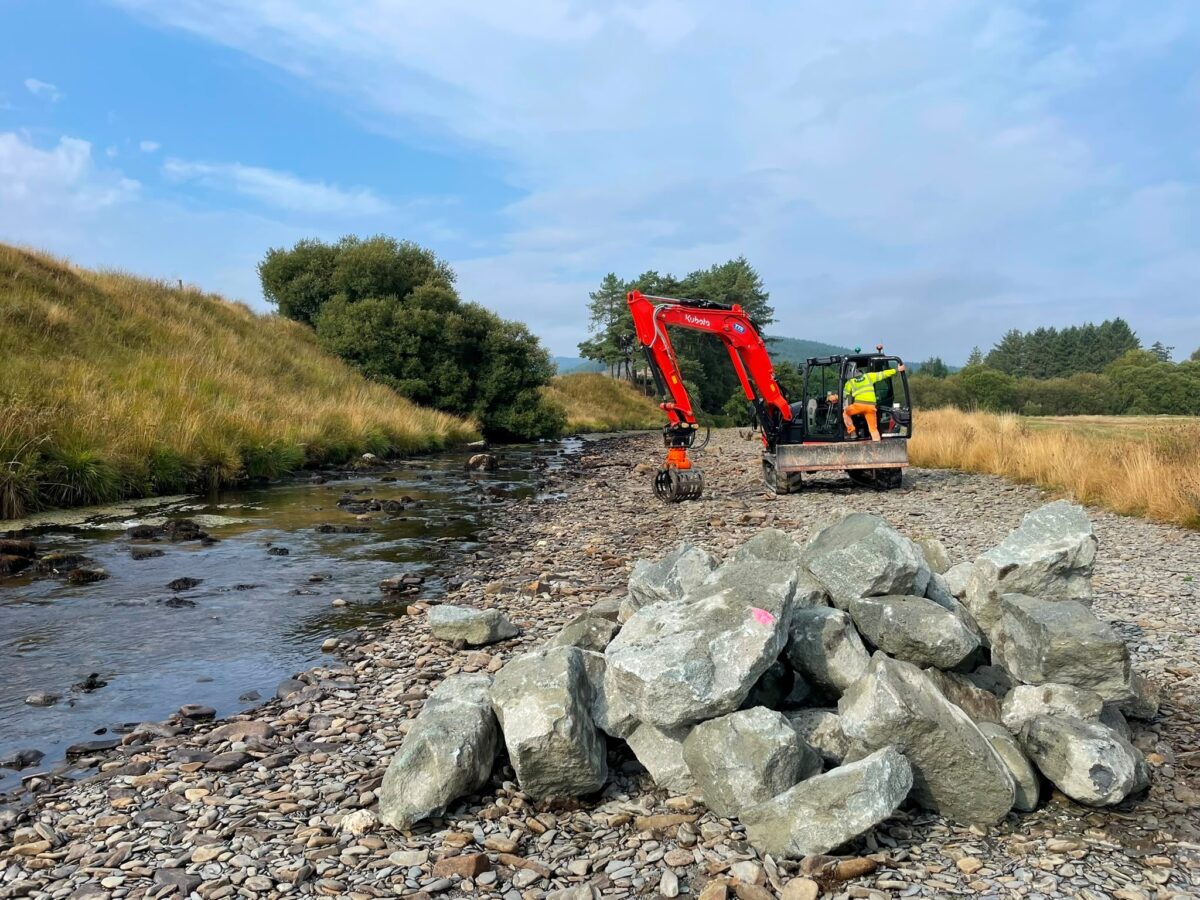
Boulders are being reintroduced to sections of a major Welsh river in an effort to improve habitats and support Atlantic salmon and other wildlife.
Natural Resources Wales (NRW) is beginning work to reintroduce boulders to sections of the River Wye at Llangurig, after many were removed from the river over time.
Boulders play an important role in healthy river systems, creating different flow patterns and providing pools, shelter and habitat for fish and aquatic invertebrates.
The stretch of river being restored is particularly important for Atlantic salmon and trout, providing spawning habitat as well as areas where young parr can shelter and grow. Salmon especially need to be robust before migrating downstream to sea.
Surveys carried out by the project team have found salmon and trout parr in areas where boulders remain present, while numbers are much lower in sections where boulders have been removed.
The project team will continue monitoring the river following the work to assess how the river responds and measure changes in habitat and wildlife.
The boulder reintroduction complements wider work already being delivered with farmers and landowners around Llangurig, including planting riverside trees to provide further shelter and shade.
NRW says these measures will help reduce soil, nutrients and pollutants entering the river, as well as supporting resilient farming and river systems in the face of extreme weather.
Brendan Adair, Project Manager for the Upper Wye Catchment Restoration Project, said: “We’ve spent the last two years building a detailed understanding of this stretch of river through surveys and monitoring, so we can target the work where it has the greatest benefit.
“We’re particularly interested in how the reintroduction of boulders can improve survival rates for young Atlantic salmon, a key species that needs all the support we can provide.
“This work sits alongside the wider changes we’re making with farmers and landowners around Llangurig. By tackling pressures both within the river and across the surrounding catchment, we can build a healthier and more resilient River Wye for the future.”
The work forms part of NRW’s Upper Wye Catchment Restoration Project, which is working with farmers, landowners and local organisations to address the pressures affecting the River Wye Special Area of Conservation (SAC).
Support our Nation today
For the price of a cup of coffee a month you can help us create an independent, not-for-profit, national news service for the people of Wales, by the people of Wales.
Get more trusted Welsh news
Choose Nation.Cymru as a preferred source in Google News to see more of our journalism.




After all these years, who removed them and why?
How dumb !
From the Cwm to the Sea, our rivers go through ‘human hell’ it seems…
Imagine if Rio Tinto and many of the community had had their way, the result would have been the devastation of an entire river system. Read the penultimate chapter of Richard West’s River of Tears 1972* and reflect on how a Neuadd full of hairy locals managed to stop a wanton act of greed led by Scientologists…
This ‘chapter’ in my home county’s history, (maybe in volume three) needs a new book on it nearly sixty years down the line…
* might be a free read on Project Gutenberg…
Conversations about our rivers are severely restricted it seems…
Speaking of volume 3 of the ‘History of Merioneth’, volume one came out in 1967 and was by E.G. Bowen and C, A. Gresham. Volume Two, was published in 2001 and is a series of Essays on the Middle Ages edited by the Beverley Smiths. It is one of the most expensive s/h Welsh books of the century so far I believe, so expect volume three in 2035…! A book on the rebirth of Gwynedd C1974 and all the machinations that took place, the property that changed hands, dynasties born and fortunes made, what a thriller it could be. Some… Read more »
A clue as to who removed the boulders in the first place can be seen on street view of the A44 near to where the above photo was taken. In 2009 we see newly installed gabions (large rectangular wire cages which are then packed with boulders). These gabions having been freshly installed to reinforce the bank alongside the road. There’s a kink in the road there which has been ‘straigtened out’ about this time, also forming a layby where the old stretch of road once ran.