


British Steel set to be nationalised as UK Government mulls future for Scunthorpe
Anna Wise, Press Association Business Reporter and Nation.Cymru Staff
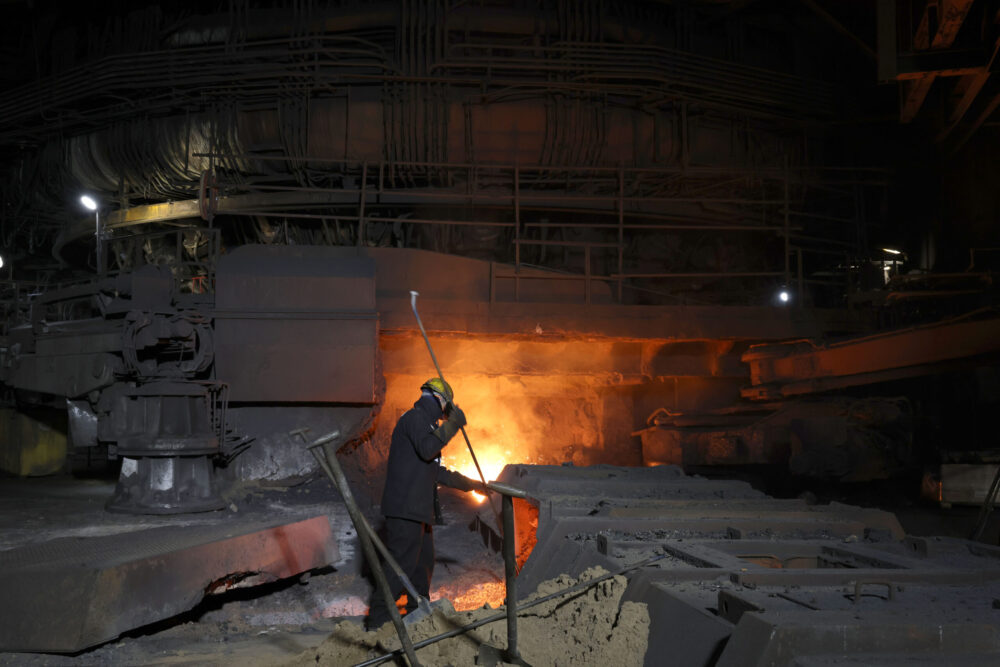
British Steel is set to return to public ownership as Sir Keir Starmer announced new laws he said will give the UK Government “options” to protect the industry and Scunthorpe workers.
New powers could be used to nationalise British Steel, 38 years since the firm was first sold off.
It comes a year after the Government used emergency powers to take control of the firm and continue production at the site in Scunthorpe after its owner, Chinese firm Jingye, proposed to close the two blast furnaces.
It has since been in discussions with Jingye but said it could not agree a commercial sale, and that it did not think a deal could be reached that would deliver sufficient value to taxpayers.
The Government said it believes introducing legislation to provide a route to public ownership was the right next step and will enable it to make decisions about the steelmaker’s future.
The legislation, which will be brought forward this week, will be subject to a public interest test, which considers factors including national security, maintaining critical national infrastructure and supporting the economy.
The Prime Minister said: “Steel is strategically important to our economy and our national resilience.
“That’s why we acted last year to avoid a sudden halt to production at Scunthorpe, protecting workers and the community that depend on the site, and why we’re now bringing forward legislation to give us options to protect Britain’s steelmaking capability.
“This is what an activist state looks like – taking decisions in the national interest.
“This Bill would allow us to take action if we need to, while we continue rebuilding our steel sector.”
A steel union welcomed the move to nationalise British Steel which it said will “protect it from foreign owners”.
Charlotte Brumpton-Childs, GMB national secretary, said: “This legislation will cover the whole steel industry – it isn’t specifically for British Steel but it is what will protect it from foreign owners.
“British Steel is a nationally strategic asset, it is right the Government does everything in its power to secure its long term future.”
Gareth Stace, director-general for trade association UK Steel, welcomed the decision that he said “provides vital certainty for the workforce, the company’s customers and the wider supply chain at a critical moment”.
But he stressed: “Nationalisation is not an end goal.
“This must now be the beginning of a clear and credible long-term plan for British Steel.”
The Government’s intervention last year put the breaks on Jingye’s proposals and ended its redundancy consultations, which could have seen the loss of between 2,000 and 2,700 jobs.
It also meant the Scunthorpe blast furnaces were able to continue operating.
Jingye had been considering shutting them down after announcing it was losing £700,000 a day due to challenging market conditions, tariffs and high environmental costs.
The Government’s move to protect the site cost it £377 million between April 2025 and January 2026, a report by the National Audit Office (NAO) found.
As well as the £377 million to keep British Steel operating, £15 million was spent on advisers and £359 million to the company for operating activities such as paying for raw materials, payroll and other costs.
But closing the blast furnaces would have led to a large number of job losses at Scunthorpe and affected customers in the supply chain, such as Network Rail, NAO said.
Business Secretary Peter Kyle said: “Revitalising our steel sector is a top priority for this Government and bringing forward this legislation would allow us to explore potential future options for British Steel.
“The Government recognises that securing the long-term future of the UK’s steel sector relies on both public and private investment for modernisation.”
Refusal
The UK Labour government faced accusations of “double standards” in April 2025 over moves to protect the steelworks in Scunthorpe despite failing to do so when Tata Steel shut its blast furnaces in Port Talbot.
Tata announced in January 2024 that both Port Talbot’s blast furnaces were to be replaced with an electric arc furnace. They were shut down in September that year, cutting 2,800 jobs.
Calling for nationalisation to be on the table to save jobs in Port Talbot, Plaid Cymru raised the issue 21 times since 2023 in both the UK Parliament and the Senedd.
Then-first minister Eluned Morgan rejected Plaid Cymru’s calls, describing nationalisation as a “pipe dream”.
Responding in the House of Commons on 12 April 2025 to UK Government’s proposed £2.5 billion steel fund, to which Plaid Cymru tabled an amendment aimed at ensuring Wales benefited under the same terms, Liz Saville Roberts MP said: “What my party cannot support is this government’s approach to steel in the UK which deems steel in Scunthorpe is worth saving, but not steel in Wales…
“Under this Government Scunthorpe gets security, whilst Port Talbot gets a pittance…
“We will not let Labour hide from the fact that they own the decision not to intervene to save Welsh steel when they had the opportunity to do so.”
Speaking after Prime Minister Sir Keir Starmer’s ‘reset’ speech on 11 May 2026, Welsh Liberal Democrat Westminster Spokesperson David Chadwick MP added: “Labour has rubbed salt in the wounds of communities like Port Talbot by announcing a further nationalisation of British Steel in Scunthorpe after refusing to do the same for workers and families in south Wales.”
Support our Nation today
For the price of a cup of coffee a month you can help us create an independent, not-for-profit, national news service for the people of Wales, by the people of Wales.
Get more trusted Welsh news
Choose Nation.Cymru as a preferred source in Google News to see more of our journalism.




What a difference between how Scunthorpe have been treated compared to the betrayed workers at Port Talbot.
Another justification for electing a government whose primary focus is Wales.
Did anyone expect any other response. With london parties, its England first, last anx always. Plaid were laughed at for suggesting nationalisation before and look at them now
It’s all about England as usual, the ‘colonies’ are an afterthought. No suggestion of addressing the issues that demonstrate his indifference to Wales such as Crown Estates, HS2, further devolution of powers. No change there!
So London Labour’s genius response to losing Wales is to save steel in England.
Eluned’s ‘Pipe Dream’ clearly only applies to the colonies!
So in Scunthorpe but not Port Talbot?
Cymru being dumped on as always.
This abusive relationship needs to end.