


Campaigner backs call for probe into national park authority
Martin Shipton
A campaigner who has monitored multiple planning applications involving an historic barn for nearly 20 years is backing a call for an investigation into alleged shortcomings in the performance of the Bannau Brycheiniog National Park Authority.
Christopher Coppock resigned from the authority’s board in 2022 because he did not believe it was being led in a way that would deliver its statutory purposes.
Last month Nation.Cymru reported how he wants a Senedd committee to examine what he believes to have been the ineffective use of public funds by the authority.
In 2021 Audit Wales produced a report recommending the need for the park authority to “drive forward the change programme, strengthen governance and decision-making,” but Mr Coppock believes the situation has not improved.
Now Melanie Davies, a conservation campaigner who also has serious concerns about the national park authority, has spoken out.
She told Nation.Cymru: “I believe I may have a documented planning case that illustrates, in practical terms, some of the broader concerns recently raised publicly about governance, accountability, transparency, and institutional decision-making within BBNPA.
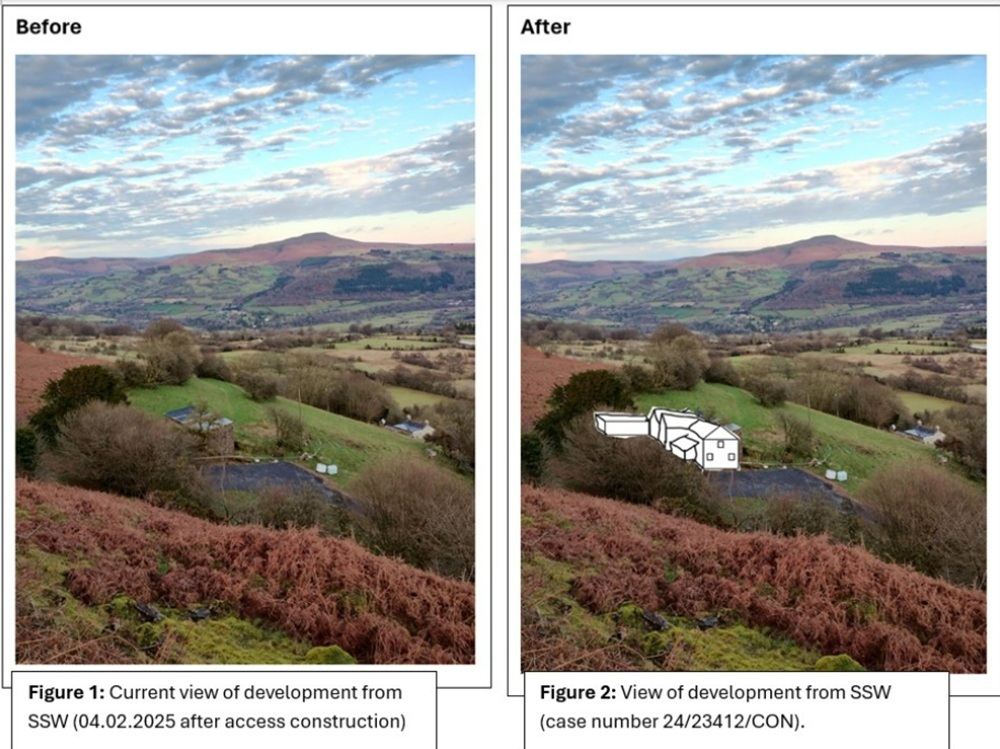
“The case concerns Ty’r-y-Wen, at Llanelly, Monmouthshire, a pre-industrial stone barn documented to 1713, situated within Bannau Brycheiniog National Park, within the Mynydd Llangatwg SSSI and adjacent to a Scheduled Monument.
“Over approximately 19 years, the site has been subject to a sequence of applications, appeals, condition variations, discharge applications, complaints and enforcement action. My concern is not simply the outcome of one planning application but whether this chronology demonstrates wider institutional problems.”
Multiple linked applications
Ms Davies said the issues that concern her include the fact that one project is progressing through multiple linked applications. Although treated administratively as separate planning cases, the applications concern the same site and broadly the same development objective.
Previous proposals were refused and dismissed on appeal before later permissions and variations progressed.
Ms Davies went on to state: “During BBNPA’s own complaint investigation, the authority acknowledged that Cadw [the Welsh Government’s conservation arm] had not been consulted on earlier applications and described this as a procedural oversight.
“The complaint report concluded that this omission would not have changed the outcome, but nevertheless recommended reminders to planning officers regarding future Cadw consultation.
“Separately, concerns remain regarding whether all communications material to understanding the chronology of decisions have consistently appeared on the public planning portal.”
Ms Davies said she was also concerned about open enforcement versus continuing approvals: “Development commenced in September 2024. An enforcement case was opened by BBNPA and remains open. At the same time, further condition discharge applications have continued to progress.
“My concern is not that enforcement must automatically prevent decisions, but whether the interaction between enforcement and ongoing determination has been adequately explained.
“[Another] issue I believe merits scrutiny concerns communications during the determination of [one] application. In July 2025, a planning officer wrote to the applicant’s agent during a live application, indicating that refusal was likely and suggesting the applicant could reapply or appeal. The application was subsequently withdrawn.
“I appreciate that there may be entirely legitimate explanations for this communication and for any publication decisions. However, viewed alongside later communications indicating an expectation that approval was imminent before determination, I believe questions arise about transparency and public confidence in the process.
“I pursued formal complaint procedures; enforcement reporting; information requests;
internal review; engagement with elected representatives; and representations to public bodies.
“One response from BBNPA’s Chief Executive accepted that my complaint should ultimately be reconsidered ‘as a whole’ once live enforcement and planning matters conclude, rather than treated as isolated strands.
“That point struck me because it appears to recognise that the various applications and complaints cannot easily be separated.
“What concerns me is whether this case provides a documented example of:
* procedural irregularities being regularised retrospectively;
* overlapping responsibilities leading to accountability gaps;
* consultation and publication practices affecting transparency;
* and wider governance concerns becoming visible in operational decisions.”
Development
Ms Davies added: “Originally, the developers had until October 2026 to begin; now they have until 2030. Although development has begun, it began illegally. This is gaming the system, and the public has a right to know because it is happening throughout the National Park. Furthermore, government guidance discourages ‘gaming the system’.
“There have been so many planning applications at the property over the past 19 years that it can become quite confusing. As time progressed, my blog posts became more focused, concentrating on points that I have learned are currently actionable because the planning cases are either live or still within an actionable ‘window’.”
Ms Davies stated that every year the park authority publishes an annual monitoring report, adding: “Each report generally exonerates them (they are the authors), and BBNPA think that they are performing adequately as a planning authority, but acknowledges that the ecological and heritage conditions of the park are under strain, largely due to wider environmental and systemic factors beyond planning control. Thus, an institutional demonstration of ‘There is underperformance in vital areas, but we (BBNPA) think that other government bodies have oversight in those areas’.
“I have learnt much during this process because appealing to various public bodies is, in effect, appealing to the Welsh Government and a range of its departments. I’ve come across a parsimonious inertia in which each department defers to another government department or falls back on BBNPA, citing BBNPA’s devolved decision-making powers. So the process is structured in favour of developers rather than protective of Welsh history, culture and ecology.
“I have proposed to BBNPA many times that, because this is a humble structure, it represents working-class history, and it attracts less attention than a castle or manor house.
“I think Cadw should schedule the building, which would provide it with protection. This is because it is a Stuart-era building that has survived heavy quarrying in the vicinity. It was a lambing shed on a remote mountain that survived the Industrial Revolution, a rarity in this part of Wales.”
Support our Nation today
For the price of a cup of coffee a month you can help us create an independent, not-for-profit, national news service for the people of Wales, by the people of Wales.
Get more trusted Welsh news
Choose Nation.Cymru as a preferred source in Google News to see more of our journalism.


