


‘Chained’ mother and babies confront TUI at Cardiff Airport
Stephen Price
A demonstration against travel provider TUI has taken place at Cardiff Airport, calling on the company to stop “cashing in on the misery of orcas and dolphins” at marine ‘abusement’ parks.
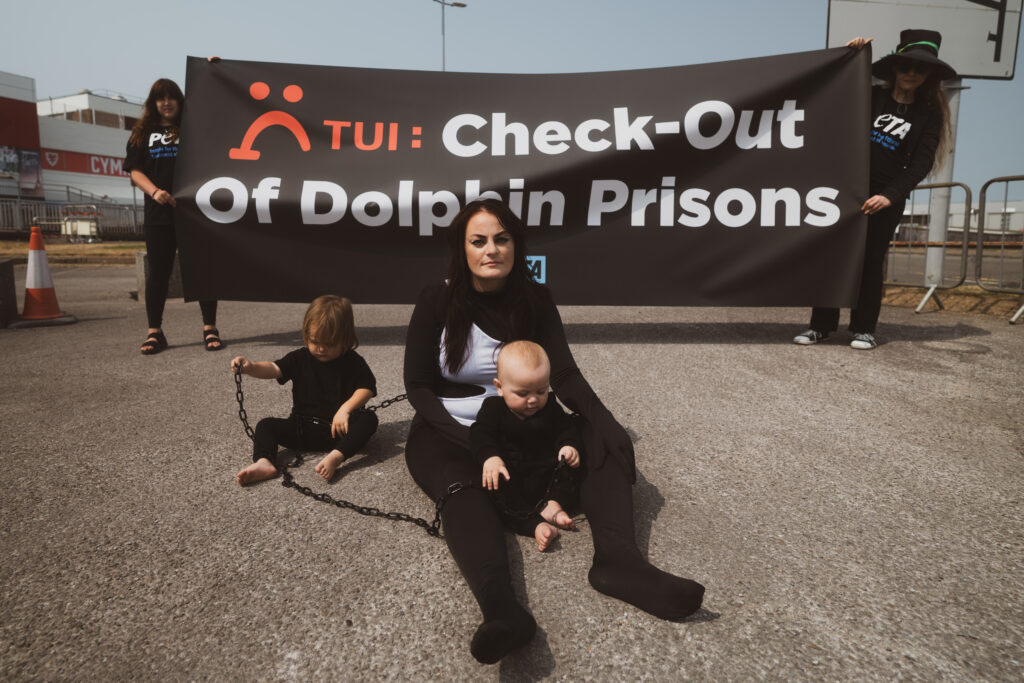
A PETA supporter and her two babies, dressed as a captive orca family and bound in chains, gathered at Cardiff Airport – where TUI has announced a major expansion – and called on the travel giant to stop selling tickets to facilities like Loro Parque, where orcas and other dolphins are imprisoned in tanks.
The orca family was surrounded by fellow animal defenders holding a giant banner reading “TUI: Check out of Dolphin Prisons.”
The demonstration comes as TUI remains the last major travel provider in the UK to promote and sell tickets to dolphin prisons, despite mounting public concern over the welfare of captive marine mammals.
At Loro Parque, young orca Teno has already been seen joining his mother in performances despite TUI’s stated policy against supporting facilities that breed cetaceans for entertainment. Its continued support for facilities like this directly contradicts its policy and enables the continued commercial exploitation of marine mammals.
“No holiday memory is worth a lifetime in a tank,” says PETA’s Senior Campaigns Manager Kate Werner. “While other major travel companies have stopped promoting marine abusement parks, TUI is still cashing in on the misery of orcas and other dolphins. It’s time for TUI to axe dolphin prisons from its itineraries.”
“Today’s kind travellers have no interest in supporting the suffering of whales, orcas, and other dolphins who are confined, abused, and forced to perform demeaning tricks for human entertainment.
What if a human mother and her babies were chained up and forced to perform for strangers?
A mother and her two babies, dressed as captive orcas, confronted @TUIUK at Cardiff Airport.No holiday is worth a lifetime in a tank. TUI: drop dolphin prisons pic.twitter.com/9Ou8r70rIY
— PETA UK (@PETAUK) July 21, 2026
In nature, orcas and other dolphins live in large, complex social groups and swim vast distances every day in the open ocean.
But at marine amusement parks like SeaWorld and Loro Parque, they spend their days floating listlessly or swimming in circles in tanks comparable in size to a human living in a bathtub.
Around the world more than 3,600 whales, dolphins, and porpoises (collectively known as cetaceans) are held in captivity for human entertainment.
These complex, highly intelligent creatures are kept in restrictive, barren, chemically-treated pools and over-crowded tanks, or trapped in shallow sea pens.
Most die far short of their natural life span, and they often suffer from distressing health conditions that increase their misery.
They are made to perform repetitive tricks and display unnatural behaviours in front of crowds of tourists, often multiple times a day.
This cruel, confined existence is unimaginably different to their life in the wild. When free, marine mammals live in closely-bonded family groups, often swimming more than 100 miles a day and diving to depths of 300 metres.
Many captive cetaceans are further exploited by being forced to interact with visitors, swim with tourists or pose as ‘props’ for souvenir photos and selfies.
The incredible harm caused to captive marine mammals may not be immediately evident to holidaymakers, who may only be visiting for a few hours, but these animals suffer physically and psychologically in many ways such as premature death and reduced resistance to disease.
While tourists can influence real change, the responsibility for ending this exploitative and unethical industry does not lie solely with the public. PETA and other organisations strongly believe the travel industry and national governments must step up and do their part to protect these incredible creatures.
They say that travel companies and tour operators, across Europe and around the world, need to recognise that the public is increasingly rejecting the idea that keeping cetaceans in captivity is an acceptable form of entertainment, just as they have in the UK.
PETA—whose motto reads, in part, that “animals are not ours to use for entertainment”—opposes speciesism, a human-supremacist worldview.
In nature, orcas and other dolphins live in large, complex social groups and swim vast distances every day in the open ocean. But at facilities like SeaWorld and Loro Parque, they spend their days floating listlessly or swimming in circles in tanks comparable in size to a human living in a bathtub.
Most die far short of their natural life span, and they often suffer from distressing health conditions that are not seen in their wild counterparts and perpetuate their misery.
PETA – whose motto reads, in part, that “animals are not ours to use for entertainment or abuse in any way” – points out that when it comes to the ability to feel pain, hunger, and thirst, a bull is a dog is a boy. For more information, please visit PETA.org.uk or follow PETA on Facebook, X, TikTok, or Instagram.
Support our Nation today
For the price of a cup of coffee a month you can help us create an independent, not-for-profit, national news service for the people of Wales, by the people of Wales.
Get more trusted Welsh news
Choose Nation.Cymru as a preferred source in Google News to see more of our journalism.


