


Charity calls for urgent action on pesticide use as toxicity levels rise in red kites
Stephen Price
A Welsh charity has repeated calls for the use of poisons to combat rodents outdoors to be prohibited after discovering an increase in toxicity levels within red kites.
There are few birds that reflect the changing fortunes of nature in Wales and the rest of Britain more than the red kite.
Driven to near extinction by the middle of the 20th Century by persecution and pesticide poisoning, with the native population down to only 5 breeding pairs, its protection by a handful of Welsh farmers and conservationists, and then its eventual re-introduction into England in the 1990s, has been seen by many as a resounding successes of recent years.
However, red kites are still relentlessly persecuted by some people who regard them as threats, as shown by a recent report on the illegal poisoning of birds of prey in Northern England.
How this bird is faring in the countryside has now become a major test of one of the Government’s key environmental policies.
Red kites, by their habit of scavenging and consuming dead animals, act as barometers of levels of toxins in our environment.
One group of these toxins, Second Generation Anticoagulant Rodenticides (SGARs) are widely used as rat poisons by farmers and householders. SGARs kill red kites when these birds eat poisoned rodents.
A risk assessment carried out by the Health and Safety Executive concluded that, due to the risk of this poisoning, these poisons should not be used outdoors in the UK, thus reducing the potential for birds to be killed.
This was not acted upon and the UK Government, much to the alarm of wildlife lovers and conservationists, permitted the continued external use of SGARs.
The use of these poisons was based on an agreement between the Government and the pest control industry that action would be taken to reduce SGAR exposure in wildlife. This resulted in the Rodenticide Stewardship Scheme (RSS), which committed the industry to achieve a significant reduction in this exposure.
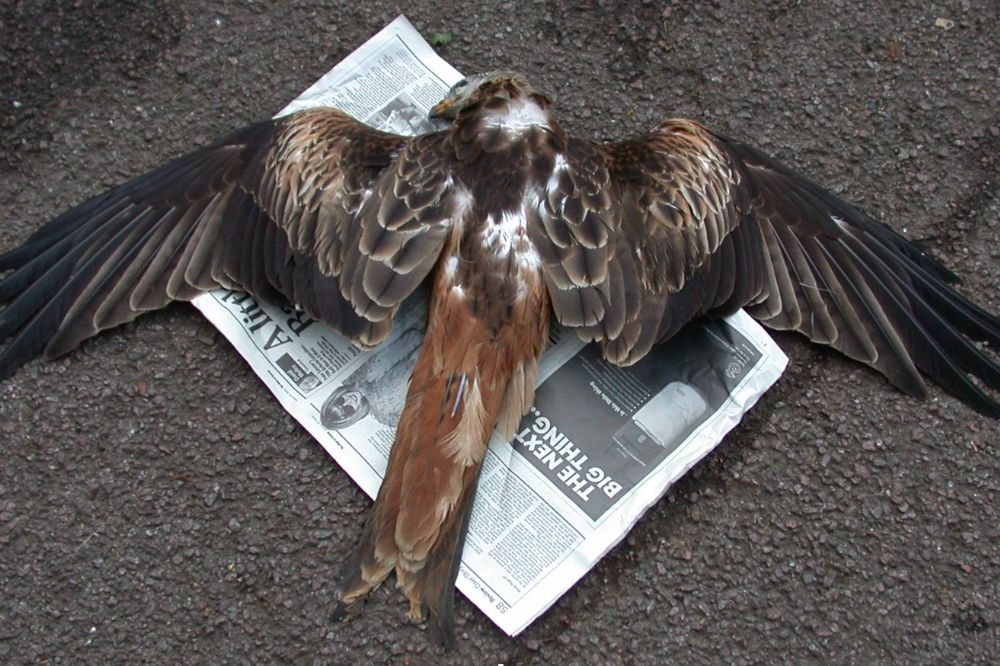
Wales-based Wildlife Poisoning Research UK (WPRUK) has conducted a review of red kite poisoning incidents investigated under the Government’s own Wildlife Incident Investigation Scheme in Wales and England to see if poison levels have actually fallen.
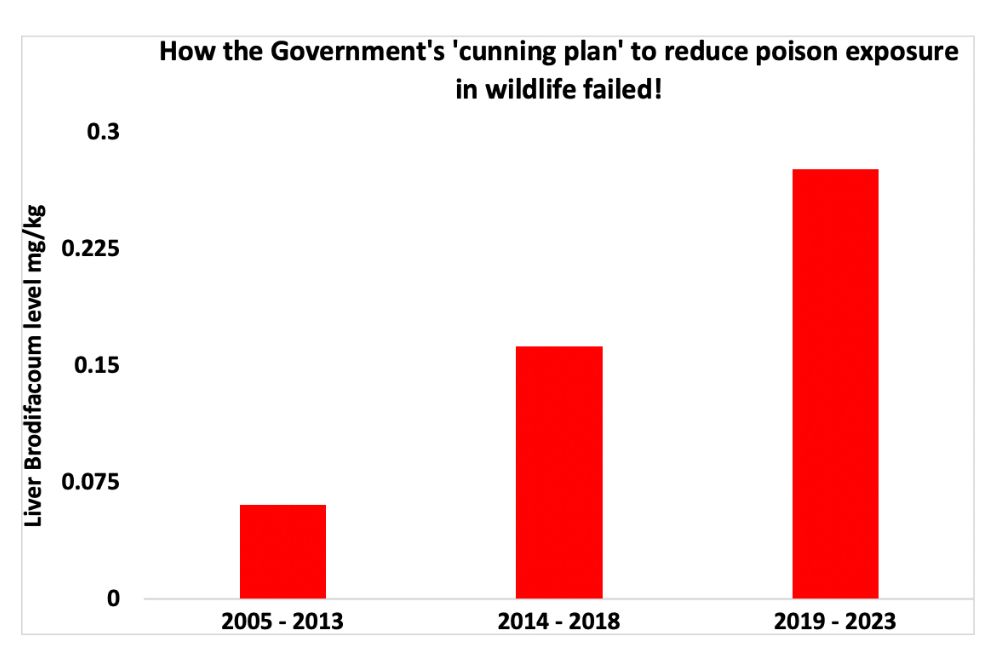
This has shown that there is no evidence of a reduction in SGAR exposure in the red kite. Instead, there has been a substantial increase in toxin levels, especially in the high-toxicity SGAR poison Brodifacoum.
WPRUK have shown that in the years 2019 to 2023, several years after this policy started, a staggering 62.9 % of red kites tested in England and Wales had potentially life-threatening levels of SGAR poisons.
Levels of Brodifacoum, still widely available in shops and garden centres for anyone to buy with no questions asked, have increased an alarming 355 % since the Government’s ‘cunning plan’ to lower poison exposure in wildlife.
Releasing the WPRUK report on red kites, Dr Ed Blane said: “Evidently this Government policy has dramatically failed and the situation is getting worse.
It is clearly time now for the UK Government, devolved Governments and their conservation agencies to review where these poisons are used and by whom.
“They appear to have been collectively ‘asleep at the wheel’ as this environmental crisis has developed.”
The full report on red kites, along with earlier reports on other species, are available on the WPRUK website: wildlifepoisoningresearchuk.wordpress.com
Support our Nation today
For the price of a cup of coffee a month you can help us create an independent, not-for-profit, national news service for the people of Wales, by the people of Wales.



We need to develop the use of rat contraceptive bait which reduces the rat population to acceptable levels without total eradication. Total eradication doesn’t work long term because more rats move in from neighbouring areas. Similar techniques can be used for grey squirrels. We also need to stop all fly tipping and properly fund waste disposal and recycling. This should make it harder for rats in populated areas.
Poisoner’s know what they are doing.