


Charity secures 1000 acres for Wales’ largest rewilding project
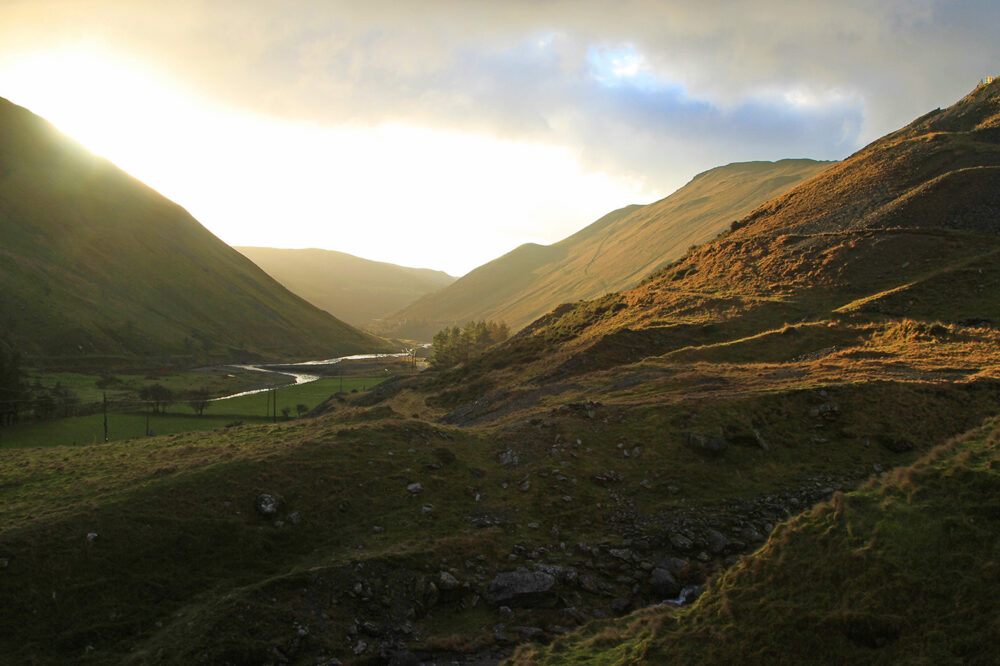
A Welsh charity has secured over 1,000 acres to establish what will become the country’s largest rewilding project.
Tir Natur, who acquired the 1,195-acre site at Cwm Doethïe in Ceredigion’s Elenydd (Cambrian Mountains), said it marks a significant national moment for the future of Welsh landscapes, wildlife and rural communities.
The charity launched a fundraising appeal to establish the flagship rewilding project, designed to demonstrate what rewilding at scale can deliver for Wales at a time of accelerating climate change and nature loss.
Rewilding encompasses large-scale restoration of nature’s web of life – habitats, natural processes and, where appropriate, missing species – until it can take care of itself and humans again.
Having raised over 50% of the £2.2 million purchase costs, a philanthropic bridging loan enabled Tir Natur to purchase the Cwm Doethïe site.
Further fundraising is in progress, allowing rewilding and community activities to begin without delay.
The charity said the support so far reflects the growing concern about the state of nature in Wales, and a strong desire to see similar landscape-scale nature recovery projects here to those already underway elsewhere in the UK.
The latest Natural Resources Wales ‘State of Natural Resources 2025’ report sets out the urgency for nature-recovery, calling it a ‘life or death issue’.
Wales is one of the most nature-depleted countries in the world according to the Biodiversity Intactness Index, ranking 225th out of 240 countries.
The charity said this demonstrates the urgency for large-scale, cost-effective and impactful approaches to the biodiversity and climate crises.
The land at Cwm Doethïe was assessed as of poor grazing value and is unsuitable for commercial forestry due to its location within the Mynydd Mallaen / Cwm Doethïe Site of Special Scientific Interest.
Tir Natur aims for the Cwm Doethïe site to be a blueprint for rewilding, showing how it can work alongside and support rural livelihoods and nurture community involvement, while contributing to Wales’s wider nature, climate and water goals.
The charity’s approach will include introducing hardy cattle and Welsh mountain ponies to the land, with ancient breeds of pigs to follow. Their grazing and roaming will support habitat restoration.
Peatland rewetting and natural water retention across the site over the next five to ten years means the project will contribute to increased biodiversity, cleaner water, healthier soils, improved carbon storage and reduced flood risk for downstream farmland.
It is hoped these actions will create conditions to boost various species, with the potential for red squirrels, pine martens, polecats, curlews and hen harriers to return.
The charity also aims for much of the work to be carried out by local tradespeople. Community participation will also help uncover and share stories of those who lived and worked across the site’s 55 historic stone landmarks, from Bronze Age cairns to traditional upland buildings.
Tir Natur Chair, Tash Reilly, said: “This is about more than restoring one place. This project is part of the urgent response needed to restore nature in Wales. It is a national statement of intent, showing how Wales can lead in rewilding at scale while supporting rural communities.
“At a time when nature loss and climate impacts are accelerating, this site will demonstrate what’s possible when we allow nature to take the lead and work for people again. It’s a hopeful, practical vision for the future of Wales, that anyone can contribute to.”
Tir Natur volunteer Elen Robert said: “Rewilding this land offers optimism and hope at a time when nature loss can feel overwhelming. We believe this site’s regeneration will inspire people and projects across Wales and beyond, and show what’s possible when we act.”
The project has already attracted significant backing, including support from The Moondance Foundation, the Garfield Weston Foundation and Mike Servent, alongside other generous individual donors and partners.
Tir Natur (“Nature’s Land” in Welsh) is Wales’ only charity dedicated solely to rewilding. Founded in 2022, it aims to showcase rewilding in action and inspire similar projects across Wales.
The charity is inviting people across Wales to take part in guided walks, talks and volunteer days on the land that spans hilltops in the Doethïe valley, enabling the public to see and take part in rewilding first-hand.
A calendar of ecology surveys and landmark restoration events, beginning in spring 2026, will be published on the Tir Natur website and through their newsletter in March.
The charity is continuing to appeal for public donations through its Crowdfunder page both towards the land purchase and to kickstart early restoration work and community-centred activities.
Limited match funding is available to help double supporters’ contributions.
Tir Natur will also be inviting expressions of interest from people who would like to get involved in the charity’s work, including local, Welsh-speaking individuals interested in joining its Board of Trustees, as the organisation grows its governance to support long-term delivery.
Support our Nation today
For the price of a cup of coffee a month you can help us create an independent, not-for-profit, national news service for the people of Wales, by the people of Wales.



Anhygoel! edrych ymlaen at ymweld
Bendigedig. Looks like these guys have covered a lot of the bases of concern around rewilding. Good to see the role of grazing animals emphasised too! They are a part of these landscapes.
Looking forward to visiting someday – it’s a stunning part of the world.
Gwych!
This landscape is already wild. So what does this re-wilding seek to achieve? There’s a myth that this upland was once covered in dense forest but we know from pollen drills into the bogs this was never the case. It is however, currently degraded upland pasture since the end of hardy upland cattle grazing, evidenced from the ‘doving paths’ of medievel times. But such husbandry is of no modern commercial value. It would be pointless replacing one wild habitat with another just for the sake of picture postcard mythology. Suspect this ‘re-wilding’ scheme is just an excuse to plant holiday… Read more »
It is not wild; it is a man-made desert. The pollen drills you refer to do not go back as far as the period after the last ice age. If you were to do that you would see that the land was indeed forested. The drovers routes of medieval times are the blink of an eye ago in historical terms; by the time they were established humans had had thousands of years to cut down the forests. It was that cutting of trees, followed by the keeping of cattle, and later sheep, that created the ecologically dead landscape of today.… Read more »
The pollen drills on Elenydd follow the same stratigraphy as that on the comparator site of Migneint in Eryri, back to 2500BP. Prior to this back to the last ice age we observe a significant climate fluctuations, sub boreal 5000BP, Atlantic 7500BP, Boreal 9000BP to the ends of the last ice age 10,300BP Tundra. If there was ‘deciduous tree cover’ as you speculate on this part of the Cambrian mountains prior to the pollen record we know of from the peat core, it was when the rainfall was half that of today. Pre-agricultural grazing was Eurasian aurochs (wild cow) and… Read more »
Maple syrup is harvested from a tree species of Acer Saccharum (hence the name) a tree only native to the north eastern United States and Canada. It is alien to the British Isles. Planting forests of these on the Cambrian mountains would be an environmental disaster.
I don’t think they’ve spoken at all about tree planting but have said a lot about cattle (and nothing about glamping)? Have you seen anything on that elsewhere?
I live nearby and I don’t think anybody in their right minds are going to be setting up either of those things there.
Plus, two of Wales’ finest wilderness hostels are in the immediate vicinity!
It’s not exactly wild up there though, the molinia is everywhere (not through overgrazing but through under grazing, is my understanding. More cattle on the land sounds good to me!
Yes. The dominance of molinia (a hard tufty grass) is as a result of recent grazing species. Sheep who graze with their teeth can’t eat and digest it, whereas cattle who graze with their tongues or wild horses who have more powerful grazing habit will have the effect of reducing the dominance of molinia. Also results in churning the soil. This allows for the spread of a more ‘disversity’ of grassland at altitude.
https://www.youtube.com/watch?v=4lm_5ehk9AA
We see this in the Cwm Idwal studies and of course the patch-work of grazing of wild ponies of Carneddau.
Interesting that there is actually a lot of agreement between the contributors here about the benefits of hardy cattle and ponies.
My understanding is that at the start of the Neolithic, just over half of Wales was wooded. Which means a lot of land was not wooded. But if I’ve understood Tir Natur right, woodland regeneration is only a small part of their plan.
I don’t really understand how this comment relates to your critical comment above? To my eyes they seem to be looking to increase the grassland diversity by the means you’ve described so what’s the problem?
I saw on the news that the land has been previously undergrazed so it seems like a good step forward to be bringing more stock onto the land. If they’re looking for volunteers I’ll be first in line!
I cannot help wonder whether a big company in disguise is behind this. I have looked at the “meet the staff” and, apart from three or four, do not appear to have Welsh surnames. Details on their birth, upbringing etc. would be very handy. Where did all the money to purchase 2,000 acres come from? Sorry to be negative about this but we are forever being taken for a ride by big companies disgused with Welsh titles with only one thing on their mind and that is wind powered generators and pylons. I sincerely hope I am completely wrong. If… Read more »
Correction: 1,195 acres
Of the 11 names listed, 6 of them have “welsh” names. The others could well have been born here; you don’t know, you are making an assumption based on no evidence. You don’t mention that Iolo Williams is their ambassador; is he “welsh” enough for you? As far as the money goes, they rely on donations; a list of donors, with the amounts given, is on the website. And this is a rewilding project, not an energy project; easy to tell the difference surely?
Since my previous innocuous reply was censored, here is an even more innocuous response: of the 11 staff members, 6 have welsh names. Iolo Williams is the ambassador, and you couldn’t get more welsh than him. The money comes from donations, and there is a list of the donations on their website. There is no evidence that any company is involved, whether for energy or anything else.
They organised a major fundraising scheme, generating nearly £100,000 members of the public
Looks interesting. hope it works out
First remove the human from the equation…
Eagle of the 9th country for sure…
When do they mention doing that? From what I can tell they plan to do the opposite
My point, to rewild remove the human…never mind…!
Some quite thoughtful comments posted here. The Nation obviously attracts a better quality of readers than many other publications!