


Chest trauma expert supports frontline medics in Ukraine
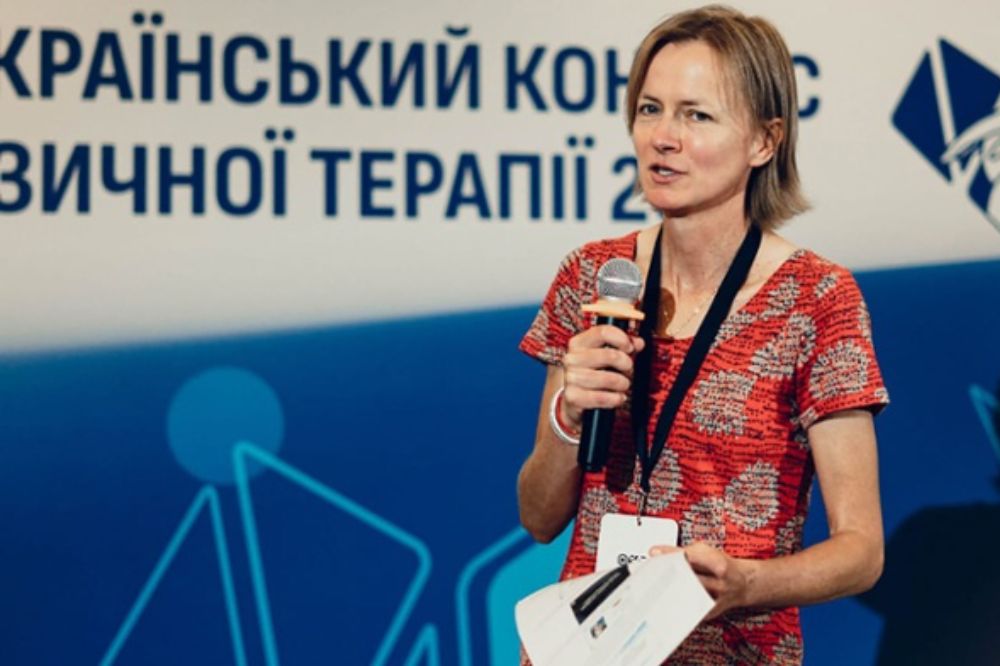
An expert in managing chest injuries from a Welsh hospital has shared her skills with physiotherapists treating frontline troops and civilian casualties in Ukraine.
Dr Ceri Battle is a consultant physiotherapist in Morriston Hospital who has carried out extensive research into blunt wall chest trauma.
After hosting virtual training sessions with physios in Ukraine, Dr Battle was invited to attend a conference with three other UK-based experts in the city of Lviv, to deliver two presentations and a hands-on skills masterclass.
Although Lviv is close to the Polish border and deemed relatively safe, the conference was held in a hotel basement, and delegates had to download a phone app that would sound an alert in the event of an air raid.
“I had really mixed emotions,” said Dr Battle. “I was excited, but I knew I was going into a conflict zone. When I was flying into Poland, the airspace was closed because the Russians had gone in that morning.”
Dr Battle has for many years been involved in research focusing on people sent home from emergency departments after chest injuries which, while relatively minor, can lead to serious or fatal complications.
Often these complications do not emerge for several days, leading to people returning to hospital as emergency cases.
Dr Battle developed a screening tool using a risk score to identify patients most at risk of developing complications.
“All my work has been focused on a civilian population,” she said. “The main causes of injury would be old people falling, people falling from ladders, car crashes, sporting injuries and assaults.
“Now that has translated into a population where there is a lot of conflict trauma. So things like gunshot wounds and blast injuries. They get a lot of penetrating trauma from flying shrapnel and glass.
“It could be an explosion in a building affecting civilians or it could be the military conflict on the front line.”
Respiratory focus
Dr Battle said that, before the war with Russia, most physiotherapy in Ukraine was musculoskeletal, dealing with things like knee injuries or hip replacements. There had not been a focus on the respiratory side of it.
“That led to me doing some virtual teaching for Ukrainian physios and rehab specialists because obviously now they’ve got tens of thousands of patients who need physio for chest injuries,” she said.
“Off the back of that, they invited me to attend their annual rehab conference. They have around 500 physios and rehab specialists who attend from all over Ukraine.
“I did two theory presentations and a chest trauma masterclass which was a one-hour practical session where I taught more hands-on skills. It was all related to my own clinical expertise and research work over the last 20 years.”
Research
Dr Battle is now supervising a Ukrainian doctor undertaking a PhD in chest trauma.
Additionally, an anaesthetist working on the frontline contacted her in 2023 about the risk score she had developed.
“I’ve been doing research with him ever since,” she said. “We set up a research programme together. He works on the front line, so he cares for military patients who are coming to his hospital after being injured.
“We have done two studies so far. One has already been published, looking at chronic pain in patients who have had chest trauma. The other is about using my risk score, which will be published soon.
“We are now starting a new study in which we will be interviewing military patients about their recovery, to see if there are things we can change in the future to help other people.”
Teaching and training
Dr Battle said the conference had also led to a request for her to advise on research, audit and quality improvement.
“While they are introducing all these new skills and resources, they need to be able to evaluate whether it is actually making a difference to the patient groups as well,” she said.
“So it looks like I will be doing more teaching and training on how to evaluate treatments for effectiveness.
“I get a huge sense of satisfaction out of being able to translate the work I’ve been doing for many years with a civilian population into a military population where there’s a huge need for structured rehabilitation.
“Knowing my work is helping the situation over there, which is so dire, does give me a big sense of achievement and I hope to continue to do more.”
Support our Nation today
For the price of a cup of coffee a month you can help us create an independent, not-for-profit, national news service for the people of Wales, by the people of Wales.


