


Concern as blood-red river pollution linked to abattoir
Stephen Price
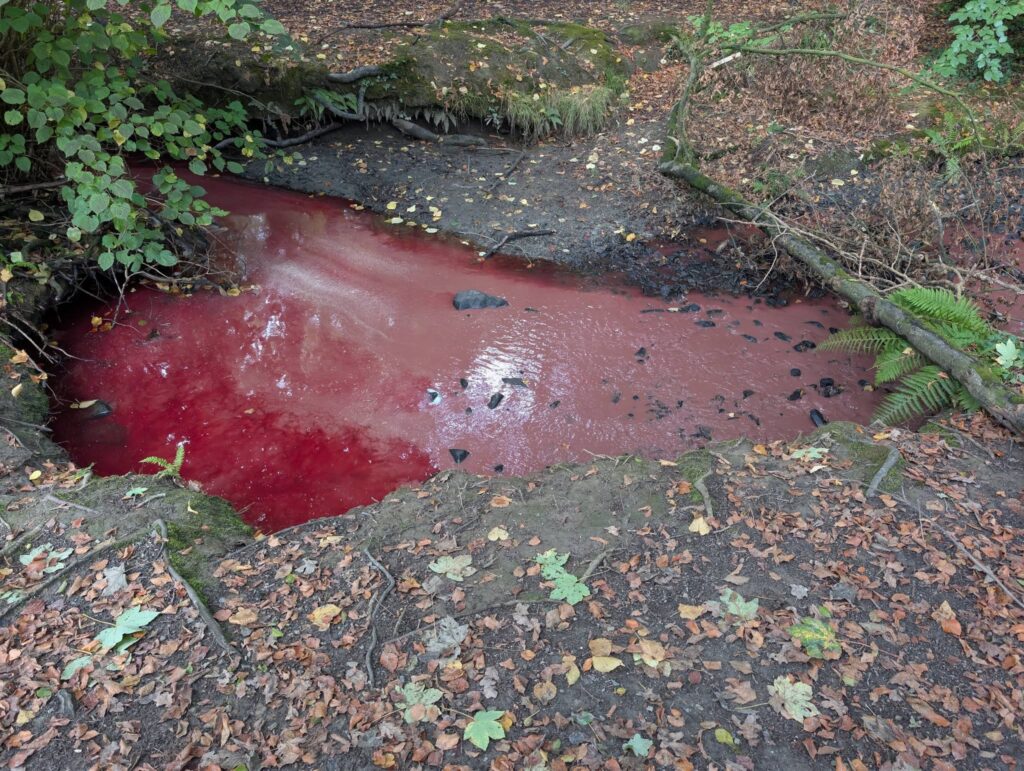
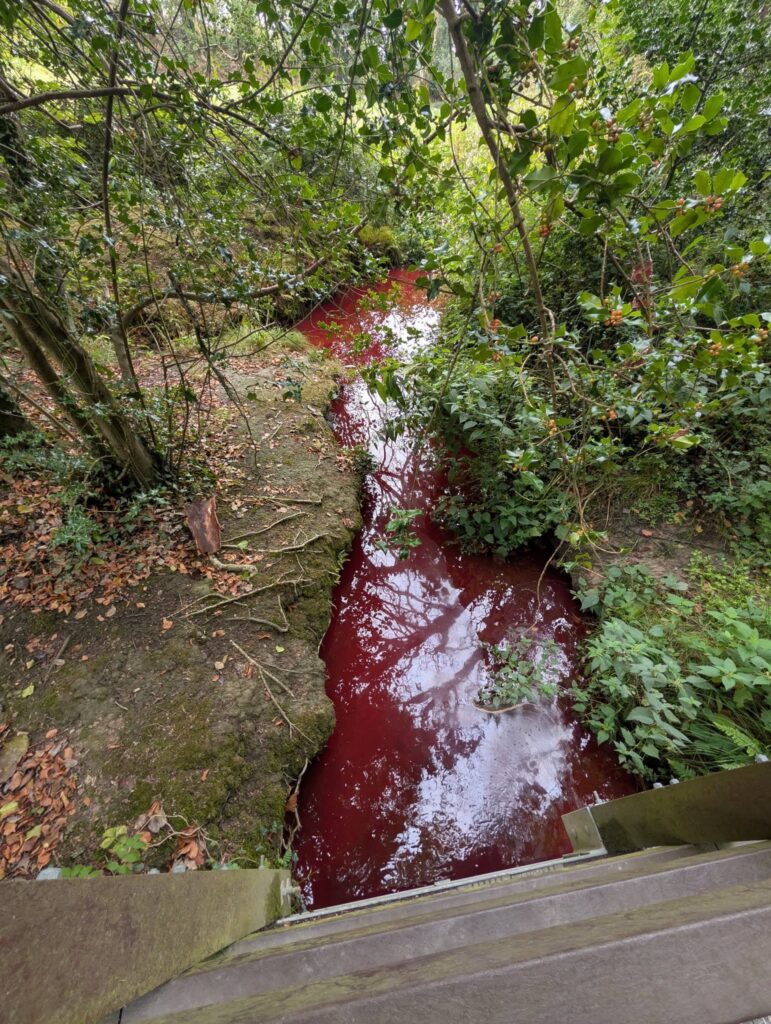
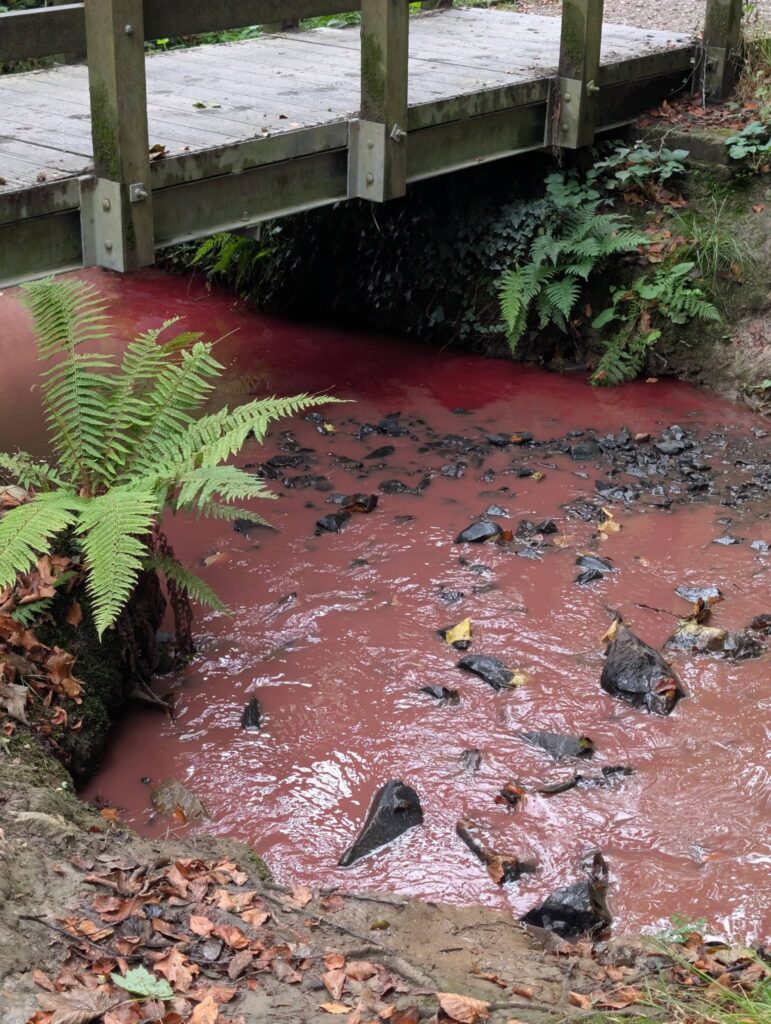
Walkers in a west Wales beauty spot have shared their ‘horror and disgust’ after witnessing a stream turn red with what is suspected to be blood from a nearby abattoir – prompting an investigation by Natural Resources Wales.
In images shared to a Facebook Group for ‘Friends of the Cleddau’, community members have voiced their concern after damning images were shared showing one of the Cleddau River’s tributaries contaminated and flowing ‘blood red’.
One local, Anna Gardner shared: “This was being discharged this morning at Withybush woods. Suspect it is from the abbatoir? Surely this can’t be allowed?! Reported to Natural Resources Wales.”
The Cleddau Project is a group of volunteers with a shared concern for the the Cleddau, its streams, rivers and estuary from source to sea.
They share: “Decades of pollution from sewage, agriculture, industry, landfill and other sources – exacerbated by climate change – is severely compromising the health and habitats of the entire catchment ecosystem. We need to act now to stop the pollution and save it from ecological disaster.”
Whilst locals have shared their belief that Euro Farm Wales (also known as Euro Farm Foods), a local abattoir, is the source of the current and previous red water and congealed ‘bloody’ masses, Natural Resources Wales (NRW) have yet to confirm the source and the abattoir denies any involvement.
An environmental officer from Natural Resources Wales attended the site after receiving the report, with the regulatory body concluding: “An environment officer attended the site promptly, by which time the stream was running clear. No odour or fish kill was detected.”
Sharing their anger, one community member wrote: “This is totally unacceptable and disgusting! I would suggest this is made more publicly known to be investigated as criminal activity, not just reported to NRW as pollution incident.
“How can this actually be possible let alone be unacceptable? If the source is actually the abattoir, there should be no possibility of it being able to discharge what appears to be blood anywhere near a water source. To be able to do so, they must actually have direct access into the drains/sewer pipes to discharge blood and anything else into an open stream!!!
“This needs to be seriously investigated as a matter of extreme urgency, not least as a health hazard for everyone in the area and downstream from this point.”
Another community member added: “I have reported similar incidents at this location. The most recent last month.
“I walk my dog around here a couple of times a week. I would warn all of you not to let hour dogs drink out of this brook. I had to put my last one down due to her lungs and body being badly contaminated.
“The vet hadn’t seen it so bad in a dog before. Even asked us if we were heavy smokers! We dont smoke. So be safe rather than sorry and keep reporting it. Hywel Manley was written to directly about this. He leads the NRW in this area.
“They care more about protecting the business of environment criminals than the public. Much of their annual revenue comes from business. Its not a regulator its a private friggin enterprise!!”
One local wrote: “No-one you report to lately sees or listens to you unfortunately NRW not fit for purpose or Environmental, it is disgusting to allow this to happen and they talk about saving our environment waste of space take this to parliament.”
Calls for reform of water sector
Anna Gardner, whose photos prompted national attention to the pollution, contacted Henry Tufnell MP, Welsh Labour MP for Mid and South Pembrokeshire, sharing her concerns, writing: “Eastern and Western Cleddau rivers and their shared estuary, whilst designated as a Special Area of Conservation and being of enormous importance to the economy and wellbeing of the county and its people, is suffering from a long term and continuing catastrophic decline in its health and environmental value.
“Indeed, the catchments are the most polluted SAC watercourses in Wales with nutrient pollution at record levels as recorded among other sources by ‘The Cleddau Project’, a major citizen science initiative, in which my father participates. This pollution largely arises from point source and diffuse inputs from Water Authority and farming operations all of which continue unabated with little regulation and enforcement by the Authorities.”
She told Nation Cymru: “After watching Dirty Business, and prior to a Cleddau Project’ meeting at PCC, I wrote to our local MP, Henry Tufnell, about the state of the Cleddau.
“My father worked in fisheries for years and, now retired, takes part in river water quality testing. My daughter and I are members of the Haverfordwest Kayak Club and as such, use the rivers and beaches around the county regularly throughout the year. The club has a dedicated launch site directly onto the Western Cleddau in the centre of Haverfordwest.
“We use this launch site to introduce beginners to the water in a calm and sheltered spot. We are incredibly lucky to have such beautiful natural resources on our doorstep, however, particularly following this event, I no longer feel it is safe to use.”
After the email from Anna and contact from others, he echoed their shock and concern at the ongoing pollution issues, writing: “I have written to the Chief Executive of NRW to ask why this happened and what measures they are taking to ensure it does not happen again. I will keep you updated on their response. Incidents like this are becoming far too frequent. It is time for change.”
His letter reads: “I am writing following the recent suspected pollution incident at Withybush Woods. As you will be aware, a number of my constituents reported a reddish discolouration in the stream that passes through the woods on 3 September. Local residents were understandably concerned to see the waterway so heavily discoloured and are still awaiting further clarification regarding the cause of the incident.
“I appreciate that the officers from Natural Resources Wales (NRW) have already attended the site and I was pleased to hear that the stream is now running clear. I would be grateful if you could provide clarification as to the cause of the discolouration and offer reassurance that the appropriate regulatory action will be taken to prevent similar incidents from occurring in the future.”
In a statement shared to his Facebook page, Henry Tufnell MP said: “Red water flowing through Withybush Bush Woods should shock you. Pollution events on the Cleddau are becoming far too frequent. This must not become our new normal.
“I’m going to be contacting the relevant organisations to work out what happened here. And I’m also going to continue my work on the Environment, Food and Rural Affairs Select Committee to make sure that we have a root and branch reform of our water sector. Change must start now.”
Echoing many commenters’ statements that the pollution should be a wake-up call for supporters of industrialised meat and dairy farming, a Reddit user also shared their dismay at the ongoing pollution, referring to a damning report from River Action UK which revealed widespread non-compliance with environmental laws across the dairy industry – leading to one of the largest causes of UK river pollution.
The poster writes: “In Wales 80% of the 83 dairy farms inspected by Natural Resources Wales (NRW) between 2020 and 2022 were non-compliant with anti-pollution regulations.
“These findings are corroborated by several other data sources, including a recent statement by the Chair of the Environment Agency in February 2024, which showed that the dairy farms accounted for over 75% of all serious pollution incidents caused by agriculture, with agriculture being the largest single source of river pollution.”
Regarding NRW’s statement that: “No odour or fish kill was detected,” the Reddit poster added: “As I said, because the stream/river is already dead as this has been happening for years, maybe decades, there will never be a sign of fish death.”
A Natural Resources Wales spokesperson said: “We received a pollution report on Thursday 4 September relating to a stream turning red at Withybush Woods.
“An environment officer attended the site promptly, by which time the stream was running clear. No odour or fish kill was detected.
“Officers returned to the site on Friday to continue our investigations. We will take any appropriate enforcement action necessary in line with our enforcement policy.
“Suspected pollution incidents can be reported to NRW via our 24/7 incident line 0300 065 3000 or online: Natural Resources Wales / Report an incident.”
If you’re worried about the condition of the Cleddau and would like to support Friends of The Cleddau Project’s aims, visit https://thecleddauproject.org.uk/join-us/
Support our Nation today
For the price of a cup of coffee a month you can help us create an independent, not-for-profit, national news service for the people of Wales, by the people of Wales.
Get more trusted Welsh news
Choose Nation.Cymru as a preferred source in Google News to see more of our journalism.



The NRW response seems to suggest that as the stream is flowing clear of blood on their visit, they will not undertake an investigation as to what happened.
Has anyone actually sampled the water to see what the cause really is rather than speculating? I remember when I was a student in Manchester the River Medlock ran various colours mostly blue but sometimes red or yellow. The reason was a dye works further up the river in East Manchester. Blue because denim had become popular. So analyse the water on various occasions and see what’s in it.
Could be a drain testing dye which explains why it quickly vanished. In more modern days, these dyes are typically bright green but older ones can be red.