


Controversial plans to close four Catholic schools
Alec Doyle Local Democracy Reporter
Councillors have formally asked a Welsh council’s Cabinet to ‘find an alternative’ to controversial plans to close four catholic schools and build a single catholic super-school.
A special meeting of Flintshire County Council’s Education, Youth and Culture Overview and Scrutiny Committee on Wednesday was expected to rubber-stamp a consultation report into the plans. After 95% of respondents rejected the proposals however, members have challenged the Cabinet to reconsider.
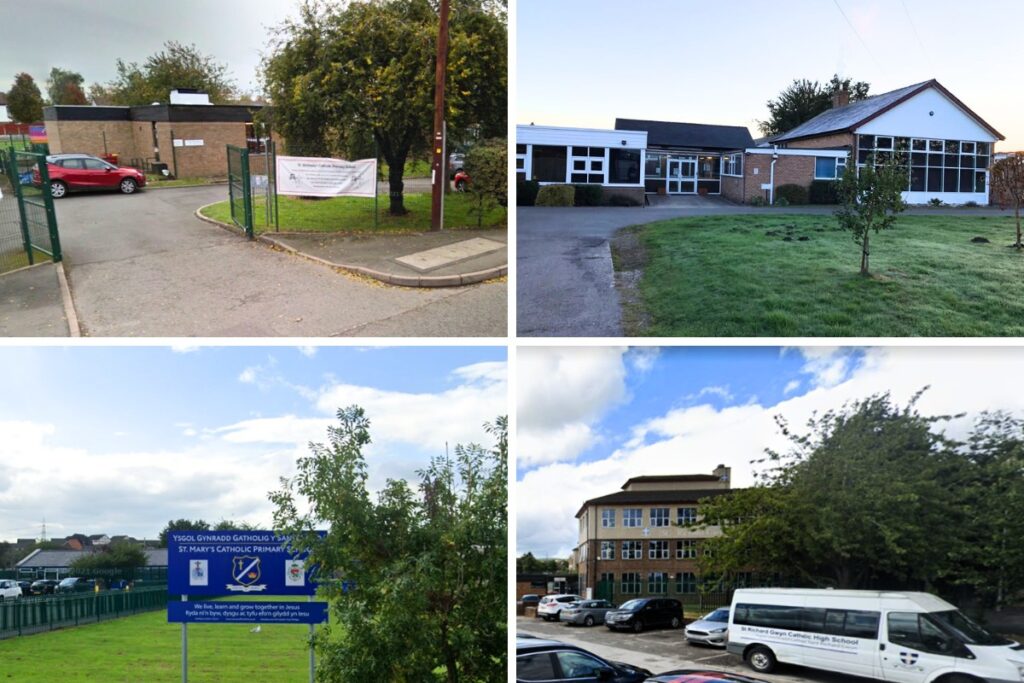
Carried out over the summer, the consultation asked the public for feedback on plans by the council and the Diocese of Wrexham to build a £55 million catholic super-school in Flint. The project would mean the closure of St David’s Catholic Primary School in Mold, St Anthony’s in Saltney and St Mary’s in Flint plus St Richard Gwyn High School.
Councillors met to review the responses and provide feedback ahead of the next statutory phase of the scheme – a 28-day objection period. However, they chose instead to support an amendment by Flintshire People’s Voice Cllr Carolyn Preece asking Cabinet to look again at the plans.
Impact
The main sticking point for members was the impact on pupils in Saltney, where St Anthony’s School would close with pupils expected to move to the Venerable Edward Morgan School almost 10 miles away.
“We recommend that the Cabinet do not proceed to statutory notice, instead work with the Diocese to find an alternative,” said Cllr Preece. “One that sustains catholic education in Saltney rather than removing it.”
That amendment included a recommendation that cabinet include an assessment on the impact on St David’s High School in Saltney – which has been omitted from the reorganisation proposals – in its review by Liberal Democrat group leader Cllr Andrew Parkhurst.
While not binding the Cabinet to re-appraise the proposal, it represents a victory for parents of both St Anthony’s and St David’s who have campaigned since January against the plans.
Lisa Allen, a lay member of the committee, said: “Saltney to Shotton is not a quick and easy route to travel.
“I would not be comfortable putting my four-year-old on a bus to travel that amount of time without me or a trusted adult companion.
“The loss of local schools breaks the connection between families in their local area. The impact this could have on the Saltney community is immeasurable.
“Working parents are gong to face challenges in terms of childcare, school events, parents evenings, grandparents will struggle to offer support.
“What is the point of sending these things out to consultation if we don’t listen to those voices? We’re forgetting that education is about more than just buildings and budgets.”
“Grave concerns”
Cllr Parkhurst was scathing about the proposals.
“I’ve got grave concerns,” he said. “Surely we have to pay some consideration to the overwhelming views of the local community.
“This proposal will involve children criss-crossing the county. Children from Mold going to Flint, from Saltney going to Shotton, although in Saltney there is a catholic school just across the boundary in England.
“So we will send our children to England to be educated and they will stay there. What will that do to the viability of St David’s High School in Saltney?
“The consultation has serious flaws. Estyn have commented it is unclear what the impact of this proposal is likely to be on the standard of education provision in the area.
“Flintshire’s own report says the impact on pupils with additional learning needs (ALN) and transport issues will be considered and there will be measures to mitigate and reduce their effects but it doesn’t say how.”
Before tabling her amendment, Cllr Preece added: “I have real practical concerns about this plan. We would be asking small children – three, four, five year olds – to be travelling in transport with up to 18-year-olds on it.
“This consultation is people screaming at us saying ‘we do not want this to happen’. That is not a marginal view, it’s an overwhelming community rejection. We cannot claim to value consultation if we ignore the very clear message sent by parents, governors and parishes.
“It will also increase reliance on transport and our carbon emission, the exact opposite of what a net zero project should achieve.”
Proposals defended
Flintshire’s Chief Officer for Education and Youth, Claire Homard, defended the proposals.
“We are very supportive of the Catholic diocese proposal because we believe it addresses a number of the significant challenges all of our school estate in Flintshire is facing,” she said.
“It is about delivering that long-term, sustainable model in a state-of-the-art net zero carbon in operation building which would support learners to achieve their potential.
“We acknowledge the response from community but there is a real risk that the catholic education offer will wither on the vine because there are insufficient pupils to make those sustainable.
“We have clearly outlined there is a reasonable offer for a catholic education in Flintshire within a reasonable distance, it’s up to parents whether they wish to avail themselves of it.”
Referring to concerns about school travel she added: “It’s not unheard of for pupils to travel longer distances – it’s something our welsh medium sector does all the time. Through close collaboration with the transport operators those schools manage very well.”
She also addressed the concerns around ALN provision.
“By coming together and having a larger staff compliment there is the opportunity to actually enhance the offer for children with additional learning needs at a new school site,” she said.
Cabinet will consider the recommendation on Tuesday, October 14.
Support our Nation today
For the price of a cup of coffee a month you can help us create an independent, not-for-profit, national news service for the people of Wales, by the people of Wales.



No religious school should be ‘state funded’, they should all be independent and self funded at best afforded charitable status if some of the funds go to the church/good causes. (Schools should not by default be considered charitable imo). So if the church wishes to keep the schools open, the church will have to fund them. I’m sure the parents, who obviously feel very strongly about this and likewise the catholic community will have no problem providing the schools with the necessary funding. (There are other non-Catholic schools in the areas). Although I do have to raise an eyebrow that… Read more »