


Coral reefs’ fate tied to ocean forces hidden below the surface, say scientists
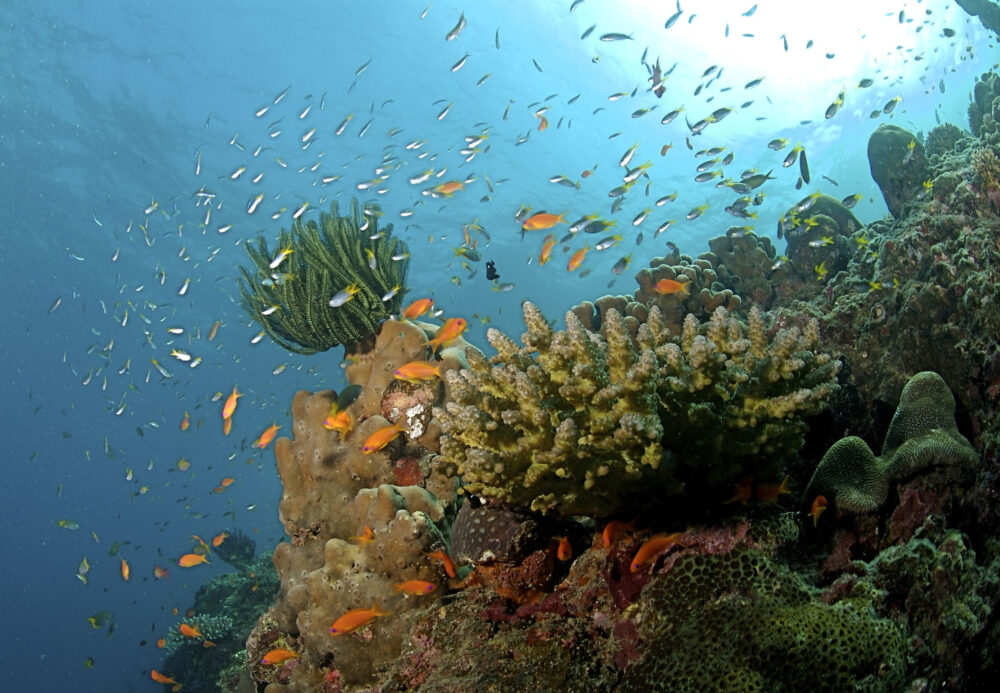
New research led by Welsh scientists reveals that many predictions about the future impact of climate change on coral reefs may be missing a crucial piece of the puzzle.
The study, published in Nature Ecology & Evolution , and led by researchers from Bangor University and King Abdullah University of Science and Technology (KAUST), warns that coral reef science must look beyond life on the reef and better account for the physical forces shaping reef environments.
These range from ocean currents and upwelling to deep-water temperature patterns and nutrient flows.
Without integrating these factors into models, the authors say, we risk misunderstanding where and why coral reefs survive—or collapse—under climate stress.
As a result of this they say policy makers and conservation managers are not targeting interventions for saving coral reefs where they are most likely to succeed.
Dynamic seascape
“Coral reefs don’t exist in isolation of their surrounding ocean. They’re part of a dynamic seascape shaped by water movement, nutrient supply, and subsurface temperature patterns,” said lead author Dr Laura Richardson, a Research Fellow at Bangor University. “But our current models of coral reef futures and the impacts of large marine heatwaves often rely solely on satellite data of sea surface temperatures. That misses much of the story.”
The paper highlights striking examples where large-scale ocean processes altered reef outcomes following climate stress.
For example, at the island of Palmyra Atoll in the Pacific, corals survived the record-breaking 2015 El Niño — a natural climate phenomenon that happens when water in the Eastern Pacific Ocean heats up more than normal. This survival was due to cool, nutrient-rich water delivered by powerful ocean currents.
In contrast, reefs in the Chagos Archipelago in the central Indian Ocean and Moorea in French Polynesia experienced severe bleaching from deep-water heat stress in 2019 that went undetected by satellites measuring surface temperatures.
The report says that identifying oceanographic reasons why some reefs survive a marine heatwave while other reefs die is crucial to help guide coral reef conservation efforts.
Scientific papers
The researchers, including from James Cook University reviewed over 1,000 scientific papers. They found that fewer than 10% explicitly considered both the ecology (the relationships between living organisms and their physical environment) and oceanography (the study of the physical, chemical, and biological features of the ocean) of the study locations.
The lack of integration between these different scientific disciplines, the authors argue, may explain why many reef forecasts increasingly do not match field observations.
“Understanding reef resilience isn’t just about measuring heat stress—it’s about understanding the integrated physical processes that can mitigate or amplify heat while concurrently supplying or restricting critical nutritional resources for coral reef communities” said senior author Dr Michael Fox, an Assistant Professor of Marine Science at KAUST. “Bridging this gap could dramatically improve how we model, manage, and protect coral reefs in a warming world.”
The researchers call for a new wave of collaboration between oceanographers and ecologists, and more widespread empirical data collection, to support better decision-making and conservation strategies.
“Importantly, we are not starting from scratch”, said Prof Gareth Williams, Professor of Marine Biology at Bangor University and co-author of the study. “For over a century, ‘biological oceanography’ has laid the foundations for linking the physical environment to the ecology of marine organisms, we just need to move these approaches a little closer to shore in coral reef science”.
Support our Nation today
For the price of a cup of coffee a month you can help us create an independent, not-for-profit, national news service for the people of Wales, by the people of Wales.


