

Could Reform UK get more broadcast coverage than other parties in the run-up to next May’s Senedd election?
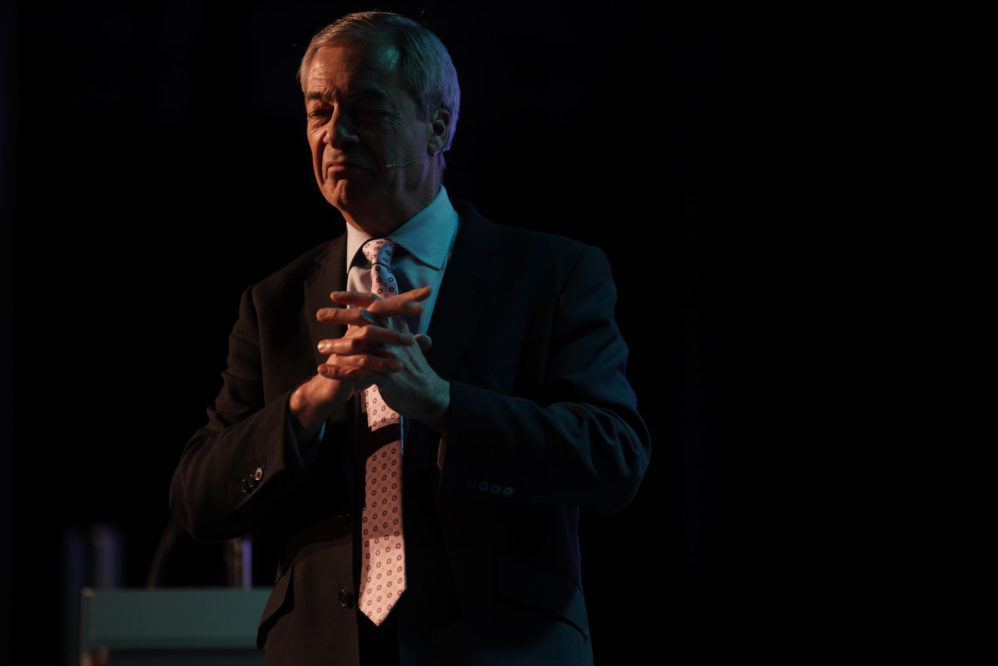
speaking during the Reform UK Wiltshire conference – Photo Ben Birchall/PA Wire
Martin Shipton
Concerns have been expressed that Reform UK could have an in-built advantage in terms of broadcast coverage in the run-up to next May’s Senedd election.
Researchers led by Professor Stephen Cushion at Cardiff University’s School of Journalism, Media and Culture have suggested that if Reform continues to lead UK-wide polls, the attention given to the Welsh election by network broadcasters could focus more on the right-wing party than its rivals.
Litmus test
In a paper analysing broadcast coverage of the final week of the Caerphilly by-election campaign, they write: “Political events and issues at the Senedd do not regularly feature in UK network news. But with Reform riding high in the polls both in Wales and the UK, the Caerphilly by-election is being viewed as a litmus test for what could happen at the Senedd election next year as well as at a future UK general election.
“Reform’s prominent coverage on BBC network news in the last week of the campaign – namechecking its UK leader Nigel Farage – demonstrates how seriously the main public service broadcaster takes the party’s electoral chances. Meanwhile, BBC Wales balanced coverage of the main six parties over the last week, while ITV Wales featured all eight parties in its coverage.
“As campaigning intensifies ahead of the Senedd election next year, all parties and candidates will be desperately competing to gain the attention of both UK network news and broadcasters in Wales. Given the volatility of voting intention polls in Wales, it will be interesting to see how broadcasters weigh coverage of parties during the campaign according to the latest trends in surveys and their past electoral record.
“It could be UK network news allocates airtime differently to broadcasters in Wales by more prominently reporting Reform and Nigel Farage if the party is still clearly leading UK-wide polls.
“Ahead of the Caerphilly by-election, we examined how BBC and ITV – two major sources of news in Wales – reported the final week of the campaign on TV and online between October 15 and 22. This included monitoring coverage on BBC Wales Today at 6.30pm and ITV Wales at 6pm on TV, the BBC Wales and ITV Wales politics home news pages online, as well as the UK network bulletins on BBC and ITV News at Ten on TV.”
Key findings
An analysis of the coverage produced a number of key findings:
BBC Wales (10 items) covered the by-election more extensively than ITV Wales (3 items) on TV and online news.
BBC Wales Today featured 4 items, compared to 1 item on ITV Wales. BBC Wales online reported 6 items compared to 2 items on ITV Wales.
Both broadcasters included a list of all candidates, or a link to a list of all candidates, in every story about the by-election.
BBC Wales hosted a live TV debate on October 15, featuring the candidates of the six largest parties (according to the latest opinion polls). Each party was mentioned an equal amount of times on BBC Wales News TV and online: Labour (7), Plaid Cymru (7), Reform UK (7), Conservatives (7), Liberal Democrats (7), and the Green Party (7).
The two other parties who had candidates in the election were mentioned fewer times on BBC Wales TV and online news: UKIP (2) and Gwlad (1).
However, both candidates for Gwlad and UKIP were interviewed about their campaigns on TV (BBC Wales Today).
ITV Wales interviewed all candidates in its one TV news item about the by-election.
The by-election featured on BBC UK network News at Ten on 21 October and ITV UK network News at Ten on 22 October.
The BBC UK network news item was framed around the decline of Welsh Labour and Reform’s political ascendency. The segments dedicated to Reform’s candidate (1m 01s) was longer than those given to Labour (36 seconds), Plaid Cymru (30 seconds) and the Conservatives (16 seconds). Nigel Farage was the only UK party leader referenced.
Candidate-centred
Describing the BBC’s coverage, the paper said: “BBC Wales provided a mix of candidate-centred coverage and non-party political voter-centred reporting, such as the article ‘Voting in by-election daunting and confusing for students’ which explored the experience of students voting for the first time in a by-election.
“The centrepiece of BBC Wales’ candidate-centred coverage was the Your Voice, Your Vote, Caerphilly by-election debate, which included six of the eight parties standing, with Gwlad and UKIP excluded. As we outlined in our previous report, broadcasters have to follow strict rules on impartiality during election campaigns, ensuring a balance in the allocation of airtime for parties. They take into account factors such as past electoral performance and the latest trends in opinions polls. Broadcasters also have to consider the live TV debate format and how many candidates they can realistically invite to face questions in an hour-long programme. The BBC took the decision to exclude Gwlad and UKIP.
“However, both parties were given a platform to present their positions on TV. On October 15, the Gwlad candidate was interviewed on BBC Wales Today as was the UKIP candidate on 16 October. They were the only candidates to be interviewed on both nights.
“One of the most high profile moments in coverage of the Caerphilly by-election was when it featured on the UK’s network news agenda, with the BBC political editor, Chris Mason, covering it on the BBC News at Ten.
The item was framed around the decline of Welsh Labour and Reform’s political ascendancy.
Labour’s Richard Tunnicliffe, Reform UK’s Llŷr Powell, Plaid Cymru’s Lindsay Whittle, and the Conservatives’ Gareth Potter were all interviewed.
The time provided to the Reform candidate UK (1m 01s) was much longer than those given to candidates from Labour (36 seconds), Plaid Cymru (30 seconds) and the Conservatives (16 seconds). Nigel Farage was the only UK party leader referenced.”
ITV’s coverage
Reviewing ITV’s coverage, the paper said: “ITV Wales coverage of the final week of the by-election included two items on TV and online news. They chose not to cover the BBC debates and referenced the by-election once on TV news coverage. That item appeared on October 21 and it previewed the by-election by interviewing all of the candidates, including Gwlad and UKIP.
“On ITV Wales Online, the coverage of the by-election included one report focused on polling data and another on voters’ sentiments before the election. There were no articles focused on the candidates.
“The by-election was also featured on ITV UK network News at Ten on 22nd October. The story was framed around the stakes for Labour, as Reform UK and Plaid Cymru set their sights on victory. The story did not cover any of the candidates. Instead, it concentrated on voter sentiment with vox pops from a variety of constituents.”
Support our Nation today
For the price of a cup of coffee a month you can help us create an independent, not-for-profit, national news service for the people of Wales, by the people of Wales.



Of course it will. The main media is so biased towards this deformed party it is unbelievable.
People in Wales are also much more likely to watch PMQs over FMQs. Welsh parties will always have an uphill fight getting voters to consume more local news, it’s a huge advantage for Reform.
The BBC have always given a disproportionate amount of uncritical coverage to Reform Ltd, its owner Farage, and his previous political businesses. I do not imagine that they intend to change this.
They should give more coverage to its finances and overseas connections, particularly the Russian connections of the current and previous leadership.
Because Reform are a potential threat to our democracy -the party will get more media coverage. Increasing the chances of that threat panning out. Look at how much press coverage Reform’s conference received. In the past such a bad party would have simply been ignored. During the EU referendum Farage got too much press coverage, acting like a greasy car salesman with a pint in his hand – and look at the sh*t that’s got us into. Now the media are helping him again.
Why have none of the main stream press looked at Farage and Gill. Any other party they would be all over them.
Farage and Reform UK are soaking up the spotlight—scandal or scrutiny, it’s all fuel for the fire.
The media’s fixation, whether fawning or critical, keeps them centre stage. Flashy slogans echo unchallenged, shaky local leadership goes unchecked, and populist theatre steals the show.
It’s Reform wall-to-wall—while other parties barely get a mic, let alone a moment to state their policies.
The latest seat forecasts for the 2026 Senedd when the D’Hondt Formula does offer some encouragement .
Tho Reform (36) are forecasted to get most seats, Even adding in the Tories (8) that is still 5 less than Plaid (29) and Labour (20) combined
The minnows green (2) and Lib Dem (1) could have a part to play . Reform will bethrowing money at the campaign over the next 6 mths
Gratifying to know this could be straight down the toilet .
Fagash is a mate of Murdochs. They’ve been seen together and private parties on several occasions.
So of course they get more disproportionate amount of media coverage.
The coverage Reform gets here is absolutely massive not just in the number of articles but in comments as well. The same is true of PMQ Nigel is constantly attacked with no right of reply. PMQ’s is totally outdated because his Majesties Loyal opposition are the Conservative Party in name only everyone knows in reality it is Reform and as such in a functioning democracy they should have a right of reply. The BBC is well past its sell by date and should be defunded because when Cymru becomes independent which is now guaranteed with the fantastic leadership of Rhun… Read more »
There are 650 MPs, the only one constantly supported and publicised
by mainstream Media is Farage, .WHY??