

Council forced to shelve school closure plans until after Senedd elections
Alec Doyle, Local Democracy Reporter
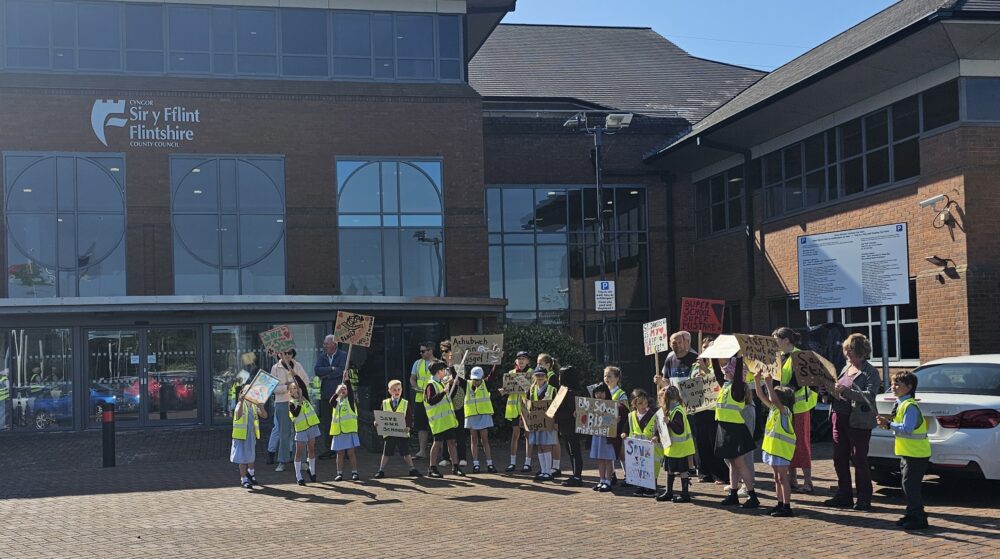
Plans for a Catholic super-school and a merger between two primary schools have been shelved until after the Senedd elections.
One group opposed to the plans has now slammed the local authority for putting pupils, parents and school staff through ‘hell’.
Chief Officer for Education and Youth at Flintshire County Council, Claire Homard, has now confirmed the consultation processes around Flintshire’s school reorganisation proposals for the Catholic Diocese and the merger of Saltney Ferry and Saltney Wood Memorial Primary Schools will need to begin again after the Senedd elections have been concluded.
Those plans include the Catholic super-school proposal – which would see the closure of Catholic primary schools St David’s in Mold, St Anthony’s in Saltney and St Mary’s in Flint plus St Richard Gwyn Catholic High School. They were due to be replaced by a £55 million 3-18 Catholic super school.
Neither plan has been scrapped, but both will now be put on pause until after the Senedd elections take place on May 7.
In a statement Ms Homard said: “The Cabinet decision to consider the outcome of the statutory objections on both proposals was paused on March 10 when a late legal challenge was received in relation to the Catholic proposal.
“Flintshire Council sought its own legal advice regarding this challenge and is in the process of reviewing the feedback from its barrister.
“With the Senedd elections due to take place on May 7, all public bodies are now bound by rules governing activity during the formal ‘pre-election period’ which started at 9am on Wednesday, March 25.
“During this period, the council is required to delay items that may be considered controversial. While the school organisation proposals are pressing, they are not sufficiently urgent to need consideration during the pre-election period.
“The School Organisation Code also stipulates a fixed time period for school reorganisation proposals to be concluded following the start of public consultation. With the delay because of the pre-election period, this timescale cannot be met. As a result, the consultation processes for both proposals will need to begin again.
“We appreciate that all of the school communities impacted by these proposals need clarity about what is happening and acknowledge the frustration that these delays will be causing, but the council needs to ensure appropriate processes are followed and legal advice has been fully considered.
“I can confirm that we will be seeking Cabinet approval to restart the consultation on both proposals in May, as soon as it is practicably possible after the election.
“I can also confirm that we will reflect on the result of the first consultation in relation to both proposals to improve how we communicate on issues of concern to the school communities, parents and carers.”
‘Disgrace’
Reacting to the news, Sarah Cunningham of St David’s Action Group, said: “We are glad to hear that the process has been paused but it is a disgrace.
“The council and the education department have given no thought to the impact of this uncertainty on school staff, who have kept schools running while fearing for their jobs and being given no information.
“They have not considered the impact on children – especially those with additional learning needs – who have been dealing with this uncertainty.
“We are also very concerned that it has taken so long for them to acknowledge that there were some legal and statutory questions surrounding this process. They ploughed on regardless and the result is that the schools affected have seen falling pupil applications for September, which will affect their funding.
“We will continue to campaign against these plans but we are concerned about the seeming lack of competence within the council that has brought us to this point so late.”
Support our Nation today
For the price of a cup of coffee a month you can help us create an independent, not-for-profit, national news service for the people of Wales, by the people of Wales.



The biggest disgrace is that the council and government are spending so much money on a selective sectarian school which they won’t even own despite paying for it. Moreover it seems that any money recovered from the sale or development of the closed sites will not mitigate this cost but likely go back to the diocese of Wrexham. Wales is supposed to be a secular state with a disestablished church – the only part of the UK to have this status on the island of Great Britain. It is time that state subsidies of religious schools ceased. Traditionally money was… Read more »