

Council looks to add Kernewek to Cornwall’s road signs
Stephen Price
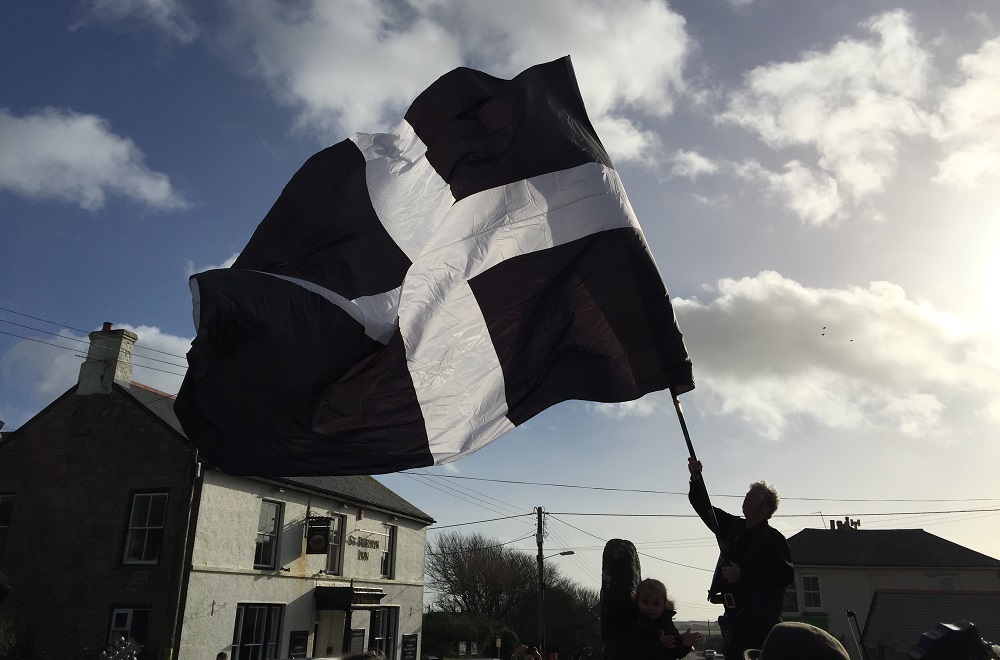
The Cornish language could soon appear on road signs across Cornwall, which councillors say would help promote the Celtic language and create a sense of pride.
Cornwall Council has explained that it doesn’t hold the power to make the changes at present, but has written to the Government asking for permission.
According to the BBC, the Department for Transport has said it was committed to supporting Kernewek, the Cornish language, but there were strict rules around the design and language allowed on road signs for safety reasons.
The BBC quotes Liberal Democrat councillor Dan Rogerson, cabinet member for transport on the council, saying: “We already use it in street nameplates… what I’ve written to the government about is being able to use Cornish on the other road signs.
“Cornish has been recognised and given the same status as a language within the UK as Welsh and Scots Gaelic and there are things that flow from that.
“If you’ve got Welsh on road signs, if you’ve got Scottish Gaelic on road signs in those parts of the UK, absolutely Cornish should be there too. Otherwise that push for equality of languages isn’t really manifesting itself.”
He continued: “This is not about ripping all the signs down that are there, but as they are replaced we could have the opportunity to do more to promote Cornish using those signs.”
Wales and Scotland have devolved powers to be able to use their native languages, but for Cornish to appear on road signs, a change in the law would be required.
Rogerson added: “My response to that will be – can we work together to get that change in the law. As Cornwall Council we’re very happy to work with them to get us to the place where we can see Cornish being used in that way,” he said.
Status
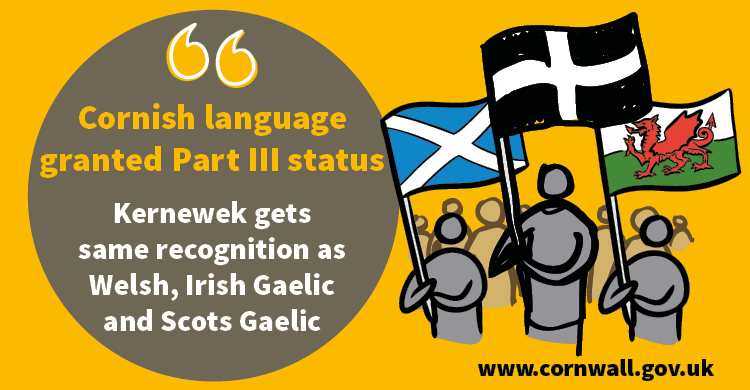
In 2025, it was confirmed that Kernewek, the Cornish language, will be recognised alongside Welsh, Irish Gaelic and Scots Gaelic after the UK Government recommended it for Part III status – the highest level of protection under European treaty.
The announcement follows years of campaigning from Cornwall Council, community groups and cultural organisations dedicated to protecting Cornwall’s native language.
Councillor Sarah Preece, Portfolio Holder for Tourism, Localism and Planning said “Kernewek is a fundamental part of Cornwall’s unique identity. We welcome this announcement as a huge step forward, giving the language the recognition and protection it deserves for future generations.”
Councillor Dick Cole, chair of the Fifth Nation Working Group said “It is really positive news that the Government has confirmed that Cornish will be covered by Part III of the Charter for Regional or Minority Languages. It means that Cornish will have the same status as the other Celtic languages of the United Kingdom – Welsh, Scottish Gaelic and Irish – and I would like to pay tribute to everyone who has campaigned for these greater protections for the Cornish.
“The priority must now be for the Government to work with the people of Cornwall to better support and promote our national language. And we must build on this status to ensure that Cornish nationhood is better reflected in all aspects of the governance of the UK, which needs to include a meaningful devolution settlement.
Council Leader Leigh Frost said: “This is brilliant news for Cornwall. Achieving Part III status reflects years of hard work by Cornwall Council, our partners and the many community groups who have fought to keep the Cornish language alive. To see Cornish recognised alongside Welsh, Scottish Gaelic and Irish Gaelic is something we can all be extremely proud of.”
He added: “Our language is a vital part of who we are. This announcement sends a strong message that Cornish matters, and that it deserves the highest level of support and protection. It’s an important step in strengthening our culture for future generations.”
To “celebrate the latest step in the ongoing resurrection”, Cornwall Live wrote their news story about the new status for Kernewek bilingually, gaining widespread praise across social media for the move.
Cornish became extinct as a living community language in Cornwall by the end of the 18th century.
A revival started in the early 20th century and in 2010 UNESCO reclassified the language as critically endangered, stating that its former classification of the language as extinct was no longer accurate.
In 2024-2025, over a million searches were made using the online Cornish dictionary and Cornwall Council’s Cornish Language Team received more than 650 requests, translating more than 32,000 words into Kernewek – up 22% from the previous year.
More than 200 people sign up for Kernewek classes each year, and almost 6,000 schoolchildren are having fun with the Cornish language through the Go Cornish for Primary Schools programme, commissioned by Cornwall Council.
Petition
Next month, a Westminster petition which has attracted 5,000 signatures, calling for a Cornish identity tick-box in the next UK comes to a close.
Campaigners say the current system fails to properly recognise Cornish identity, despite the Cornish being formally recognised as a national minority more than a decade ago.
Mebyon Kernow – the Party for Cornwall – has led the latest push, submitting detailed proposals to an Office for National Statistics (ONS) consultation on the 2031 Census.
The party, which campaigns for greater recognition and self-government for Cornwall, argues that the absence of a Cornish tick-box in the 2021 Census led to a significant undercount of people identifying with the nation.
It said the UK Government was “not treating the Cornish equally with the other national/national minority groups of the United Kingdom” despite formal recognition in 2014 under the Council of Europe’s Framework Convention for the Protection of National Minorities.
More than 117,000 people identified as Cornish in the 2021 Census through write-in responses across ethnicity, nationality and language questions, including over 100,000 in Cornwall itself.
Campaigners argue that figure would be significantly higher if a dedicated option had been available.
Support our Nation today
For the price of a cup of coffee a month you can help us create an independent, not-for-profit, national news service for the people of Wales, by the people of Wales.
Get more trusted Welsh news
Choose Nation.Cymru as a preferred source in Google News to see more of our journalism.



Good on Kernow for this, but they’ll have to brace themselves for the waves of hatred and intolerance the UK native language users face.
Excellent news!
However, expect fallout. Cymru had some awful abuse for announcing they were reverting back to the normal language.
Positive news from our brothers and sisters in Cernyw. 👏
Good luck to our Cornish Celtic cousins but wait until GB News, The Daily Mail and The Torygraph get to hear of this. They’ll predict that the number of accidents on the roads will increase by at least 3000%.
They’ll be speaking Cornish in the pubs next when you walk in, just to be rude. Mark my words.
Pryz koth (hen bryd)!