


Councils urged to save young trees from perishing in the extreme heat
Martin Shipton
A leading conservationist has called on local authorities to nurture and save young trees during heat waves.
Writing to Cardiff council, Nerys Lloyd-Pierce, who chairs Cardiff Civic Society, said: “Our extremely hot, dry summers are now a pattern and not an occasional inconvenience. Once again, trees in the city are stressed due to the lack of rain and the relentless heat.
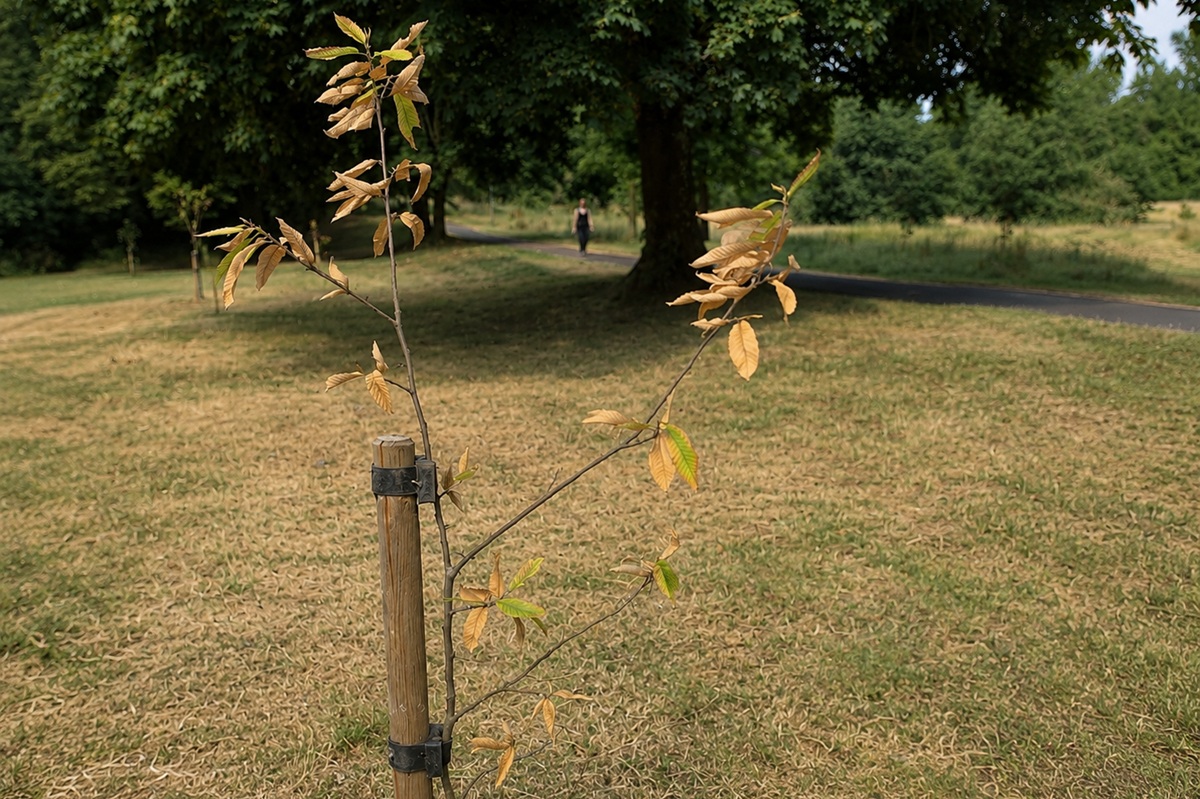
“While volunteer tree watering ‘guardians’ do a wonderful job, it is abundantly clear that this is by no means enough. The attached image tells the story of young trees throughout the city. While many trees struggle in these periods of intense dryness, young trees do not have sufficiently well-established root systems to withstand extreme weather and will die.
“As climate change is now clearly with us with a vengeance, we cannot simply carry on planting trees in the autumn and winter for them to perish in the annual summer droughts. Not only is this a waste of precious trees, it’s also a waste of money and people’s time.
“A more nuanced and systematic approach is needed, whereby bowsers are used to water recently planted trees for at least the first three years, aiding their survival to maturity. The same goes for bushes and scrub – these areas of vegetation provide vital foraging and breeding
habitat for a variety of species, bird, mammal, and invertebrate. Scrub needs to be recognised as essential habitat, vital for our declining wildlife – a fact that tends to be overlooked by those in authority.
“Bowsers provide a quick and easy way to get fresh water to locations throughout the city and are relatively inexpensive. Instead of employing people to mow parched grass, people need to be employed to operate bowsers during the summer. Mowing grass also increases evaporation from the soil – the worst thing to do during periods of hot, dry weather.
“Trees and vegetation are vital to keep the city cool. During the current heatwave, the difference between a leafy street and one without canopy is striking, with trees keeping the heat to a bearable and health supporting level, as well as supporting struggling wildlife.
“Please ensure that plans are put in place to keep young trees and other vital vegetation watered during hot weather.”
Ms Lloyd-Pierce said the points she makes are relevant across Wales.
Air quality
A spokesperson for Cardiff council responded: “We recognise the important role that trees, parks and green spaces play in supporting biodiversity, improving air quality, reducing urban heat, and benefitting the health and wellbeing of the city’s residents and visitors.
“As with local authorities across the UK, we are experiencing increasingly frequent periods of hot and dry weather, which can place significant pressure on vegetation, particularly newly planted trees and young shrubs that are still establishing their root systems.
“The council takes a balanced and targeted approach to maintaining the city’s parks and green spaces during periods of drought. Our parks and operational teams monitor conditions closely and prioritise resources towards areas where action will have the greatest impact, including the watering of newly planted trees and other vulnerable plants.
“We are grateful to the many volunteers, community groups and tree guardians who support the care of trees across the city. Their contribution plays an important role in helping young trees become established and complements the work of our own teams. Tree Guardians and volunteers have been provided with watering equipment to support the establishment of newly planted trees during their critical early years.
“The council’s Coed Caerdydd tree planting programme is designed to increase Cardiff’s urban tree canopy and improve the city’s resilience to climate change. While some losses can occur during periods of prolonged drought, species selection, planting methods and ongoing maintenance are designed to maximise survival rates and ensure the best use of public resources. Our annual tree monitoring continues to demonstrate strong establishment rates for newly planted trees: an 82% survival rate in 2024/25, 83% in 2025/26.
“Maintaining Cardiff’s extensive network of award winning parks, green spaces, green verges and woodlands involves careful management, particularly during periods of extreme weather. We balance a range of priorities, including public safety, biodiversity, environmental benefits and the efficient use of resources.
“As climate patterns continue to change, we review and adapt our approach to tree planting and watering to ensure Cardiff’s green infrastructure remains healthy and resilient, and is there for residents, wildlife and future generations to enjoy and benefit from.”
Support our Nation today
For the price of a cup of coffee a month you can help us create an independent, not-for-profit, national news service for the people of Wales, by the people of Wales.
Get more trusted Welsh news
Choose Nation.Cymru as a preferred source in Google News to see more of our journalism.



Stop cutting grasses and verges to the bone. Area’s remain greener longer and reduces fire risk.
I’d love to know where the Council is watering young trees. I’ve seen no evidence of it – although of course I haven’t covered every inch of Cardiff.
‘Careful management’? I really don’t think so.
The Council’s management of parks, trees, verges, etc, etc is in dire need of a complete overhaul.
Many trees were felled in Pontypridd town during road widening early 1990s. The ash tree on the north-east side of William Edwards 1756 bridge was felled to make way for a short-lived lighting installation for the bridge by English artist Lulu Quinn ~ 2008. It was therefore, pleasing to see planting of 21 maple tree around the Llys Cadwyn buildings which replaced the demolished “Precinct”. Of those 2 were dead by 2025, 13 look dead or dying and the remaining 6 sick. Will the 17 trees planted this year on the demolished M&S site share the same fate?