


Couple worry dog’s rare tumour may have been caused by contaminated land
Alec Doyle, Local Democracy Reporter
A couple say a rare health condition that claimed the life of their dog may have been possibly caused by exposure to contaminated land.
Donna and Pete O’Brien say their previously healthy dog Misty slowly became ill after wading through a swampy pool near Cefn Aqueduct. Ultrasound scans near the time of her death indicated she had a heart tumour – a condition that affects just 0.19% of dogs.
Following the BBC’s Buried documentary – where actor Michael Sheen and a team of scientists and environmental journalists investigate historic chemical dumping across Wrexham and Wales – they now believe Misty’s death may have possibly been connected.
And they say that veterinary records from across Wrexham should be analysed to identify whether there is a clustering of rare conditions affecting pets in the area,
“We never thought too much of it at the time,” said Donna. “It was December 2019 and we went out for a walk near Ty Mawr.
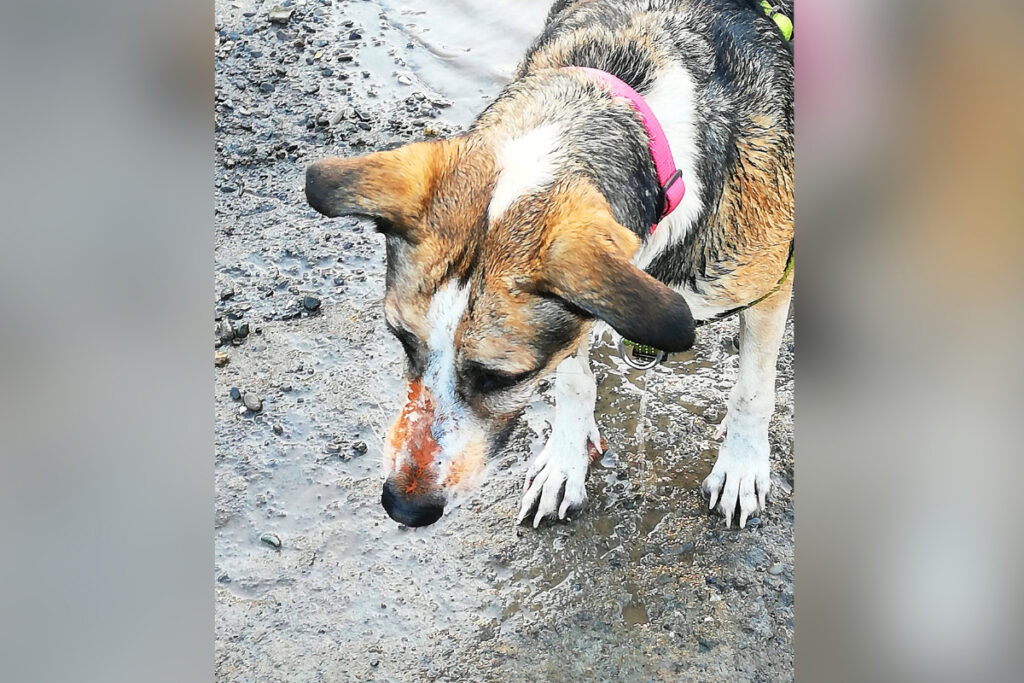
“Misty loved running in the mud and swamps. We were walking under the aqueduct and she ran off to play in some swampy land and when she came back she was covered in a sort of greasy orange film.
“At the time you think it might be copper or iron washing down through the landscape but it stank and it was sort of oily all over her coat. It was kind of iridescent, it caught the light like oil would.
“When we got home we washed it off her and vowed not to go back but we had no idea what this stuff was. It stained her for weeks.”
After that they noticed Misty, who was four at the time, began to get sick.
“She had been a really healthy dog,” said Donna. “But then that seemed to change.”
Vets records show that Misty started to have periodic diarrhea and vomiting from late 2022.
And by 2024, aged nine, Misty was struggling.
“She would get to the end of a walk and just stop for a while,” said Pete. “It was unusual but I put it down to her wanting to stay out a bit longer.”
Around April 2024 Misty’s health deteriorated – she was coughing up blood and expelling blood from her nose. Ultrasound scans showed a growth – believed to be a tumour – on her heart and potentially others on her stomach and lungs.
That would have been that had it not been for the documentary.
“When we watched that it made us sit up and take notice,” said Pete. “People were describing substances similar to what we washed off Misty – greasy, oily orange deposits.
“Then we went to the meeting of the Monsanto Contamination Action Group and heard more stories that resonated.
“It’s worrying because a lot of people visit Ty Mawr and the aqueduct and if there is a risk those visitors are unaware – plus what if that is finding its way into the River Dee?
“We can’t say for certain that Misty’s health was affected by contaminated land but because there are so many questions we can’t say it wasn’t.
“That’s why we feel that as well as human medical records, pet medical records need to be examined for clusters of rare illnesses.”
Their concerns over land at Cefn Aqueduct were echoed this week by Cefn Cllr Derek Wright at a meeting of Wrexham County Borough Council.
Debating a Notice of Motion to make significant changes to monitoring and management of contaminated sites, Cllr Wright said: “Just a stone’s throw from Ty Mawr Country Park there are three areas I believe were settling ponds from the waste in Monsanto – one of which has always been fenced off.
“Wrexham Council had the fence renewed in about 2014 and is still fenced off now. Why are these areas fenced off? What is in there? The fence is only three foot, there’s no signs on that say the chemicals that are in there or why they’re fenced off.
“One of the ponds has now become a public footpath and it’s less than 130 yards away from the River Dee,.
“Dogs are walking across them, people with children are walking across them, yet to my knowledge, there have never been any publicised tests of what is in those lagoons, or what used to be lagoons.”
A spokesperson for Wrexham Council said that investigations around Cefn Aqueduct indicated deposits came from mining activity.
“The ocherous deposits along the banks of the River Dee and footpath adjacent to the Dee arise due to coal mine impacted water,” said the spokesperson . “There is at least one known adit – a horizontal mining access shaft – in this area.
“Notwithstanding this, we have inspected the area with Natural Resources Wales and they have undertaken liaison with the Coal Authority – we are satisfied there is no requirement for any further action to be taken.”
Pete and Donna believe that due to many suspected or undocumented dump sites and water run-offs being in public rural areas, pet health data may provide more evidence of the impact of ‘forever chemicals’ on communities.
“Dogs go everywhere,” said Pete. “Illnesses that take decades to develop in humans often progress much quicker in animals.
“Data on pet health from local vets could perhaps fill in some of the gaps around just how much of an impact this historic dumping has had on the area.
“We don’t walk our dogs by Cefn Aqueduct any more but there are so many sites who knows what we and they are being exposed to. That’s why we need clear answers.
“If medical data from vets shows clusters of rare diseases or conditions that might help indicate where we need to look for some of the undocumented sites around Wrexham.”
Support our Nation today
For the price of a cup of coffee a month you can help us create an independent, not-for-profit, national news service for the people of Wales, by the people of Wales.
Get more trusted Welsh news
Choose Nation.Cymru as a preferred source in Google News to see more of our journalism.


