


Darren Millar calls on Auditor General to launch probe into Bute Energy’s finances
Martin Shipton
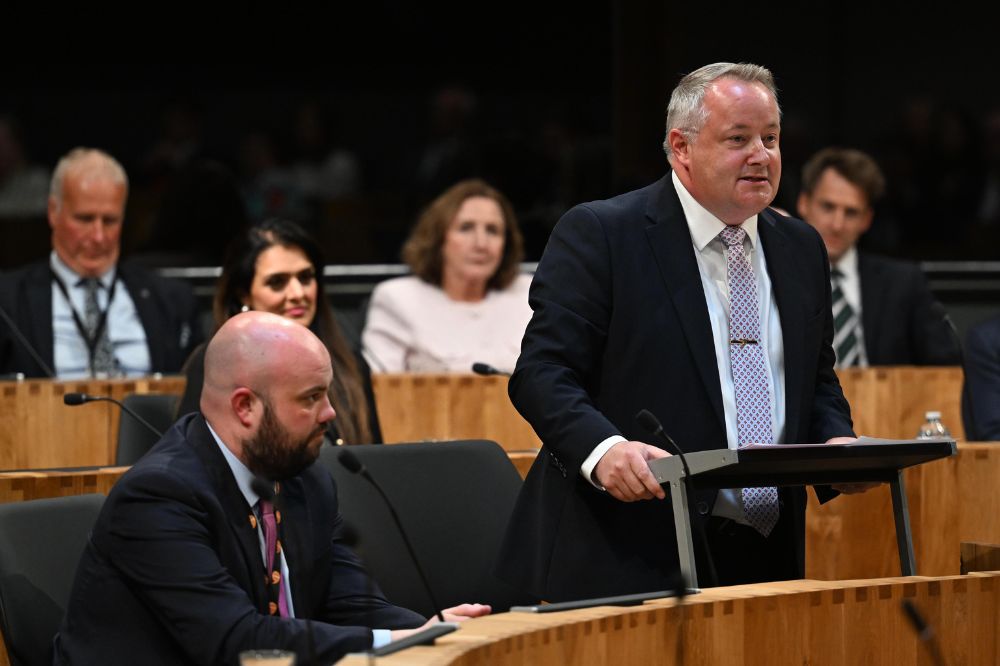
Welsh Conservative leader Darren Millar has called on the Auditor General for Wales to investigate concerns about the finances of renewable energy company Bute Energy and its parent company Windward Energy.
Bute Energy’s plans to build a network of wind farms across Mid Wales has met strong resistance from residents who fear the desecration of Wales’ landscape.
Last week Nation.Cymru revealed how many millions of pounds taken out of Bute Energy, which plans to build a network of wind farms across Wales, have been reinvested in unrelated businesses in Scotland.
Bute Energy principals received payments totalling £58m after the value of the company’s projects had been upgraded in anticipation of their future profitability. We also revealed that the company was making staff redundant.
A forensic accountant who does not wish to be identified has produced an investigative dossier which outlines how fresh investments have been made in Scotland and claims there are grounds for regulators to launch investigations.
The dossier, which was passed to Nation.Cymru, states: “This dossier provides a forensic evaluation of the divergence between the public-facing infrastructure commitments of Bute Energy and the internal financial operations of the Windward Energy Group [Bute’s parent company].
“Analysis indicates a ‘speculate-and-anchor’ model, wherein speculative energy development in Wales has served as the primary mechanism for generating liquidity subsequently anchored in tangible Scottish industrial assets.
“In September 2023, the Wales Pension Partnership (WPP), representing the local government pension schemes of eight Welsh councils, announced a £68m investment into the group’s onshore wind portfolio. This influx of public-sector capital followed a £60m ‘call option’ payment from Copenhagen Infrastructure Partners (CIP).
“Forensic analysis of Windward Energy Limited reveals that following these capital inflows, approximately £58m was extracted as personal dividends by the four principal directors. While the core Welsh operating entities announced staff redundancies in May 2026, the extracted liquidity was utilised to capitalise a high-value portfolio of Scottish industrial real estate.”
‘Aggressive accounting’
The dossier goes on to claim that the extraction of nearly £60m from a loss-making development group was facilitated through “aggressive accounting and legal manoeuvres designed to facilitate cash distributions”
It continues: “The group, audited by KPMG, transitioned to ‘Fair Value’ accounting, reporting a subsidiary valuation uplift of £190m. This figure was derived from ‘Level 3’ inputs, representing the highest degree of reporting subjectivity. The valuation is based on directors’ internal projections of future cash flows from wind parks that currently lack final planning approval or grid connection agreements.”
“A primary forensic concern is the apparent lack of professional scepticism regarding the ‘future cash flow’ models used to justify this uplift. While the directors ‘cashed out’ based on these optimistic projections, Welsh pensioners (via the WPP) remain joint investors in projects carrying the full weight of planning and delivery risk.”
The dossier goes on to describe the accounting mechanism used to justify the uplift in value of the projects: “As the group lacked distributable reserves (actualised profit), the directors utilised a Deferred Share Scheme. By issuing and subsequently cancelling deferred shares against the paper revaluation, the group ‘created’ the legal reserves necessary to justify the cash payout. This effectively allowed development capital to be recharacterised as personal profit.
“In January 2025, the group utilised a court order under Section 1096 of the Companies Act 2006 to ‘rectify’ the public register. This action removed historical filings related to an initial, legally deficient attempt at dividend extraction. Consequently, the public record now lacks the administrative trail of these earlier manoeuvres, masking the aggressive hollowing out of the company’s regional capital base.”
‘Community benefit disparity’
The dossier then outlines what it describes as a “community benefit disparity”, stating: “While communities in Mid Wales were promised modest ‘community benefit funds’ (typically in the thousands of pounds), the group’s principals were executing personal payouts in the tens of millions. This disparity represents a fundamental deviation from the ‘social licence’ ostensibly required for large-scale regional infrastructure projects.”
The dossier goes on to list investments in Scotland made by the company’s principals, stating: “The forensic trail confirms that capital generated through Welsh development has been used to capitalise a network of entities focused on Scottish property, detached from Welsh operating risks.”
‘Serious allegations’
In a letter to Adrian Crompton, the Auditor General for Wales, Mr Millar states: “I am writing following receipt of the attached correspondence containing a number of serious allegations concerning the financial operations and corporate structure of companies connected to Bute Energy and Windward Energy, including matters linked to investment through the Wales Pension Partnership.
“The correspondence raises concerns regarding the governance, financial arrangements, and movement of capital within the corporate group, alongside questions about the exposure of Welsh local government pension funds to significant speculative investment risks.
“To be clear, I am not in a position to verify the allegations contained within the document, and nor do I seek to prejudge the matters raised. However, given the scale of the sums reportedly involved, the references to public sector pension investments, and the wider public interest implications, I believe the issues outlined warrant careful consideration and investigation.
“Members of local government pension schemes across Wales are entitled to expect that public funds are subject to rigorous oversight, proper due diligence, and robust governance arrangements, particularly where substantial investments are made into complex infrastructure developments and associated corporate structures. In light of the concerns raised, I would urge you to undertake an independent investigation into this matter.”
A spokesperson for Bute Energy said: “The company operates in accordance with all relevant legal, regulatory and statutory obligations and, in the circumstances, we do not intend to comment further.”
It is understood that at a “Town Hall” meeting involving Bute Energy’s remaining staff following the redundancies, it was announced that the company’s directors would take a 50% pay cut.”
Support our Nation today
For the price of a cup of coffee a month you can help us create an independent, not-for-profit, national news service for the people of Wales, by the people of Wales.
Get more trusted Welsh news
Choose Nation.Cymru as a preferred source in Google News to see more of our journalism.



Yes thats fine but lets have the AUDITORS have a long hard look at the Tory very expensive WHITE ELEPHANT H S 2 its now doubled to over a HUNDRED BILLION POUNDS
The clue was in the name, more power to your elbow Mr Llwyd…