


Denmark reports renewed drone sightings at defence facilities
AP Reporters
Drones have been observed at several Danish defence facilities overnight on Friday into Saturday, the government in Copenhagen said.
The renewed sightings come after several drones were spotted in the Nordic country earlier this week, with some of them temporarily shutting down Danish airports.
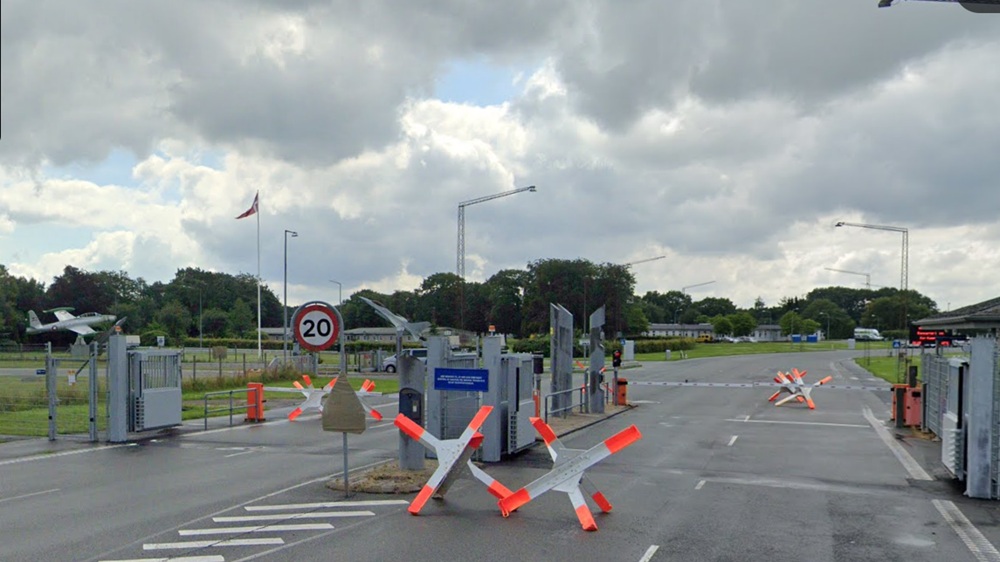
The Danish defence ministry said drone activity was noticed at Skrydstrup Air Base and the Jutland Dragoon Regiment.
Several local media reported that one or more drones were also seen near or above the military Karup Air Base, which is Denmark’s biggest military base.
‘Operational security’
The ministry refused to confirm the sighting at Karup and said later that “for reasons of operational security and the ongoing investigation, the Defence Command Denmark does not wish to elaborate further on drone sightings”.
Danish public broadcaster DR reported that in Karup, there were drones in the air both inside and outside the fence of the air base at around 8pm local time (6pm GMT), quoting Simon Skelkjaer, the duty manager at the Central and West Jutland Police.
DR said that for a period of time the airspace was closed to civil air traffic, but that did not have much practical significance as there is currently no civil aviation in Karup.
The repeated unexplained drone activity, including over four Danish airports overnight on Wednesday into Thursday and a similar incident at Copenhagen Airport, has raised concerns about security in northern Europe amid suspected growing Russian aggression.
The Copenhagen drones grounded flights in the Danish capital for hours on Monday night.
‘Fear’
The goal of the flyovers is to sow fear and division, Danish Minister of Justice Peter Hummelgaard said on Thursday, adding that the country will seek additional ways to neutralize drones, including proposing legislation to allow infrastructure owners to shoot them down.
For the upcoming European Union summit next week, the Danish defence ministry confirmed on X that the country’s government had accepted an offer from Sweden to “lend Denmark a military anti-drone capability”, without giving further details.
In Germany, several drones were reported in the northern German state of Schleswig-Holstein, which borders Denmark, from Thursday into Friday night.
The state’s interior minister, Sabine Sutterlin-Waack, said that “the state police are currently significantly stepping up their drone defence measures, also in coordination with other northern German states,” German news agency dpa reported.
German chancellor Friedrich Merz said that in regard to frequent attacks on infrastructure and data networks, “we are not at war, but we are no longer living in peace either”. He did not allude to a certain country as the actor behind those attacks.
Espionage
He cited “drone flights, espionage, the Tiergarten murder, massive threats to individual public figures, not only in Germany but also in many other European countries. Acts of sabotage on a daily basis. Attempts to paralyse data centres. Cyberattacks” during a speech at the Schwarz Ecosystem Summit in Berlin on Friday, dpa reported.
What became known as the “Tiergarten murder” in Germany refers to the case of Vadim Krasikov, who was convicted of the August 2019 killing of Zelimkhan “Tornike” Khangoshvili, a 40-year-old Georgian citizen who had fought Russian troops in Chechnya and later claimed asylum in Germany.
Krasikov was returned to Russia as part of a massive prisoner swap between the US and Russia in 2024.
Support our Nation today
For the price of a cup of coffee a month you can help us create an independent, not-for-profit, national news service for the people of Wales, by the people of Wales.


