


Details revealed of ‘mammoth’ Cardiff tramway project
Emily Price
Further details have emerged of a “mammoth” new tramway in Cardiff which is expected to close a critical gap in the Welsh capital’s connectivity.
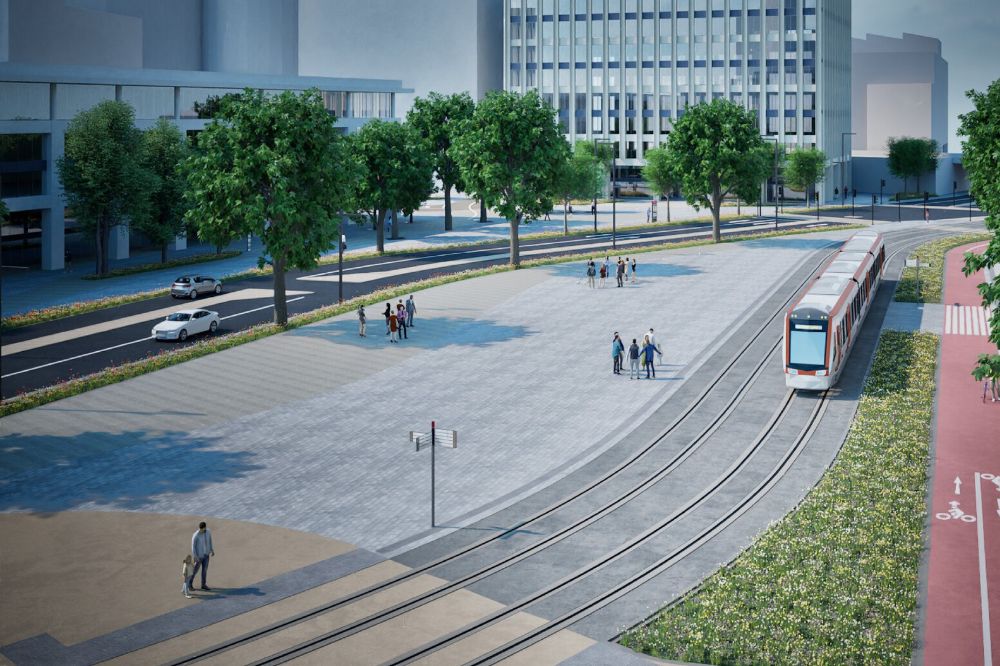
The collaborative Crossrail scheme will see Cardiff Council and Transport for Wales (TfW) work together to deliver a tramway from Cardiff Central railway station to Cardiff Bay, connecting the two directly by rail for the first time.
The long awaited tram line has been hit with years of delays and uncertainty due to a lengthy Welsh Government review after the initial planning permission was granted in April 2022.
A November news article published by New Civil Engineer has revealed further details of how Cardiff’s new transit system will be delivered.
It explains that the £100m, 800m long Phase 1a of Cardiff Crossrail will create the foundation for the light rail system.
Cardiff Council director of planning, transport and environment Andrew Gregory told New Civil Engineer: “In terms of Phase 1a, that forms the catalyst to create an east-west link, but it also has a focus on providing the spinal connection of a big development corridor from Cardiff city centre to Cardiff Bay.”
The tramway will start with a dedicated stop at Cardiff Central Station, then will travel through Cardiff’s Callaghan Square and connect to the existing Cardiff Bay railway line.
The southern arc of Wales’ capital is one of the most deprived areas of the country.
It’s hoped that by connecting deprived communities with the city centre the project can boost jobs and growth in the area.
The tramway will also link with plans for a new 16,500-capacity indoor arena in Atlantic Wharf in Cardiff Bay set to open in 2028.
Andrew Gregory added: “Between the new arena being built in Cardiff Bay and Cardiff Central Station, there are further development works going on in the city.
“Phase 1a will form the sustainable transport spine of that development corridor. Crossrail is the first step in achieving the sustainable transport vision for the city.”
TfW and Cardiff Council worked together to go to both the UK and Welsh Government’s to make the case for the multi-million pound rail project.
Metro
The Welsh Government has provided funding of £50m and the UK Government had provided £50m through the Levelling Up Fund.
The new Crossrail line will also aim to link up with the newly revamped Core Valley Lines network.
TfW is currently in the process of electrifying around 170km of track as well as upgrading stations and signalling as part of the South Wales Metro project.
Earlier this year TfW began testing brand-new electric tram-trains on the recently electrified Valleys railway lines.
Meanwhile, Phase 1b of the Cardiff Crossrail project is still at concept stage.
This phase will see an extension through Cardiff Bay to the Pierhead building with the refurbishment of Cardiff Central Station planned as a separate project.
WSP was appointed in early 2024 to provide programme and management services, working alongside cost consultant Rider Levett Bucknall.
Construction engineering company Graham Group secured the contract to design and build Phase 1a of the tramway in 2024.
Engineering company Amey was appointed as a design partner and will be responsible for highways, drainage and public spaces.
Highway and public realm works are expected to begin next spring while construction of the tram track and platforms at Cardiff Central Station will take place in late 2026.
Challenge
It’s hoped that Cardiff’s new tram link will become fully operational by mid-2028.
Conceptualising the project has proved challenging because it involves multiple interconnected infrastructure projects as well as the integration of new routes with older infrastructure.
Cardiff Council’s operational manager for major projects Gethin Shields told New Civil Engineer that collaboration has been key due to the large number of documentation required across several parties.
For example, a key piece of documentation is the TWA (Transport and Works Act).
The legislation relating to England and Wales is used to authorise major transport schemes.
Sheilds said that over the summer, over 50 documents, drawings and reports were submitted to the Welsh Government.
He said: “It goes through all the transport assessments, planning documentation, heritage impact assessments, drainage, all those things that you would normally have to do for the project.
“Documentation has been one of the challenges, but it’s been overcome through the strong relationships and collaboration that the council and TfW have had working together.”
The Cardiff Crossrail scheme will also involve improvements to the city’s active travel routes with new walking, wheeling and cycling links and improved footways for pedestrians.
This will involve changes to the road layout on Callaghan Square and traffic routing in the area.
Design
Sheilds told New Civil Engineer: “One of the biggest challenges we had was during the concept design stage, where we were coming up with an arrangement for the Callaghan highway and tramway that worked for everybody.
“We were working towards an optimal solution that wouldn’t cause massive congestion.”
Using automatic number place recognition cameras to collate data, a traffic model has been created using traffic simulation software.
This has allowed the scheme’s collaborators to create a working model of the existing situation at the site today and can add all the known developments that are going to be in play for when the tramway goes live.
Further design challenges for Phase 1a will include the removal of two roundabouts at Callaghan Square and reduction of three lanes of traffic both sides of the gyratory system to one lane in each direction.
Filter lanes will also be added to make space for the tram line.
Cardiff’s historic canals have had an impact on the scheme’s design with collaborators required to identify the ground conditions where the tramway intersects with the city’s waterways.
Graham contracts director Andrew Henry told New Civil Engineer: “There are also Victorian sewers and quite a lot of services, such as tower services in a fragile condition or unknown condition.
“Where the scheme ties into the CVL in the Bute Street area, there’s an existing masonry retaining wall.
“However, that existing wall appears to have no foundations. So again, there are a few geotechnical challenges in development design.
“Additionally, we’re incorporating the track into the existing highway, so there’s only so much we can deviate from the existing highway level in terms of the track.
“To limit that, we’ll have to try and work the track as close to road level as possible.
“We’re looking at altering the track design so that we can reinforce the track at various points, which would allow us to get away with a slightly slimmer track substructure design to pass over the services.”
Utilities
Engineers are also building 3D models of the underneath of the utilities in the area and running a clash detection process to design the project around utilities.
Henry added: “That’s about creating a model in which all the elements tie in with each other, to make sure that involved parties are getting that model with the clash detection built in.
“That means we can all identify where there may be a service clash that would affect not just the track, but the support infrastructure for the track, including drainage, signal cables, power cables and so on.”
Collaborators of the Cardiff Crossrail scheme say they have drawn on learning from schemes such as the Edinburgh Tram Network – an 11.5 mile line which runs between Newhaven and Edinburgh.
During its constriction the Scottish project used reinforced soil structures, non-load-bearing bridge abutments and the construction of retaining walls and bridges, as well as a portion of the concrete track line.
Support our Nation today
For the price of a cup of coffee a month you can help us create an independent, not-for-profit, national news service for the people of Wales, by the people of Wales.



Is there any reason why they can’t just put on more buses to Cardiff Bay from Cardiff Central? Sorry, I’m just not grasping why all the money is being spent. Central needs a refurb for sure, but the trams feel dangerously like a vanity project. Convince me someone…
Because this isn’t a bay shuttle. Crossrail services will eventually run to various destinations in the east and west of the city.
https://www.bbc.co.uk/news/articles/c303y2l8g85o
Crossrail Cardiff will never happen, who funds a 3 billion pound project? No EU funds to tap, Wales has just been allocated 400 million to fund railways over the coming decade from UK gov, we’ve just had a footbridge built in Abergavenny at a cost of 10 million, our annual allocated rail budget is 4 footbridges!
Laying a few hundred yards of tram line adjacent to an existing railway between two stations already connected is the only affordable option to get trams running in Cardiff. It’s not a mammoth tramway project, it’s a fairground ride.
Where did you get that cost from. This central core part of the project is the most difficult and expensive. To continue east there’s an existing freight line through Splott that just needs converting, to continue west will just take a short connection to existing lines.
And there’ll be a new 15000 seater arena down the bay as well so even the first phase will be very important in offering good public transport options to and from the city centre on events days. One 3 car tram train unit can hold 250 people, you’d need 3 or 4 buses to match that.
Trams have better reliability, higher passenger capacity and they’re much easier to make all electric (cheaper too since they’ve been doing it for decades…). Not only that but in pedestrian heavy areas they tend to have fewer pedestrian casualties compared to buses. Meaning fewer polluting diesel vehicles and more people having a smoother ride to their destination. Trams are basically essential for proper intra-city mass-transit between certain regions of the city. Trains are more suitable for inter-city/town while buses are great for ferrying people from trams and and trains to other regions, such as residential areas, small villages and industrial… Read more »
Excellent explanation.
This is all very disingenuous. Higher passenger capacity seems irrelevant when they’ve cut the number 6 from 10 to 2 an hour, the bus follows a route of largely segregated pavements (not that Callaghan Square is ‘pedestrian heavy’), the ride is fine, and Cardiff is already introducing electric buses. The money would be better spent on more of them.
This is a vanity project and nothing else.
They’ve cut the number 6 from 10 to 2 an hour because it’s expensive to run and because its expensive to run they put up the prices and because they put up the prices the passengers stopped coming. The woman who swallowed the fly springs to mind. Trams are considerably cheaper, up front capital costs are a bit expensive, but once in, pays back dividends over the long run. Callaghan Square might not be pedestrian heavy… but that’s not the only place the tram is going… and the capital is going to keep getting more and more populous over the… Read more »
Trolleybus use existing roads!
Less disruption during build.
Have you ever tried to transfer from train to bus to go to the bay? I’ve only attempted it once, but to make a long story short I ended up walking.
They used to run 10 an hour, now it’s 2. This is a prepared solution to a created problem
If Cardiff council tax payers want to pick up the bill for this then fine. Electric trains and ample bus services (which could easily be electrified) already run from Cardiff Central to Cardiff Bay. No Welsh Government cash. That should be spent elsewhere in Wales who have neither. Priority should be to re-open Carmarthen to Aberystwyth rail line and electrification of the west Wales and north coast rail routes.
Anyone from Cardiff can tell you don’t know what you’re on about because there are no trains to Cardiff bay direct from Central Station.
If you care so much speak to your councillor. It’s not the fault of the people of Cardiff that your local councils haven’t got any vision for your transport network.
An extra mile of track missing at Dyfi Junction since 1863 linking north to south still has not been added…why I wonder?
Around Cardiff by Trolleybus 2023…There is so much available on Cardiff Transport in print that it, rather than the people, has become the story and the source of millions of pounds for all in the industry…
Long may you tear up tarmac for steel, somewhere in a Desolation Bay shanty town there must be a ‘Woody Guthrie’ the Tramline Hobo, busy writing protest songs about the lack of street furniture to bed down on…
Why not trolleybuses? Less disruption use existing roads and environmental friendly.
Trolley buses get stuck in traffic, that’s why people prefer train over bus.
Also, steel on steel is much more efficient than rubber on tarmac.
This should have been done 30 years ago but it’s great to see it finally happening. It is being done for the arena primarily, but must be used to help the local Butetown communities and not just the Bay businesses.
I’m not sure that it’s “mammoth”, it looks to me like a very modest bit of connectivity, the sort that a proper European city would have had for over a century. That Caerdydd is only just now getting around to this is sad, and the limited scope and slowness of the project doesn’t bode well for future expansions or tramway construction elsewhere.
Thanks for your efforts everyone but utterly pointless and a waste of time and money. Refurb Central but the rest can just be solved by more buses (electric ones too), be it from the Centre to the Bay or from West to East. In fact, it’s worth nothing that Crossrail doesn’t solve a huge Cardiff problem – simply going from places like Fairwater and Radyr over to Roath etc. Utter nightmare…
There are new stations planned for Roath Park, Crwys Road and Newport Road (at Rover Way) which will serve Roath. Crossrail will directly link Fairwater to Newport Road via Splott.
Some sadly expected responses to this article which hold all of Wales back. It’s the old divide and rule colonial attitude which has kept us down for centuries. Why should Cardiff have this when what about us; waste of money, etc. no wonder we have problems in Wales. Trams are the norm in cities the size of Cardiff in the rest of Europe and you know what they work and are successful. This is a good news story and you what. I don’t give a damn if some small minded people in other parts of Wales get angry about it.
Sums Cardiff up that…Millwall…
‘A Capital Centenary’ extract in four issues of ‘Classic Buses’ 2002/3 to be found in another Bay…made for you…
Mammoth? More like a shrimp! What is really needed is a tram/light rail linking the Bay with Central Station and on to the Castle, Civic Centre, North Road and Whitchurch railway station.
£125,000 per metre cost (minimum)? Really? What we need is better services and connectivity on existing services – example: show ends at wales millennium centre about 10.15pm on a sunday night, but there are no current buses or trains to meet and take people home from cardiff bay past 10pm on a sunday! In a european capital city – so disappointing.