


Emyr Lewis wins Eisteddfod Chair after strongest competition in decades
Nation.Cymru Staff
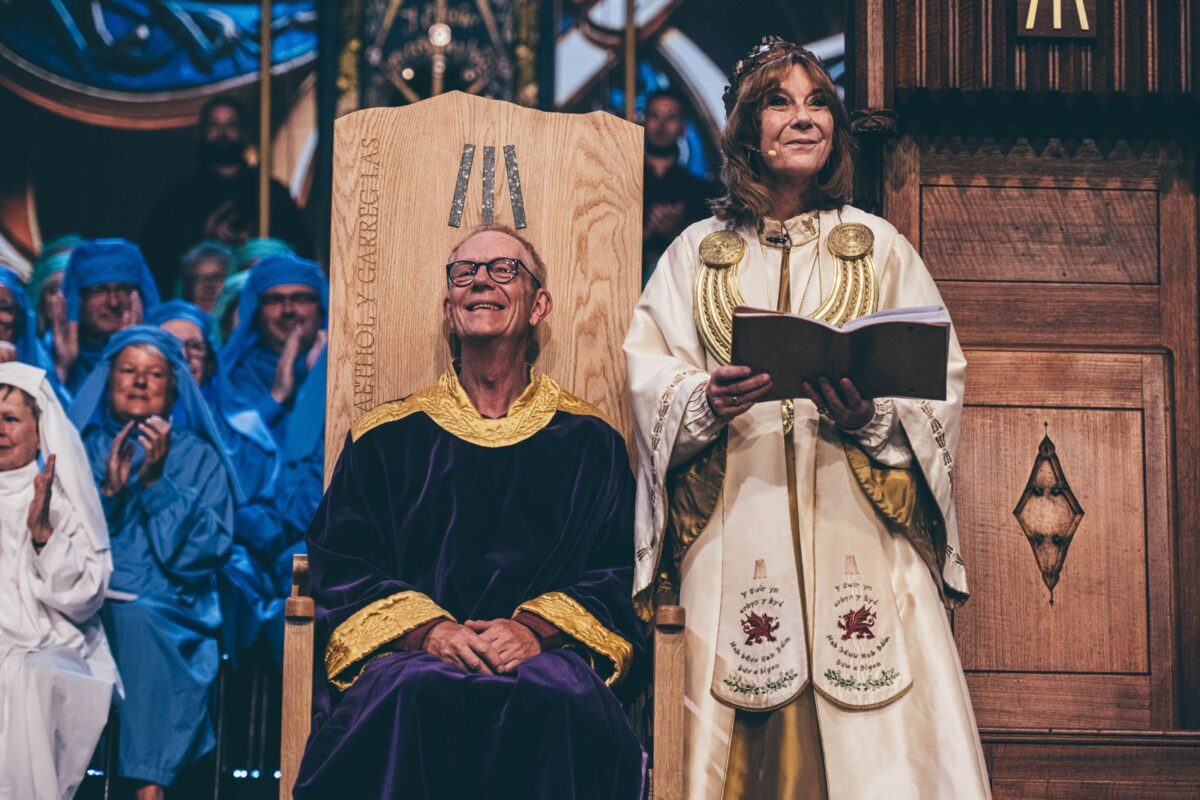
Poet Emyr Lewis has won the Chair at Eisteddfod y Garreg Las after judges praised an outstanding competition that attracted its highest number of entries in almost 40 years.
This is the second time Emyr has received the award, following his success at the 1994 Neath and District National Eisteddfod. He also won the Crown at the 1998 Bro Ogwr Eisteddfod.
This year’s Chair was awarded for an awdl (a long-form poem in strict metre) or a collection of poems in full cynghanedd, using more than one traditional metre and up to 250 lines, on the theme ‘Llinell | Llinellau’ (Line | Lines).
The Chair was presented by the Pembrokeshire Coast National Park Authority, while the monetary prize was donated by Geraint and Siân James of Siop Awen Teifi, Cardigan. The ceremony was supported by the Pembrokeshire Agricultural Society.
Presenting the adjudication on behalf of his fellow judges Mererid Hopwood and Carwyn Eckley, adjudicator Idris Reynolds said: “Sixteen entries were received, the highest number since the Newport National Eisteddfod in 1988. Line or Lines was an excellent subject and gave poets the freedom to go wherever they wished.”
Two awdlau rose to the top in this year’s competition, and the judges said: “Without doubt, Pwll y Wrach has produced a masterly awdl. It spans eight centuries of our poetic tradition and is rooted in this region. From the summit of Mwnt, near the mouth of the River Teifi, the poet sees the lines of the receding tide in the sand.
“But a sudden veil descends over the land, and through the mist the poet catches sight of Lord Rhys and his retinue arriving at Cardigan Castle to hold the first eisteddfod eight and a half centuries ago. As the mist clears, the farmhouse of Cilie comes into view, where literary brothers such as Alun, Isfoel and John Tydu play their part in the procession of tradition.
“There are key figures such as Dic and T. Llew, and there too is Waldo delivering his lecture beside the kiln at Cwmtydu. The cynghanedd is exhilarating, and this poet can construct a couplet, an englyn, or a stanza of a cywydd around a single word.
“This is an awdl that will resonate in these parts and throughout Wales. But its misfortune was to come face to face with an awdl that shone in its originality.
“That awdl belongs to A. This is a riot of an awdl, bringing astonishing novelty to the Chair competition. It leads the eisteddfodic awdl into places it has never gone before, plunging into the absurd depths of the subconscious. It is a train journey through the nightmares of the night beneath the curve of an uneven, fickle moon.
“But this is a strange train. There is no other passenger on it, nor a fireman, driver, or guard.
“In fact, it remains stationary; it is the night that moves around it. It is a terrifying journey because there is a flock of birds on the line, ‘some two times, three fifteens plus eighty-seven’ of them. They wear stickers bearing their dreadful names such as Mastrwni, Mwgi Mekk, Fathadawra and Derekk, with two ‘k’s, incidentally.
“The whole thing is encapsulated in the excellent line: ‘Birds that are not birds.’ The birds utterly confuse him as they prey upon his uncertainty.
“To escape, he gets off the train, but things only worsen as he arrives at what the poet describes as ‘a great dreadful stone house, a marble mansion.’ Its owner recognises him, and the mockery and finger-pointing are worse still.
“But salvation comes through the light touch of his companion and her gentle ‘Good morning.’ The journey is over, the nightmare is over, and the moon has disappeared. And the conclusion is rich in ambiguity: ‘It is tomorrow. It is sorrow.’
“Thank you to A for an exhilarating and tender awdl. It is the greatest privilege to agree with my fellow judges that this year’s Chair belongs to A, in a competition the like of which we haven’t seen, I believe, seen since the Cardigan Eisteddfod in 1976. Let A be chaired.”
Born in London, Emyr Lewis moved to Cardiff with his family at six years old. He attended Ysgol Gymraeg Llundain (which his father helped to found), Bryn-taf Primary School and Rhydfelen Comprehensive School.
At Rhydfelen, his interest in composing cynghanedd was sparked by his Welsh teacher, Nia Daniel (now Royles), and his craft was further developed under the guidance of the englyn poet T Arfon Williams.
Emyr holds a degree in English from the University of Cambridge and a law degree from University College of Wales, Aberystwyth.
He worked as a lawyer until 2019, when he was appointed Head of the Department of Law and Criminology at Aberystwyth University, where he is now Professor Emeritus.
Before that, he also worked at the Wales Governance Centre, Cardiff University, and served on a Council of Europe committee that monitors how countries treat minority languages.
He was also a regular member of the Morgannwg Ymryson team and has adjudicated the Englyn y Dydd competition at the Ymryson for the past four years.
Now living in Craig-cefn-parc, Emyr has published three poetry collections: Chwarae Mig, Amser Amherffaith/Dysgu Deud Celwydd yn Tsiec, and twt lol.
Chair
The local history and culture inspired designer and craftsperson, Tomos Lewis of Efailwen, when he came to create this year’s Eisteddfod Chair.
The timber used came from land within the Pembrokeshire Coast National Park, and materials for the cushion and the Nod Cyfrin were sourced from within the Eisteddfod catchment area.
The front of the Chair was inspired by the chair of Lord Rhys, which can be seen at Cardigan Castle, with the numerals 2026 arranged in the same strong square formation as the numerals 1176.
The back of the Chair is constructed from three pieces of wood representing the counties of Pembrokeshire, Ceredigion and Carmarthenshire, which together form the Garreg Las area.
An outline of Foel Cwmcerwyn, the highest peak in the Preseli Hills, appears at the top of the Chair, while its sides echo the gates associated with the Rebecca Riots, the agricultural heritage of the three counties, and the gates found along the Pembrokeshire Coast Path.
On the back is the outline of a bridge, symbolising connections between the three counties and the bridge at Cardigan.
The Nod Cyfrin was made from pieces of Preseli bluestone, and the seat is covered with a unique ‘Garreg Las’ tapestry specially created for the Eisteddfod at Melin Tregwynt near Fishguard.
The Cyfansoddiadau a Beirniadaethau, which contains the full adjudication of this competition together with details of all the Eisteddfod’s literary competition winners, will be available to buy following the ceremony.
Eisteddfod y Garreg Las runs until 8 August. More information is available on the festival’s site here.
Support our Nation today
For the price of a cup of coffee a month you can help us create an independent, not-for-profit, national news service for the people of Wales, by the people of Wales.
Get more trusted Welsh news
Choose Nation.Cymru as a preferred source in Google News to see more of our journalism.




Anhygoel!