


Everything we know about major parking changes in Cardiff
Ted Peskett, local democracy reporter
Huge changes to parking will come into force in Cardiff after the local council approved plans for new surcharges and rules for drivers in the city.
Cardiff Council’s city parking plan, approved by cabinet members at a meeting on Thursday, October 16, was brought in largely to reduce commuter parking.
However, it also aims to reduce congestion and encourage people to use more sustainable modes of transport.
Key elements of the plan include bringing in a premium for drivers who want a parking permit for larger vehicles, like SUVs, and splitting Cardiff into different parking zones.
Here is what we know about the changes that are coming in and some of the questions that are still unanswered.
The cost of new surcharges and what cars will be affected
Cardiff Council will bring in a surcharge for vehicles that have a revenue weight of more than 2,400kg in the hope of encouraging drivers to switch to smaller modes of transport.
‘Revenue weight’ refers to the gross weight of a vehicle.
That is the weight of a vehicle when it is loaded to its maximum capacity with passengers, luggage, fuel, and other fluids.
You can find out if your car will be affected by checking its revenue weight on the DVLA’s website.
The council said the surcharge will eventually be reduced 2,000kg for non-electric cars vehicles.
Very large vehicles that are over 3,500kg in revenue weight will not be entitled to parking permits.
The council said it’s move on surcharges is also about road safety, adding in a recent report that larger vehicles pose more of a danger to pedestrians.
Cardiff Council hasn’t said exactly how much the surcharge will be, but there have been indications it is considering doubling the cost of a £35 annual permit for heavy vehicles.
Diesel vehicles will also be affected by a surcharge with Cardiff Council saying these release more health-damaging nitrogen oxides and particulate matter than petrol vehicles.
Vehicles which are Real Driving Emissions 2 (RDE2) compliant will be exempt from this surcharge as they are seen to produce significantly fewer harmful pollutants.
New parking zones and how they’ll work under the new scheme
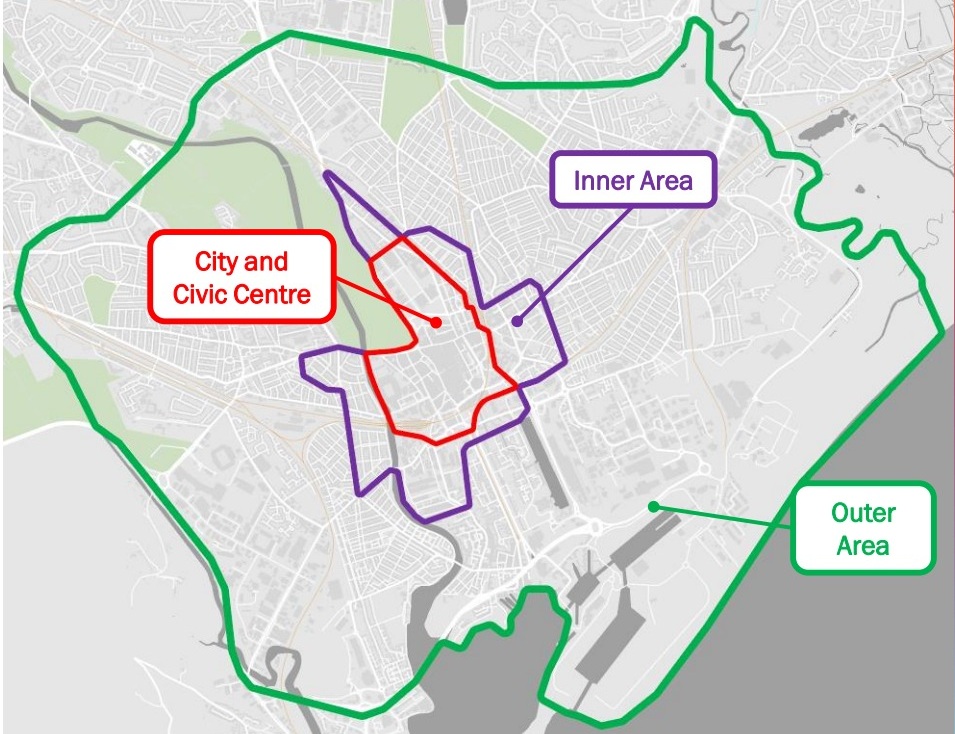
Cardiff will be split into three parking management areas (PMAs) and each of these will be subdivided into controlled parking zones (CPZs).
The three PMAs will be the city and civic centre area, the inner area, and the outer area.
The CPZs are zones where on street parking is controlled during certain times.
Cardiff Council said the whole of the city and civic centre area will be a CPZ with parking controls in place all day, every day.
However, there will still be long stay and short stay parking available in this location.
The inner area will be split up into smaller CPZs.
Zones here will continue to include permit bays, pay and stay bays and some small areas for limited waiting.
Parking in the outer area will mainly be a mix of permit holder only bays, short stay shared use pay and stay bays, and short stay shared use milited waiting bays.
A public consultation will be carried out before any CPZ is introduced and the council insisted that zones will not progress where there is no public support.
The exact days and times of parking zones will be determined through the consultation process.
A council report shows proposals for parking restriction times in parking zones will likely follow a standard framework.
The proposals will likely include a daytime scheme, operating from 8am to 6.30pm; a daytime and evening scheme, operating from 8am to 8.30pm; and a daytime and late evening scheme, operating from 8am to 10pm.
New parking permits and how much they could cost
There will be changes to residential parking permits in the new PMAs, but the charge for residential parking permits that was increased this year will remain the same.
Residential parking permit charges will be reviewed every two years.
As well as improving parking across the city more generally, the council said it wants to prioritise certain groups under its new plan, like blue badge holders and carers.
Community permits, educational permits, and essential user permits will be available for community groups, school staff, and carers.
We still don’t know exactly how much the council will charge for these permits, but a Cardiff Council report referenced other local authority areas that have a similar scheme.
The report states that Brighton and Hove and Bristol charge £158.60 and £159-£200 per year for teacher permits respectively.
Under the council’s parking plan, the local authority is also proposing to issue personal carer permits and tradesperson permits.
Motorcycle riders are currently exempt from the requirement to obtain a residential parking permit, but they will need one when the new scheme is rolled out.
When will the new parking plan be rolled out?
The new parking plan won’t come in straight away. Instead, the council is proposing to phase it in over a period of 10 years.
Cardiff Council anticipates the introduction of new permits and surcharges to take place over the next three years.
However, a review of existing permits, including charging bands and structures, is expected to take place over a longer period of about six to 10 years.
We’re yet to find out exactly when new CPZs could be brought in, but the council said the first phase of rolling them out will happen over the next three years.
The first phase will focus on areas adjacent to the city centre and existing zones where the where there are already parking problems.
Priority areas for the council include areas where there is a high density of housing, like Adamsdown, Riverside, Cathays, Plasnewydd, and Grangetown.
The full implementation of CPZs in the outer parking area of the city is expected to take between six and 10 years.
The cost of implementing the plan and what the money will go towards
Although the exact cost of implementing the whole parking plan isn’t known yet, the council has grouped each element of the scheme into three main cost categories.
The roll out of permits for community groups, teachers, carers and tradespersons are all categorized as ‘low’, meaning it’s not expected to cost more than £25,000.
Undertaking a review to see where additional parking spaces for blue badge holders and priority users can be accommodated and to carry out any necessary Traffic Regulation Order (TRO) processes is expected to cost anything between £25,000 and £99,000.
Implementing all the phases for the parking zones programme is one of the most expensive elements of the parking plan.
These are in the ‘high’ cost category, meaning it’s expected to cost more than £100,000.
Cardiff Council said some of the funding for the parking plan could come from money left over from parking enforcement charges and some could come from developers, via planning contributions known as section 106 contributions, and grants.
A financial plan will be developed before implementing each zone.
Revenue generated from elements of the scheme, like the surcharges, will also be used to help fund the parking plan.
Any surplus income from the scheme will be set aside and re-invested in improving transport across Cardiff.
Support our Nation today
For the price of a cup of coffee a month you can help us create an independent, not-for-profit, national news service for the people of Wales, by the people of Wales.



Students that commute are no longer going to bother coming to Cardiff then. It’s hard enough to get a space on the campus as is, and many have to park quite the distance and walk in. This goes for CU and CMU.
I think Cardiff Council should think about introducing more Park and Ride schemes before touching CPZs, but of course, it’ll be more profitable to bring in the CPZs first.
Cardiff Council like others around the country say its all about safety, pollution and the environment but its really about ripping off the motorist , how would the council raise extra revenue without ripping off the motorist?
By increasing ctax. Is that your preference?
And CCC will not enforce there rules, we have problem parking in our area just outside the city zone and people park for days on end in a two hour parking zones, parking in disabled zones and not displaying the cards, permit only zones with no permit, and it’s usually people that work for Cardiff city Council
Anyone who parks inappropriately is asking to make a generous donation to the local community and they should be supported to do that.
Easy to see where the likes of ReformUK can pitch themselves to take over the council:
A) ditch this plan
B) scrap the existing cycle highways
C) Revert all trunk roads to 30mph.
I suspect that will get them close to a majority on the council .