

Family share their hopes to find cure for baby’s rare life-threatening condition

Gosia Buzzanca
The parents of a seven month old baby have shared their hopes at finding cure for an ultra-rare, life-threatening neurological condition called Alternating Hemiplegia of Childhood (AHC).
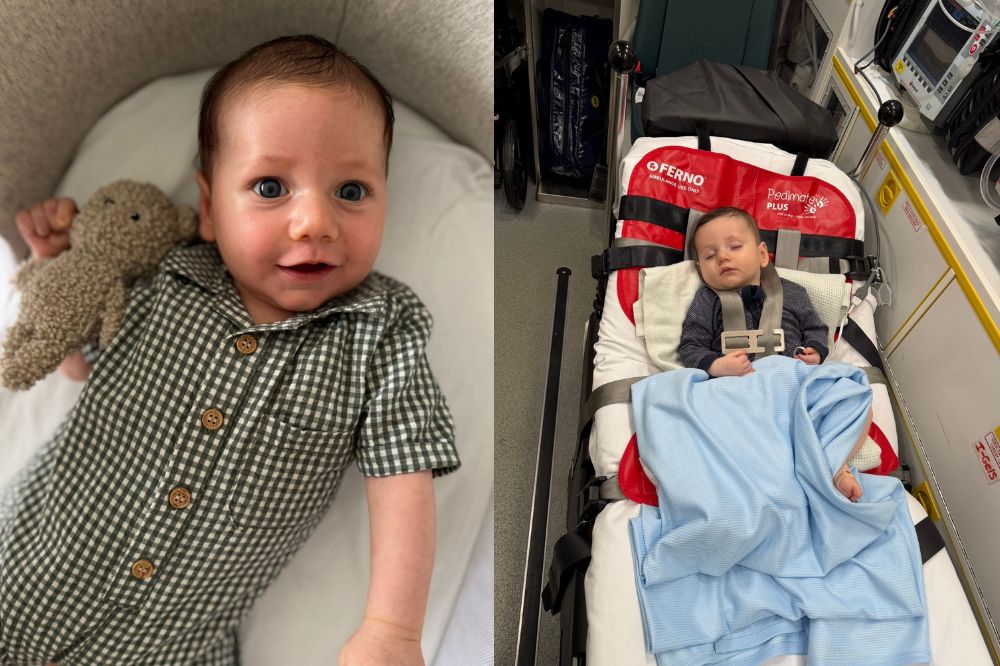
From just a few weeks old, Rupert from Broughton, Flintshire, who his parents describe as a ‘beautiful, happy, smiley little boy’ began experiencing seizure-like episodes, resulting in multiple hospital admissions and countless appointments.
Alongside this, he has shown developmental concerns, including low muscle tone, meaning he struggles to lift his head. He is currently under the care of several specialist teams, including neurology, respiratory, physiotherapy, dietetics, and speech and language therapy.
Rupert has undergone extensive investigations, including lumbar punctures, EEGs, ECGs, MRI and CT scans. His care is being managed across both Wrexham Maelor Hospital and Alder Hey Children’s Hospital.
AHC is an extremely rare genetic disorder, affecting approximately 1 in 1 million children. It is often described by specialists as a “time bomb” due to its unpredictable and potentially life-threatening nature.
It is characterised by unpredictable episodes of paralysis, seizures, abnormal movements, breathing difficulties, and developmental delay. AHC shares features with multiple neurological disorders, including stroke, cerebral palsy, epilepsy, Alzheimer’s, Parkinson’s, and autism.
There is currently no cure for AHC, and symptoms vary greatly in both frequency and severity. Episodes can be triggered by excitement, extreme heat or cold, fever, food, lighting changes, physical exertion, stress, and water exposure.
These episodes can last minutes, hours, or even days, and may occur without warning. Importantly, AHC carries a significantly increased risk of serious medical emergencies and sudden death, particularly during severe episodes involving breathing or cardiac complications.
At present, there remains enormous uncertainty surrounding Rupert’s future.
“Rupert, is a beautiful, happy, smiley little boy who greets the world with nothing but love,” his dad David shared.
“He is completely unaware of the difficult journey that lies ahead of him. In just seven short months, he has already endured more than most people will face in a lifetime.
Despite everything, he continues to smile, and that smile is what gives us the strength to keep fighting for him every single day,” David continued.
David Smith, a police sergeant in Broughton, has hit headlines for raising huge sums of money for charity throughout his life, having previously founded Wrexham Police FC, a charity football team that raised money for local causes.
In 2024 Dave was awarded the British Empire Medal for his services to community and charity.
“I never imagined I would one day be asking for help for my own child,” he said.
The family is trying to raise funds to prepare for a necessary treatment abroad and to financially contribute to ongoing research into Alternating Hemiplegia of Childhood.
Because AHC is so rare, research is severely underfunded and progresses far more slowly than for more common conditions. Without continued financial support, this research cannot advance at the pace required to save children’s lives.
For ultra rare neurological conditions like AHC, emerging treatments and clinical trials are often extremely expensive, frequently running into millions of pounds. These costs include treatment itself, specialist consultations, international travel, accommodation, and medical care not covered by public funding.
Dave added: “We are incredibly grateful to the NHS and the outstanding medical teams who have cared for Rupert. They have done absolutely everything possible to investigate his condition, stabilise him, and provide ongoing specialist support. However, due to the rarity and complexity of AHC, there is currently no curative treatment available within the NHS.
“Care is limited to managing symptoms and responding to medical emergencies as they arise. The only potential for a cure lies in ongoing research and clinical developments in the United States, which require significant private funding.
“We are fundraising now so that we are financially prepared to act immediately if and when treatment, trials, or life-saving interventions become accessible.
“For rare conditions like AHC, opportunities can arise suddenly, and delays can mean missed chances. Being prepared could make a critical difference to Rupert’s future.”
Find out more about Alternating Hemiplegia of Childhood and help the family’s fundraiser here.
Support our Nation today
For the price of a cup of coffee a month you can help us create an independent, not-for-profit, national news service for the people of Wales, by the people of Wales.


