


Father-of-two backs HPV vaccine after cancer battle
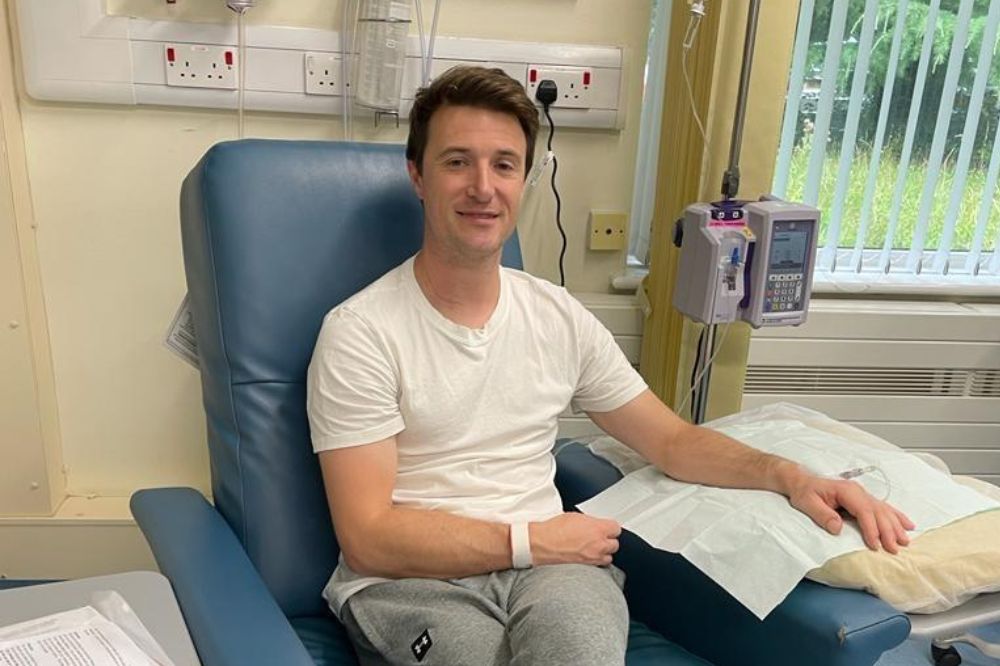
A father of two young children who survived a form of HPV is encouraging all parents and children to make the most of the cancer-preventing vaccine offered through schools.
Dad-of-two Anthony Perriam had just returned from a family holiday in March 2023 when he noticed a small, hard lump under the right side of his jaw.
While there was no pain, no sore throat, and no other symptoms, he decided to visit his GP just to be on the safe side.
“Because it didn’t hurt, I didn’t think it was serious,” recalled Anthony, from Whitchurch, Cardiff. “I even debated whether it was worth going to the doctor. Looking back, that delay could have cost me my life.”
After the GP appointment, Anthony was referred onto the NHS head and neck cancer pathway and sent for an ultrasound.
Although he was initially reassured, the speed and thoroughness of the follow-up appointments raised concerns.
Within weeks, he underwent a biopsy and CT scan at the University Hospital of Wales (UHW), followed by an MRI which fell on his 39th birthday.
Shortly afterwards, he was called back into hospital and given the heart-breaking diagnosis.
“They told me the biopsy had come back and it was cancer,” he said. “I had a three-year-old and a six-year-old at the time. My first thought wasn’t about me – it was about them. I was completely petrified for them.”
Doctors confirmed the cancer was present in a lymph node but could not initially locate the primary tumour. Further testing revealed it was HPV-related head and neck cancer, a form of the disease that is often highly treatable when detected early.
“I’d only ever heard of HPV in relation to cervical cancer,” he said. “I had no idea it could cause cancers like this, especially in men.”
Using UHW’s pioneering Da Vinci robot, surgeons were eventually able to locate the cancer at the base of his tongue, close to where his tonsils had been removed years earlier. During the operation, surgeons also removed 44 lymph nodes from his neck.
“They told me they caught it just in time,” Anthony, now 41, added. “One of the lymph nodes was on the verge of rupturing. If it had gone any further, it could have spread.”
Following surgery, Anthony spent over a week in UHW and then underwent six weeks of radiotherapy and chemotherapy in Velindre Cancer Centre in Cardiff to ensure all the cancer was removed.
“At that point, you don’t care what the treatment does to you,” he said. “You’re just focused on surviving. But in my opinion, the surgery was a walk in the park compared to the radiotherapy and chemotherapy.
“The radiotherapy doesn’t hurt, but after every session you have it makes you feel worse. I was very sick, and I dropped weight very quickly. When I started my treatment, I was around 72 kilos (around 11st 4lbs) and I ended up around 50 kilos (7st 12lbs).
“All of my saliva disappeared. Even drinking was difficult as everything turned to powder in my mouth. I was so weak that I eventually needed a wheelchair. Being wheeled down the corridor and into radiotherapy was starting to affect my mental health.
“But my family gave me the motivation to get through it – and I wanted to live to see my 40th birthday.”
While the treatment left lasting side effects – including nerve damage, muscle loss, and temporary loss of taste – he is now in long-term follow-up care.
He decided to share his story to encourage others not to ignore unexplained symptoms and to raise awareness of HPV-related cancers.
“If you find a lump, even if it doesn’t hurt, get it checked,” he said. “This kind of cancer isn’t talked about enough, especially among men. Early action really does save lives.”
HPV (human papillomavirus) is the name given to a very common group of viruses that are passed on through skin-to-skin contact and are usually found on the fingers, hands, mouth and genitals.
Most people who become infected with HPV will clear the virus from their body and won’t become unwell. But for some it can cause genital warts or even develop into some types of cancer including head and neck cancer (most common in men) and cervical cancer in women.
However, the HPV vaccine has proved very effective. Since it was introduced in 2008, it has reduced cervical cancer rates by almost 90% in women in their 20s.
Every year, Cardiff and Vale UHB’s School Nursing Immunisation Team visits schools across the region to administer the HPV vaccine to Year 8s, along with those in Year 9, 10 and 11 who missed it in Year 8.
Sandeep Berry, Consultant Otolaryngologist head and neck surgeon at Cardiff and Vale UHB, said: “The HPV vaccine has been used worldwide for years, it’s safe and effective and is part of the national immunisation programme in Wales. It helps boys and girls stay healthy, prevents HPV-related cancer and strengthens public health overall.
“The vaccine is given in Year 8 as it’s when the immune system responds most strongly – and before sexual activity begins. I would sincerely encourage you to ensure that your children get the HPV vaccine when it is offered in school.”
Anthony concluded: “It’s fantastic that the HPV vaccine is now offered to all secondary school children. It works for girls, it works for boys, and I’ll certainly be making sure that my son Maximillian, who is nine soon to be 10, will be having it.
“I consider myself lucky that I can still eat and talk, but if I’d left it much later, I could have lost my tongue or even died. The HPV vaccine can help prevent the kind of suffering that me and my family endured.”
For more information on the HPV vaccine programme in schools please visit the Cardiff and Vale UHB website.
Support our Nation today
For the price of a cup of coffee a month you can help us create an independent, not-for-profit, national news service for the people of Wales, by the people of Wales.


