


Firefighters tackle multiple wildfires as record heat grips Europe
Angela Charlton and Sylvia Hui, Associated Press
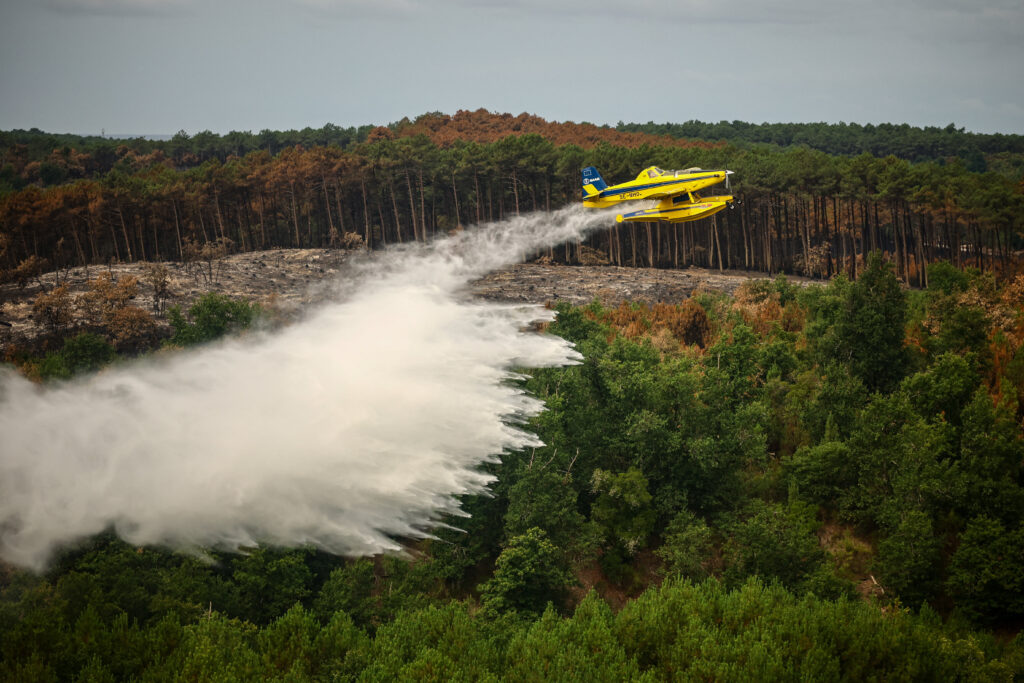
Firefighters across Europe struggled against multiple fires as a new wave of record-breaking heat baked a swathe of the continent, their task further complicated by exceptionally parched landscapes.
With France experiencing its driest year ever, a new fire raced through woodlands overnight in the Landes region on the south-west coast.
The blaze forced more than 500 people to evacuate their homes in the town of Luglon as hundreds of firefighters deployed to the area, the regional administration said on Friday.
It is one of several fires scorching forests around France this week, including in normally cooler and wetter regions in the north and Brittany.
A historic fire devoured forests near Bordeaux last month and pushed a quarter of a million people from their homes.
France has also shut down six nuclear reactors in recent days because of extreme heat and drought – and because a mass of jellyfish washed up outside one power plant on the English Channel coast, utility company EDF said.
Large numbers of jellyfish are appearing on many French beaches in connection with unusually warm sea temperatures.
Water used to cool some French nuclear reactors is drawn from nearby rivers, and then discharged back at a slightly higher temperature.
France is experiencing its driest-ever year and had its hottest-ever June and July, so river levels are low and river waters are warmer than usual.
Plant operators are obliged to halt activity if the river temperatures get too high, according to EDF.
In a statement, the company said the shutdowns had minimal impact on France’s electricity production.
It said extreme weather poses no safety risks to the reactors themselves, and that the measures were taken ″to protect flora and fauna”.
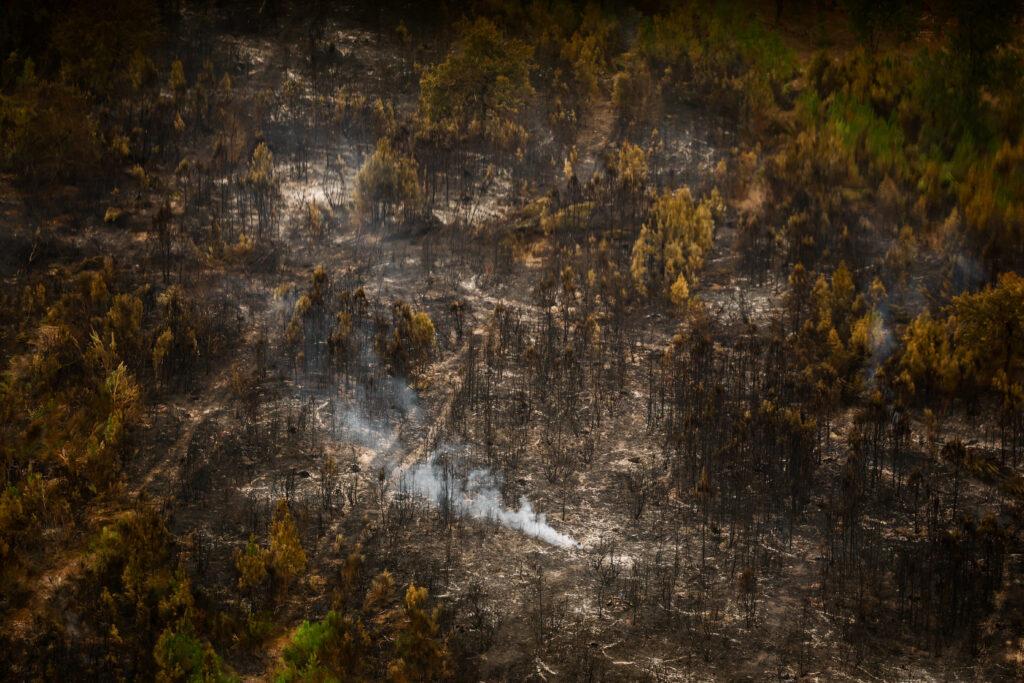
Meanwhile, efforts to contain a wildfire in Germany were complicated by unexploded Second World War munitions, and shifting winds in Croatia spread flames deeper into a coastal suburb and forced more than 1,000 people to flee.
In France, temperatures on Thursday approached 41C in several areas, from Aquitaine in the south west to the Rhone River valley in the east, according to the national weather service.
They were forecast to reach similar levels on Friday before dropping over the weekend.
The historic temperatures are linked to human-caused climate change, and are hitting countries more designed for long cold seasons and ill-equipped for this sort of heat, with limited air conditioning.
All 1,800 residents of the village of Gey in Germany’s North Rhine-Westphalia state were evacuated after a wildfire in the nearby Hurtgen forest threatened to reach their homes.
Nearly 300 hectares (1.16 square miles) of forest were ablaze on Friday morning, local authorities said.
Unexploded ordnance from the Second World War in the forest hampered firefighting efforts, German news agency dpa reported.
Explosions could be heard as the munitions detonated during the fire, forcing firefighters to stay out of the area for safety.
The fire advanced to within 300 metres (1,000ft) of Gey, which sits on the edge of the forest near the Belgian border.
Overnight a shift in wind direction raised the risk that the flames could reach Gey by morning, prompting officials to order the initial evacuation.
The cause of the blaze remains unknown, and authorities have not ruled out further evacuations in the area.
Hundreds of personnel have been deployed to battle the fire, with the German army sending tanks and firefighting helicopters providing air support.
In Croatia, 14 people were admitted to hospital, of whom seven remained in life-threatening condition early on Friday from a fire that raged overnight by the coastal town of Omis and forced more than 1,000 people to evacuate their homes.
The fire erupted late on Thursday in an Omis suburb and quickly spread because of strong wind.
Public broadcaster HRT said the blaze came close to the town’s centre, and parts of Omis were left without electricity while many cars were burned.
Croatian media published photos from a crowded sports hall in Omis where people crammed on beds and on the floor.
Witnesses told HRT that people were jumping into the sea after boats also caught fire.
Firefighters put out the blaze by Friday morning as other crews in planes headed further south towards the Peljesac peninsula where another wildfire broke out overnight.
Albania has been battling dozens of wildfires in recent weeks, with 11 active fires reported across the country on Friday.
The largest fire is in the Gure-Lure area, where the perimeter near residential homes has been brought under control, eliminating the risk of the flames spreading to the houses.
Three people have been prosecuted over the fire that engulfed Lura National Park.
They are suspected of failing to take the necessary measures to protect and safeguard the territory under their responsibility from fire, authorities said.
Meanwhile, in northern Greece, more than 300 tourists and residents were evacuated by sea on Thursday after a wildfire swept through a pine forest and threatened seaside homes, authorities said.
After marking its hottest August 13 on record, with a high of 32.6C on Thursday, Belgium was expecting to hit its highest temperature of the summer on Friday, climbing to 37C in the capital Brussels.
Belgium is going through its third heatwave of the summer and fears about a severe drought have been high, with some water restrictions in place in certain towns, although rain was forecast for Saturday.
The temperature was also set to hit 37C in the neighbouring Netherlands.
The country is suffering from severe drought, with water shortages in some areas, but Dutch authorities have held off declaring a water crisis as rain is expected in the coming days.
Support our Nation today
For the price of a cup of coffee a month you can help us create an independent, not-for-profit, national news service for the people of Wales, by the people of Wales.
Get more trusted Welsh news
Choose Nation.Cymru as a preferred source in Google News to see more of our journalism.



Reform and Conservative want to ditch net zero, funny how semi has stopped people standing that accept it needs doing but recruits a nazi.
Not doing Net Zero will make this far worse. Until we get to net zero it keeps getting worse. And I am concerned labour are about to make it worse by watering down whilst the UK starts to burn.
If the thieving Tories had bought a flight of them, people’s houses would still be standing. If Clark and Ed Miliband had taken their jobs seriously they might have looked at the rest of the world and thought about it…between them all they have completely failed us, robbed us, poisoned us and starved us and the country thinks Farage gives a monkey’s…