


First ministers to hold talks in Cardiff over future of UK
Nation.Cymru staff/agencies
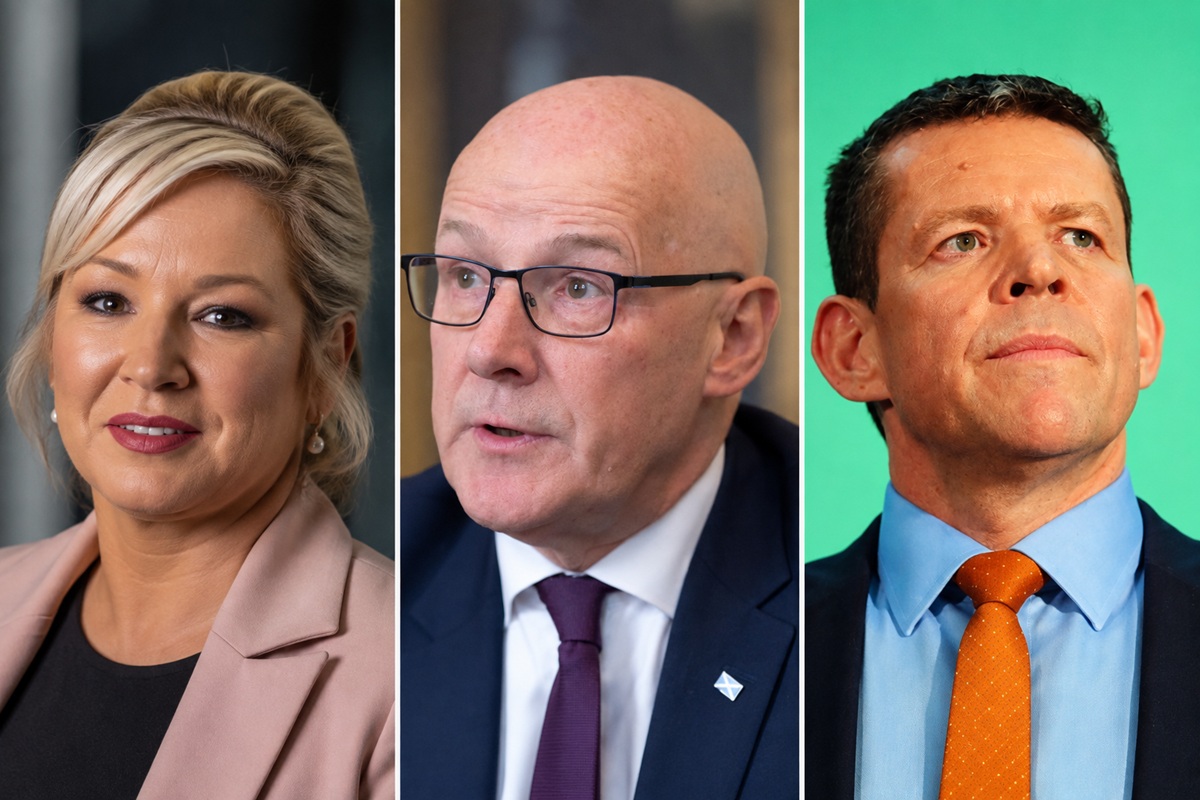
The leaders of Wales, Scotland and Northern Ireland are to meet in Cardiff to discuss independence and the future of the UK.
First Minister Rhun ap Iorwerth will hold talks with Scotland’s John Swinney and Northern Ireland First Minister Michelle O’Neill on Monday, with all three now leading governments headed by parties that support leaving the UK.
The three will meet in their capacities as leaders of Plaid Cymru, the SNP and Sinn Féin rather than as first ministers.
Mr Swinney said ahead of the talks that the “momentum behind serious constitutional change is undeniable” and claimed Westminster should prepare for a “post-UK future”.
His visit comes just days after a new poll found almost a third of likely voters in Wales would back independence, while recent polling in Scotland has put support for leaving the UK narrowly ahead.
A Survation poll for YesCymru, carried out between August 13 and 24, found 32% of likely referendum voters in Wales would vote Yes and 68% No when undecided and refused respondents were removed.
Support was substantially higher among younger people, with majorities for independence among each of the three age groups below 45.
A separate Survation poll of 2,036 Scottish voters, conducted during the same period for the Diffley Partnership, put Yes on 47% and No on 43%, with 9% undecided.
Removing those who did not express a preference produced a 52%-48% lead for independence.
Polling in Northern Ireland, however, suggests support for Irish reunification remains short of a majority. A survey of 1,534 voters carried out in May found 35.8% would vote for a united Ireland if asked tomorrow, against 49.7% who would not.
With those who did not express a Yes or No preference removed, that equates to roughly 42% in favour of reunification and 58% against.
Reignited
The constitutional debate has also been brought back into focus by comments from Prime Minister Andy Burnham, who appeared this week to leave open the possibility of another Scottish independence referendum if public opinion shifted decisively in favour of one.
Asked in the House of Commons about the circumstances in which another vote could take place, Mr Burnham said: “I am not aware that there is majority public support for another referendum, and until that changes, there will not be one.”
Downing Street subsequently insisted the remarks did not represent a change in UK Government policy.
In a letter to Mr Swinney on Thursday, the Prime Minister said there was currently “no consensus for an independence referendum in Scotland” and reiterated that another vote remained “off limits”.
Mr Swinney nevertheless seized on the original remarks as an acknowledgement of the principle that a referendum could be held if sufficient public support developed.
Speaking ahead of Monday’s Cardiff meeting, he said: “Every nation across these islands is standing at a moment of incredible constitutional opportunity.
“There is a growing consensus that the Westminster system simply is not fit for purpose and does not work for ordinary people.
“Prime Minister Andy Burnham has accepted that himself – and the people of Scotland, Wales and Northern Ireland have made it clear at the ballot box.
“For the first time ever, Scotland, Wales and Northern Ireland are led by pro-independence first ministers.
“There could be no clearer sign that the status quo is not sustainable – and that Westminster must prepare for a post-UK future.”
Mr Swinney added: “Crucially, for the first time since 2014, there is a British Prime Minister who has publicly accepted the democratic principle of self-determination.
“The momentum behind serious constitutional change is undeniable.
“Andy Burnham must now be facing up to the idea that he will go down in history as the final Prime Minister of the United Kingdom.
“Tomorrow in Cardiff, I am looking forward to discussing a better future with partners from across these islands – and that only comes with the fresh start of independence.”
Building confidence
Mr ap Iorwerth became Wales’ first pro-independence First Minister following Plaid Cymru’s victory in May’s Senedd election.
Soon after taking office, he confirmed that he had raised Welsh independence during his first conversation with then-prime minister Sir Keir Starmer.
Mr ap Iorwerth has previously said he wants to lead a “national conversation” aimed at building confidence in Wales’ ability to become independent.
He told the Senedd in May: “I have a level of ambition for my nation, where I said that I want to lead a national conversation creating that confidence in our ability, undoubtedly, to be an independent nation like so many countries like ours.
“We deal with the issues that we deal with now, and we set a journey that the people of Wales will ultimately have to decide on the trajectory and the pace of.”
National Commission
Plaid has ruled out seeking an independence referendum during its first term in government but has pledged to establish a national commission that would look at building the case for Wales becoming an independent state.
The latest Welsh polling suggests independence remains some distance from majority support, although it also points to a pronounced generational divide.
Among likely referendum voters aged 18 to 24, 59% said they would vote Yes, with support at 54% among 25 to 34-year-olds and 57% among those aged 35 to 44.
Support fell to 27% among both 45 to 54-year-olds and 55 to 64-year-olds, and to 15% among those aged 65 and over.
Support our Nation today
For the price of a cup of coffee a month you can help us create an independent, not-for-profit, national news service for the people of Wales, by the people of Wales.
Get more trusted Welsh news
Choose Nation.Cymru as a preferred source in Google News to see more of our journalism.



Diddorol iawn! Particularly when you learn that there estimated 30–35% of all voters over in Wales were born in England! This doesn’t necessarily meant they all are anti independence of course. I have many friends & acquaintances who are English & strongly support independence but it does reveal the influence of colonists? English-born residents are OVER-represented in the 65+ age group because migration from England to Wales has historically been heavily driven by retirement relocation, especially to coastal and rural areas. There are also big Regional Variations which is key for Elections. In mid-Wales and the north coast, English-born people… Read more »
They have no lesser say in our democracy.
In any case, the anti independence feeling in over 65s is far less influenced by English incomers than it is from people who are worried about who will pay their pensions
Pensions will be paid by the organisation that collected the contributions.
Just as it is for those english migrants that choose to live in other countries, the uk taxpayer is still picking up their tab.
What contributions? State pensions are not paid out of defined contributions otherwise it would not have been possible to introduce the system because the first beneficiaries had made no contributions. Pensions are financed by the current working population through NI. Cymru would be responsible not Westminster.
The appetite for the UK just isn’t there anymore. The British empire has come to its own natural end, like every empire does, and the last monarch anyone had time for has passed away.
Independence is normal.
If Cymru, Northern Ireland and Scotland gain independence let’s hope that our leaders will secure a fair share of the UK’s treasures mostly located in England. However, England can see what might develop and may be already stashing away national treasures for such an event!!
And our fair share of the massive UK debt of course.
. . . and who do you think got us into such a debt? Let me think, oh, I know ….
I,d be very surprised if Cymru,s fair share of current UK public assets didn,t significantly outweigh Cymru,s fair share of current UK debt.
Many billions due as a ‘golden handshake’ if we,re really going to go all pounds (shillings) and pence over it
Could it not be forgiven as a repatriation payment?
It seems fair that they should at least pay for the damage they’ve done, but I suppose that depends if they have the integrity to do that.
I don’t think Burnham will be the last prime minister of the UK. Total break-up will probably not happen during his tenure but it will happen and probably within the next 15 years. All three Celtic nations need to strengthen their bases over the next few years. Here in Cymru it’s showing evidence to the under 40s that independence is a worthwhile thing to vote for, keeping that demographic onside.
Isn’t it interesting that I can’t find any news articles on this apart from nation.cymru and some Indian news channel on YouTube, goes to show you that the momentum is strong enough that they’re scared to talk about it because it’s inevitable.
If the ones that control the media are silent, it means the right steps are being taken.