


Fish use more energy to stay still than originally thought – new research
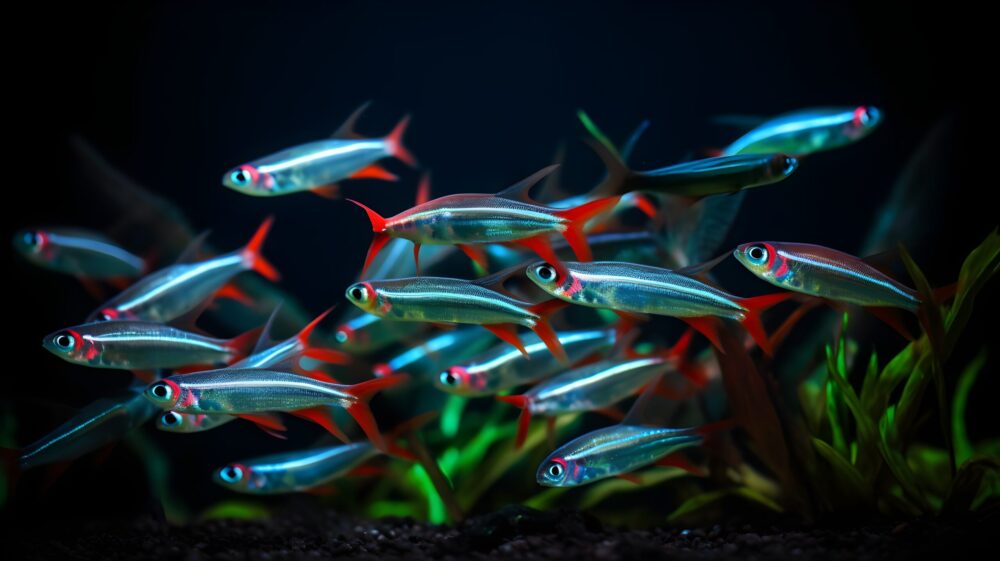
New research has found that fish that stay still in water use much more energy than originally thought.
Being able to stay still in the water is an essential skill for fish as it helps them to keep an eye out for predators, find prey in small crevices in rocks and access hard-to-reach foods such as aquatic plants.
They achieve this by “hovering”, moving their fins and bodies to stay still. Without these movements, they would naturally turn on their side or face down.
The research, carried out by a team that includes an academic from Aberystwyth University’s Computer Science Department, found that hovering requires twice as much energy compared to resting.
Instability
The reason for the extra use of energy is instability, caused by the swim bladder, a gas-filled sac found in almost all bony fish. Although the swim bladder prevents a fish from sinking, it also creates a problem in terms of stability.
Due to the location of the swim bladder, there is a difference between the center of mass of the fish and its center of buoyancy, and this means that fish are inherently unstable. This is why dead fish are seen floating on their sides or upside down, because they naturally turn over.
The findings could help in the design of small, more maneuverable and stable aquatic robots. For this research the team placed 13 species of bony fish in a specialized tank and recorded the amount of oxygen used while they were hovering and while they were resting at the bottom of the tank. High speed cameras were used to track the fin movements of the fish.
Also, the body size and shape of each fish was measured to investigate the factors that influence hovering instability. These data were then used to create a simple model to relate the properties of fish bodies to the metabolic cost of hovering. The model suggests that fish with small, deep bodies, such as goldfish, hover more efficiently, while slender and long fish such as the rummy-nose tetra have more difficulty.
Essential skill
Dr Otar Akanyeti from Aberystwyth University’s Department of Computer Science said: “You would think that staying still is easy, but the research has overturned this assumption. Hovering is an essential skill for fish to be able to eat, avoid predators or hunt prey, but there are significant consequences in terms of their energy use. It is like trying to keep your balance on an inflatable tube in the swimming pool or the sea, which is more difficult than the it looks to start.
“The findings have important implications for ocean exploration. Firstly, they help our ecological modeling work to better understand fish behaviour. Secondly, they can be used to make underwater robots more manoeuvrable, offering the possibility that they could reach previously unreachable areas.
“Traditionally, underwater robots are small to increase their stability, but by using these findings, we can effectively add some instability to help the robots move in the same way as fish, which hover more effectively.”
The findings were published in a paper in the journal Proceedings of the National Academy of Sciences . In addition to Dr Akanyeti, the study was co-authored by seven institutions. The research was led by the Scripps Institution of Oceanography, University of California San
Support our Nation today
For the price of a cup of coffee a month you can help us create an independent, not-for-profit, national news service for the people of Wales, by the people of Wales.


