


Five hour meeting fails to change course of Catholic super-school plan
Alec Doyle, Local Democracy Reporter
After a marathon five-hour debate over a county council’s Catholic super-school plans, the scheme will now move on to the next phase of consultation.
The decision to progress at last month’s Cabinet meeting had been called in by Flintshire County Councillors who felt the public consultation – which saw 96% of respondents reject the proposal to close four catholic schools and build a £55 million super-school in Flint – had been ignored and concerns over financing and safeguarding had been overlooked.
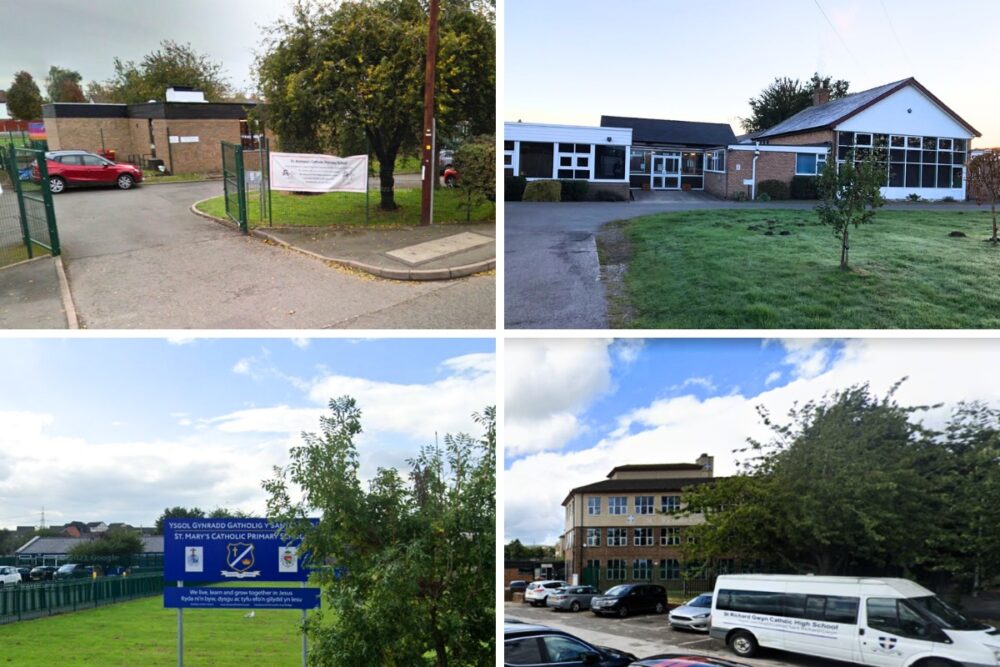
If approved the plans will see three primary schools – St Anthony’s in Saltney, St David’s in Mold and St Mary’s in Flint, plus St Richard Gwyn Catholic High School, closed down with a super-school built on the Flint site for pupils aged three-18 years-old.
The reasons given by the council for this significant development are that falling pupil numbers are creating excessive surplus places at the four schools.
That has a knock-on effect on the amount spent per-pupil, with education department data indicating that £279,000 more is being spent on pupils at these four undersubscribed schools than elsewhere in the county.
According to officers’ reports, the super school will bring pupil spending in line with the average across Flintshire – with the additional spend being redistributed throughout the authority.
“This is not about saving money,” said Cabinet Member for Education, Welsh Language, Culture and Leisure Mared Eastwood. “The proposal is focused on reducing surplus places and ensuring that budget is spent on education and teaching rather than maintenance and utilities.
“Currently, St Anthony’s has capacity for 152 pupils and has 48. In 2029 it is projected to have 35 on roll. St David’s capacity is 144 pupils. It currently has 60 and by 2029 that is projected to be 42 pupils. This is more than significant surplus places in these two schools.
“Removing surplus places facilitates a more equitable distribution of funds across the entire school network.”
Cllr Eastwood went on to highlight that the number of surplus places across the three primary schools under consultation was equivalent to the county funding one large, empty primary school.
That argument did not sway Councillors David Coggins Cogan, Andy Hughes, Linda Thew, David Richardson and Carol Ellis, who put their names to the call-in.
They believe that the overwhelming public opposition to the plans justified sending the proposal to full council for a wider debate where possible alternative options could be explored.
But those hopes were dashed as, in a recorded vote, members of the Education, Youth and Culture Overview and Scrutiny Committee voted against that option by eight votes to six.
Formal endorsement
Instead they chose to note they were ‘no longer concerned’ having received explanations from the Cabinet decision-makers, allowing the process to continue without the committee formally endorsing it.
“Closing schools can be emotive,” said Cllr Coggins Cogan. “But this can be mitigated if communities feel they are being listened to and not subjected to tokenistic consultation.
“We had over 2,000 responses, with 96% of those have been in clear opposition to these plans, yet we are still moving forward. That does not give the communities any credible evidence they are being listened to.
“In the school organisational code of 2018 it states consultation must not be tokenistic. Not giving full weight to so many respondents does smack of tokenistic behaviour.”
Cllr Eastwood added: “We did take into account the recommendations of the committee and the responses to the consultation, but we did so alongside our statutory responsibility to all our learners in Flintshire. A consultation is not a vote and should not be treated as such.”
Safeguarding
One of the biggest concerns raised during the consultation was around safeguarding and safe travel to school, with very young pupils from Saltney having to travel to Shotton or England to school and pupils from Mold having to travel 45 minutes to Flint.
Cllr Andy Hughes said: “A five year old, standing at a bus stop, soaking wet through, as their parents or grandparents or carers wave them off, have no idea why they’re getting sent to this school.
“Who will be on this bus? Will it be separate buses for primary school and high school or will it be a mixture?A five year old being exposed to what 14 or 15 year olds get up to on a school bus isn’t right.”
It was a point raised by a number of councillors. Each time Cllr Eastwood repeated that the council’s current safeguarding policy would come into play.
“We cannot say exactly what the provision will be as we do not know the numbers of pupils who will need transportation,” she said. “But we have measures in place for pupils at Welsh language schools, who also need to travel and we would apply the same policies here.”
Impasse
Flintshire’s Chief Officer for Education and Youth Claire Homard also came to an impasse with Cllr Andrew Parkhurst over another key concern for opponents of the scheme – the provision for pupils with Additional Learning Needs.
“How do the proposals improve educational standards?” said Cllr Parkhurst. “Estyn have said it is unclear what the impact of this proposal is likely to be on the standard of education.
“That is an independent voice saying there is no evidence provided. We’ve heard it mentioned that big schools are better from the Cabinet member – what is the evidence for that?
“I’ve been to see one of the schools affected – St David’s in Mold – and the standard of education is excellent, particularly for those children with Additional Learning Needs. In fact children from larger schools are being taken there because the standard of education and the care and the love and the nurturing is better.”
Evidence
Mrs Homard challenged Cllr Parkhurst’s view.
“I would be interested to know on what evidence Cllr Parkhurst is determining that standards at St David’s are excellent,” she said.
“As we have noted in discussions today all four schools are all under the local authority’s school improvement processes.
“So I’m struggling to understand the definition of the education at St Davids being noted as excellent when the local authority is intervening in that school and others.”
Following the committee’s vote to allow the process to continue, Flintshire County Council will issue a statutory notice to open a 28-day objection period for the public to submit feedback and arguments in favour of or against the proposal. The opening date of the consultation has not yet been published.
Support our Nation today
For the price of a cup of coffee a month you can help us create an independent, not-for-profit, national news service for the people of Wales, by the people of Wales.



From the figures quoted it seems that the demand for Catholic education is low and fast diminishing. How is it possible to justify spending such a large sum of public money on a selective school not open to the population as a whole? It sounds like that by the time it has been built the demand will be very small. In Runcorn where I live the Catholic and Anglican churches have a combined school as the demand for separate faith schools was too small.
Dreadful. Surely we’re in a time where we should be separating religion from public money and education (and politics). Do we learn nothing? Why do these huge churches need to sit on their own wealth and expect more from the tax payer? More and more, I suspect their own wealth is reserved to buy themselves out of the awful legal matters that they continue to embroil themselves in.