


Fossil found on Welsh beach helps solve 200-year mystery

Nation.Cymru Staff
A fossil discovered on a Welsh beach has helped researchers uncover new information about the fish that swam in the seas around Wales more than 200 million years ago.
Fossil hunter Jonathan Bow was searching the shoreline on Lavernock Beach near Penarth when he spotted the unusual find, which turned out to be part of a rare fossil jaw containing developing teeth.
For almost 200 years, fossil teeth found in rocks around the Bristol Channel were difficult to identify and, because of their unusual shape, some early scientists believed they belonged to giant amphibians rather than fish.
Cindy Howells, Curator of Geology at Amgueddfa Cymru, said: “Many teeth from Saurichthys were once mistaken for those of an amphibian, and that misunderstanding continued well into the 20th century. This lovely little jaw caused great confusion when it was first found as it bore no resemblance to any known species.”
After its discovery, the fossil was sent to the University of Bristol for further study, with researchers from the university, Amgueddfa Cymru and the State Museum of Natural History Stuttgart working together to examine the find.
Their research showed that fossils that had previously been grouped together under one name actually belonged to two different species of fish that lived during the Late Triassic period.
Jacob Quinn, lead researcher, said: “These rocks were formed during storms more than 200 million years ago, so it is remarkable that such a delicate fossil survived. Although British Triassic fossils have been studied for over 200 years, this is the first bone from Saurichthys ever found in these rocks.”
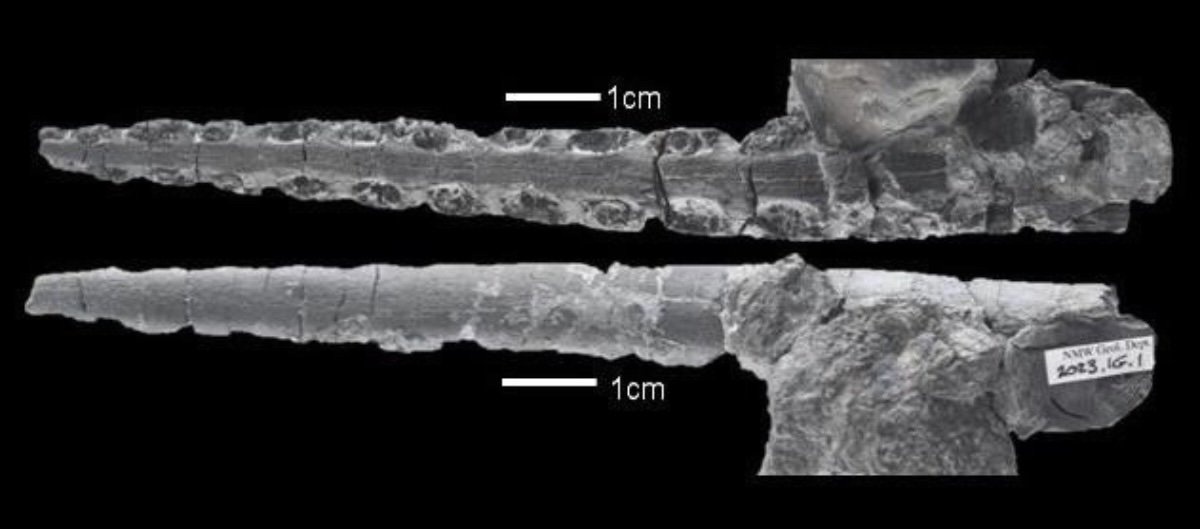
The findings have now been published in the Journal of Vertebrate Paleontology.
Professor Mike Benton, a co-author of the study, said: “This delicate fossilised jaw has now been compared with specimens in museum collections across Britain and Europe to provide clear evidence that fossils originally thought to belong to the same fish actually came from two separate species.”
Dr David Whiteside, another co-author, said: “These predators lived in a shallow tropical sea filled with small limestone islands. Saurichthys was probably a fast and agile hunter, while Birgeria was larger and more powerful, likely feeding on a wider variety of prey.”
Co-author Dr Sam Cooper added: “These fish have a remarkably complicated history. It’s amazing that a single fossil, found by Jonathan Bow during a spring tide, has helped clear up nearly 200 years of confusion.”
The fossil will go on display at National Museum Cardiff later this year.
Cindy Howells added: “Being able to share this incredible discovery with the public will capture people’s imagination and hopefully inspire the next generation of fossil hunters to explore the amazing finds that can be discovered along Wales’ coastline.”
Support our Nation today
For the price of a cup of coffee a month you can help us create an independent, not-for-profit, national news service for the people of Wales, by the people of Wales.
Get more trusted Welsh news
Choose Nation.Cymru as a preferred source in Google News to see more of our journalism.


