


From industrial wasteland to Wales’ answer to the Barbican?
Kieran Molloy, Local Democracy Reporter
Major projects could turn a former industrial space in the heart of the Welsh capital into what could be the country’s answer to London’s Barbican.
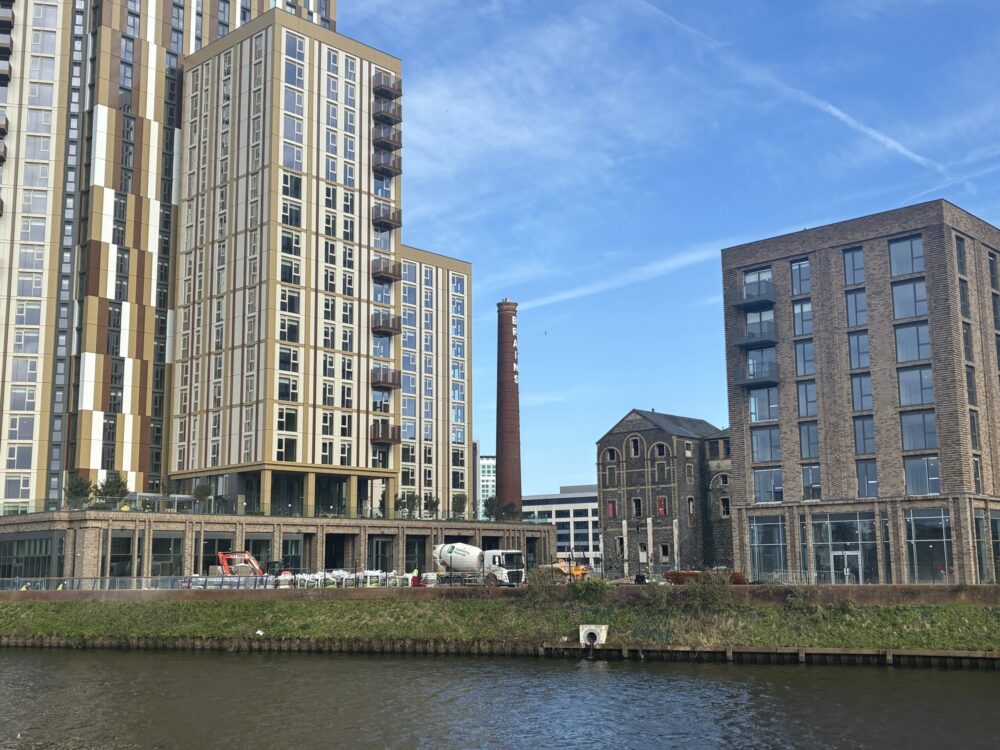
A once industrial area of Cardiff is undergoing a rapid regeneration which could see hundreds of new high quality homes built as well as other spaces every modern city needs.
At the moment, it may be a construction playground filled with vans and contractors but the area behind Cardiff Central and stretching until the embankment of the river will be transformed by two major developments that could make it the city’s new beating heart.
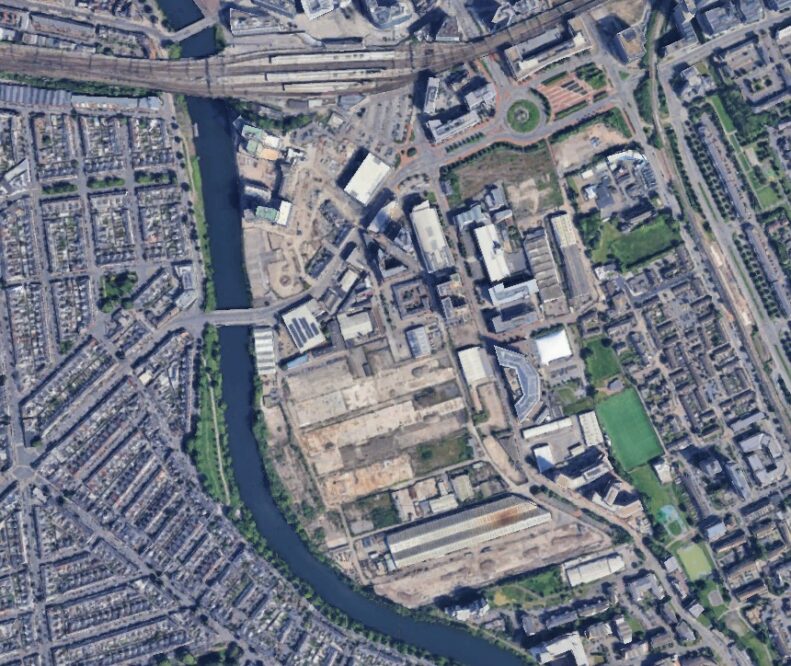
The first development is the 19-hectare “Embankment site” on the river Taff that is set to be transformed with approximately 2,500 new homes.
The developer, Vastint UK Services Limited, also committed to 5% of on-site housing being affordable as well as other infrastructure projects.
But it won’t just be housing – leisure, office and hospitality spaces are also planned for the site.
Other aspects of the development included in the agreement are contributions of £9m towards off-site affordable housing, £1.2m towards school places, almost £1m towards off-site community facilities nearby (including a potential new shared community/ health facility), just over £1.1m towards open space in the area, a new foot and cycle bridge and some more contributions for traffic regulations, waste, a nearby cycleway and a viability review of the scheme.
This would result in what amounts to a new suburb directly in the centre of Cardiff.
The project’s website reads: “An under-utilised, industrial space for 30 years, The Embankment, Cardiff is now set to become an exciting regeneration project, bringing new homes, offices, retail and jobs to this 40-acre site in the centre of Cardiff.”
Local resident Craig Sutherland, 43, told the LDRS: “I’m excited to see what they actually put there.”
He continued: “This area needed something.
“There are a lot of empty buildings so it’s difficult to be hyper positive but you never know.
“They might attract businesses that never thought about being in Wales before or they might be businesses that are succeeding moving here to scale up.
“It could be great for the economy, it could be great for local people.”
Explore
Another resident, Jannat Rasheed, 28, said: “It’s good for socialising, people could explore more, there’s more to explore and go out with friends.”
A resident of Cardiff Bay, Glynis (who did not want to give her last name) told the LDRS: “I think it’s really good because it’s making some use of the old features of the old Brains Brewery and I’m happy to see that they’ve retained some of that stuff.”
She continued: “But it’s also great to see them breathing life into the heart of the city.”
When asked if this type of development was a positive sign for where the city was headed, she said it “100%” was.
Cardiff Council is also getting involved in the regeneration boom.
Nearby, alongside the current redevelopment of the old Brains Brewery site into highrise towers, hotels, bars and restaurants, Cardiff Council has agreed to purchase a number of plots in central quay that could deliver a mixture of up to 720 council and private homes.
This comes after the council declared a housing emergency at the end of 2023 in response to unprecedented strain on the city’s homelessness services.
As of March 1, 2026, there are 9,659 applicants on Cardiff’s housing waiting list.
A spokesman for the council told the Local Democracy Reporting Service (LDRS): “The proposed acquisition of land at Central Quay, which has the potential to deliver up to 720 new homes, reflects the council’s wider commitment to tackling the housing emergency and increasing the supply of affordable homes across Cardiff.”
It continues: “We continue to face significant pressure on housing, driven by limited availability and high costs within the private rented sector.
“Central Quay therefore represents an important opportunity to maintain the momentum of our ambitious house‑building programme and to deliver new homes at pace and scale.
“As well as delivering more council homes, this opportunity is particularly important because, subject to feasibility work, the development could enable the council to offer homes for private rent at more affordable prices, helping to address some of the key pressures facing residents.”
Car park
The developments boast an enviable position, sitting right on the bend of the river Taff behind the new 681-space car park.
In regard to the increased social and affordable housing, Cardiff Homelessness charity Llamau told the LDRS: “We welcome the continued focus on increasing the supply of genuinely affordable and social housing in Cardiff. Safe, secure homes are a vital part of the long-term solution to homelessness.”
It continued: “At Llamau, we support young people, women and children who experience homelessness for many complex and often deeply personal reasons, including family breakdown, trauma, domestic abuse and poor mental health.
“Because of this, while increasing housing supply is important, it is only one part of a much wider picture.
“Our frontline experience shows that many of the people we work with need tailored, trauma-informed support alongside access to appropriate housing in order to rebuild their lives and sustain tenancies long term.
“We remain clear that preventing homelessness and helping people recover from it requires both safe, affordable homes and specialist support for those facing the most complex challenges.”
Support our Nation today
For the price of a cup of coffee a month you can help us create an independent, not-for-profit, national news service for the people of Wales, by the people of Wales.



The ‘Embankment site’ has had a development masterplan for 20 years, but no homes have yet been built. 5% affordable homes is far below the 20% brownfield sites should deliver under the Local Development Plan.
Council’s wish to build council and other affordable housing at Central Quay is welcome. Rightacres’ willingness to sell the land probably reflects difficulties landlords are experiencing in letting the surge in new flats at rents few can afford.
The Barbican has a major arts centre.
Politics has wiped out much of the private rental sector for non working people, just too much risk for owners who can now get blamed for the tenants lifestyle condensation mould.
This has a knock on effect on construction as the developers know there are fewer buy to let purchases, heaping more responsibility onto the skint public sector.
Lifestyle condensation? You mean when tenants have no choice but to let wet clothes dry inside a cramped home?
Condensation does not cause health ruining mould. Poor maintenance does that. Cardiff Council rightly prosecutes rogue landlords.
Penetrating damp is a property problem.
Condensation damp is an occupier problem.
Occupiers who spend all day in properties and create moisture need to expel it using dehumidifiers and clothes dryers with external hoses. It’s as fundamental as pulling the plug on a sink or flushing the loo.
These bizarre political times try to shift the blame onto others, but this action brings the simple reaction of deciding that renting a property to someone else is now a mugs game – hence the property rental crisis.
Have you heard of the cost-of-living crisis? Private rents have risen by close to 60% in Cardiff since 2020, far above the rate of inflation.
No wonder many tenants can’t afford the extra costs of clothes dryers or dehumidifiers. If private landlords wish to protect their properties they should provide such facilities. Some properties are small and overcrowded, making it hard for tenants to find space. You seem to think tenants should wander the streets all day, and never boil kettles or cook food.
Small private landlords are indeed on their way out.
Action and reaction, supply and demand.
Many quality small private landlords are selling up and sailing off into the sunset, leaving tenants having to chose between corporate plastic pods or years on waiting lists of councils threatened by bankruptcy.
Landlords may sail off but their housing stock won’t go with them. It will either go onto the market, helping to keep prices down, or if left empty should be compulsorily purchased.
150 years of experience since the Artisans and Labourers Dwellings Improvement Act 1875 shows that only the public sector can provide sufficient housing at a rent anyone can afford. The bankruptcy risk is a fiscal artifact resulting from rules that count debt but not assets.
Landlords sail off into the sun with constructors following them as the former have been a huge chunk of their custom, as per my original post.
Councils are going bankrupt because of massive demands on so many fronts, massively different from 150 years ago.
We have pursued the private landlord model for 40 years. It has failed. House building quanity and quality have fallen while rents and prices have risen. Big developers have become an obstacle not a solution and should be taken into public ownership.
Public sector can’t afford to pay for life saving medical operations, so how many more operations have to be cancelled to give anyone a free property with free maintenance and free bills, considering how many now demand a divine right not to work.
The financial reality is more multi generation households, more house-shares and even room shares if we keep expecting magic money properties to be bought with money that is not there.
I’m addressing the housing crisis. You’re indulging your prejudices.
The success of the development will hinge on what they do with the old brewery building which could be something really special. Perhaps one floor could be a Brains microbrewery and museum.
I have good memories of that area. My first job was in a warehouse, off Dumballs road. They’ve knocked much of the area down but nothing has really taken off there – so it’s good to see that the site will finally be fully rejuvenated. About time.
I thought the purpose of the TfW upgrade to the Core Valleys Line was for people in the Welsh Valleys to work in Cardiff – so this project contradicts that plan.
More homes in Cardiff equals more flats with no gardens and less job opportunities for residents of Welsh Valleys to commute to jobs in Cardiff.
There are lots of empty buildings midway between Newport Train and Bus Stations – could these be homes instead of being derelict? Then those homeowners can get to central Cardiff in under 30 minutes – quicker than somebody who lives in overpriced Llandaff!
I thought it was about choice. Someone could live here and walk to work. Or they could comfortably commute to Swansea, Bristol or Pontypridd. Or take a hybrid job in London and never miss the 5.54am cheap train to Paddington for their one day in the office.
If you look at the whole economy of Wales, we need more utilisation of the empty buildings near the train stations in Newport and Port Talbot. Ideally with well-paid professional services jobs of the highest economic multipliers (such as research and development into aerospace / net zero / pharmaceuticals); but if they are not available build housing that can be later converted into office space. Europe understands basic economics and have country plans https://transport.ec.europa.eu/transport-themes/infrastructure-and-investment/trans-european-transport-network-ten-t_en I used to mentor a procurement manager in Manchester who returned to Estonia and was the procurement lead for Europes largest infrastructure project http://www.railbaltica.org – one… Read more »
Surely what becomes of properties in Newport is the responsibility of Newport Council and has nothing to do with Cardiff.
The idea that people from the valleys won’t get jobs in Cardiff because there’s flats in Cardiff to rent is devoid of all logic. People from the valleys already work in Cardiff.