


Funding model blamed for building quality concerns over new cancer centre
Martin Shipton
A construction manager with 40 years experience has blamed the chosen funding model for quality concerns and increasing costs in the building of a new cancer centre in Cardiff.
Ian Vincent says the decision to use a variation on PFI – the largely discredited Private Finance Initiative model under which private companies built hospitals and schools and were repaid by the public sector at high cost over decades – has led to lax spending behaviour.
The variation on PFI – known as the Mutual Investment Model (MIM) – was meant to protect the public purse by having a public sector representative on the board of the construction company or consortium. But as reported recently by Nation.Cymru, under company law such a director’s primary loyalty is to shareholders rather than the public sector.
Mr Vincent, who lives in Cardiff and has actively campaigned against the building of a stand-alone new Velindre cancer centre in the city’s Whitchurch suburb, has pointed out that serious problems have already been identified in the quality of concrete used in the construction of new Velindre.
He has now raised further concerns about the quality of the building work on the project.
These include:
1 The contractors Andrew Scott, an established contractor from South Wales, left the consortium building new Velindre early on. Andrew Scott would have been responsible for all the earthworks, foundations, drainage, concrete frames and associated works. The firm was an integral and significant part of the consortium that won the contract to construct new Velindre, as well as being fundamental to having direct access to local supply chains and the local workforce.
2 When the main earthworks for the building were started, Sacyr, the leading construction firm in the Acorn consortium delivering new Velindre, used a freelance worker as the site manager. When he was questioned by residents as to why their concerns over safety failings at the main construction site entrance were not being addressed, he replied that he had over 600 unanswered emails in his inbox.
3 Sacyr replaced Andrew Scott with NAB, a labour only subcontractor, with the concrete supplied by different firms. However, it is standard practice for a single subcontractor to supply labour, concrete and steel reinforcements.
4 Significant problems with the quality of the concrete in the construction of new Velindre are well documented, with the Velindre NHS Trust confirming that repairs have had to be undertaken already to the concrete. Trust minutes from January 2025 record that the Independent Tester had identified as a red issue the quality of the concrete. A request has been made for Velindre Trust to release for public scrutiny the report by the Independent Tester.
To date the Trust has refused to release this document.
5 The drainage contractor firm Harte also left the construction site. The drainage plans for the site required significant modification to be compliant with planning regulations on surface water drainage. This required the addition of four large underground concrete water tanks to the plans, capable of the storage of up to 750,000 gallons of surface rainwater.
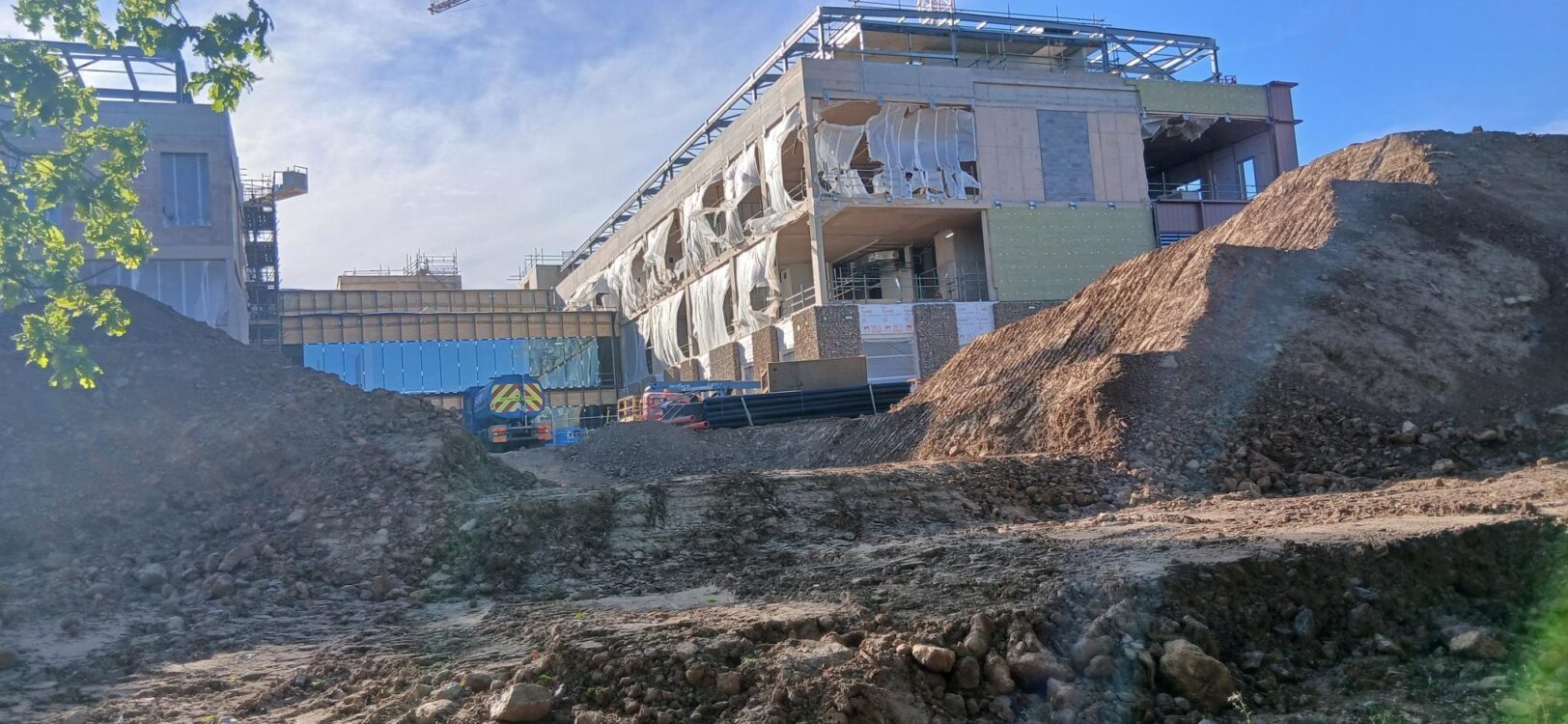
6 There was a significant delay in the design, fabrication and installation construction in Spain of the prefabricated zinc cladding for the outer walls of new Velindre. In committee papers from March 2026 the Velindre Trust confirmed the completion of the outer façade for new Velindre was 102 days behind schedule, with the contractor yet to provide a revised date for completion.
Plastic sheeting
As a result of this delay, the outer walls have been covered in plastic sheeting during the months of winter rain. Subsequently, David Powell the new Velindre Project Director reported to the April 2026 scrutiny committee the prefabricated façade was now ‘on track’ and had been completed on March 23 2026 despite being 102 days behind just one month previously.
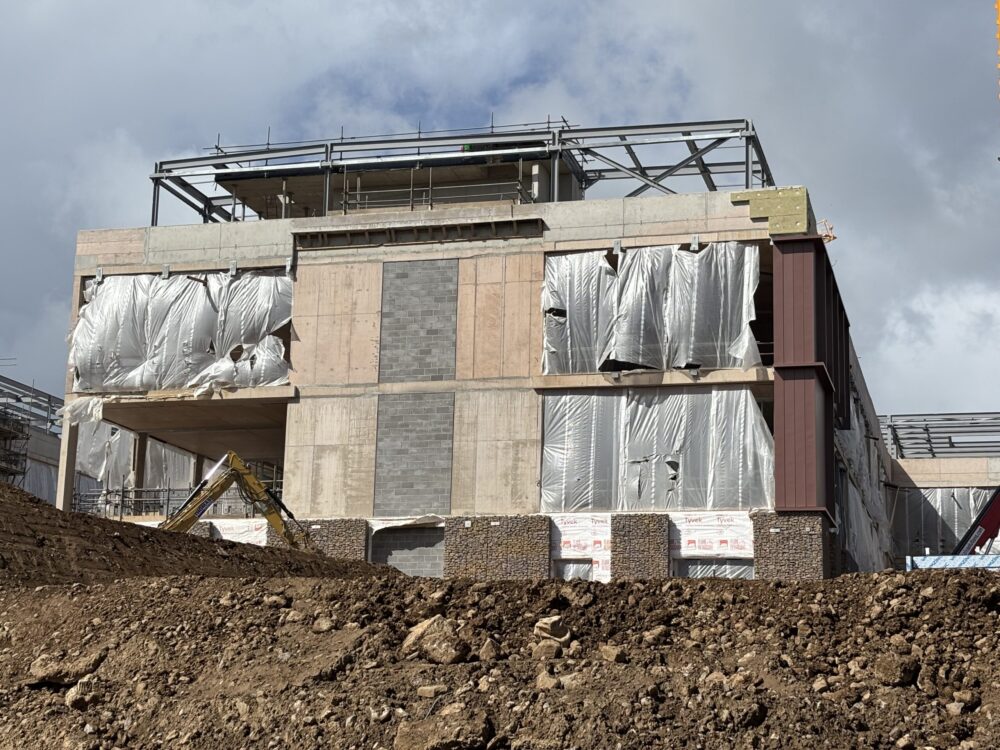
However, a simple visual inspection of the new Velindre construction site reveals the prefabricated facades are still not completed and in place by some considerable extent.
Requests to Velindre Trust for technical details of the ‘special plasterboard’ being used for internal partitions that can resist the rain and wind coming through the temporary polythene sheeting have not been answered. Concerns have also been raised regarding the quality of mechanical and electrical installation while only the polythene sheeting is in place.
7 Serious concerns have also been raised regarding why the glued laminated timber structure (glulam) has also been left exposed to the wind and rain for many months, and whether this is in accord with the agreed specification for the glulam.
8 Questions have been asked about why Sacyr is not using Lorne Stewart, a local firm, for the mechanical and electrical installations in new Velindre. Lorne Stewart carried out the mechanical and electrical work in the current Velindre cancer centre for decades. The firm was Velindre Trust’s preference for work in new Velindre.
9 Despite letters from local people to Sacyr UK, Velindre Trust and Cardiff Council Enforcement Team for the last two years, there are still important safety concerns at the main construction site entrance. The two pedestrian safety gates which protect pedestrians from construction vehicles are frequently broken. And recently the main gate padlock was left unlocked. Local residents do not understand why these problems are still occurring, particularly as the construction vehicles have to cross over a public footpath to enter the building site and this footpath is used by children walking to and from school.
‘Catastrophe’
Mr Vincent said: “I was hoping that instead of going down the route of using the well-recognised catastrophe of PFI in England, large construction projects in Wales such as new Velindre would have gone back to using capital funding. Instead, we have a Welsh version of PFI, known as MIM, and created by Mark Drakeford.
“Under the previous tried and tested system things were better, more cost-effective, and lines of communication were clearer. Local well-established contractors were used and spending the Welsh pound and zero defects on completion were the goals. A hands-on Clerk of Works
would have ensured things were built correctly first time. It could have been done for approximately half the cost.
“Velindre confirmed to me personally that the banks are controlling this project, certifying and making all payments to Sacyr UK, and have made no deductions to-date for any defective work. I am concerned that this MIM contract means Velindre Trust is not in control of the quality of the construction work. I am also aware that Audit Wales has already criticised the Welsh Government over the MIM funding model for new Velindre.”
‘Build quality’
A spokesman for Velindre University NHS Trust said: “The new Velindre Cancer Centre (nVCC) is scheduled to open in spring 2027. We continue to work closely with our construction partner, Sacyr, and the wider supply chain to deliver this state-of-the-art cancer centre for patients across south Wales.
“Build quality and project safety have always been paramount. As we have explained previously, where issues have arisen, they have been effectively managed through established contractual and independent assurance processes, and at no stage have they compromised the building’s structural safety.
“Audit Wales recently confirmed that the Trust’s decisions about procurement and project management were well governed and based on sound advice, noting that without the nVCC, significant investment would be needed to maintain the current site.”
Support our Nation today
For the price of a cup of coffee a month you can help us create an independent, not-for-profit, national news service for the people of Wales, by the people of Wales.
Get more trusted Welsh news
Choose Nation.Cymru as a preferred source in Google News to see more of our journalism.



“I was hoping that [after PFI] large construction projects in Wales [..] would have gone back to using capital funding”
Presumably the limited capital borrowing facility available to the WG at the time this was greenlit was ringfenced for a multi billion pound relief road that was spiralling in cost.
And I’m guessing the same outraged folk are also outraged that got cancelled despite knowing full well it would come at the expense of new hospitals and schools.
One of a herd of white elephants that the former first minister bought a farm to cater for their long retirement needs…
A ‘butterfly house’, hopefully Rhun will have done a ‘Hyde Park’ !
(Brian Jones, late of the Stones, tribute)…
Just hope there are no bats…