


Fundraiser launched to bring Tolkien letter home to Welsh town
Stephen Price
A Welsh community is rallying together to try to purchase a letter written by J R R Tolkien which mentions their town of ‘wonder and imagination’.
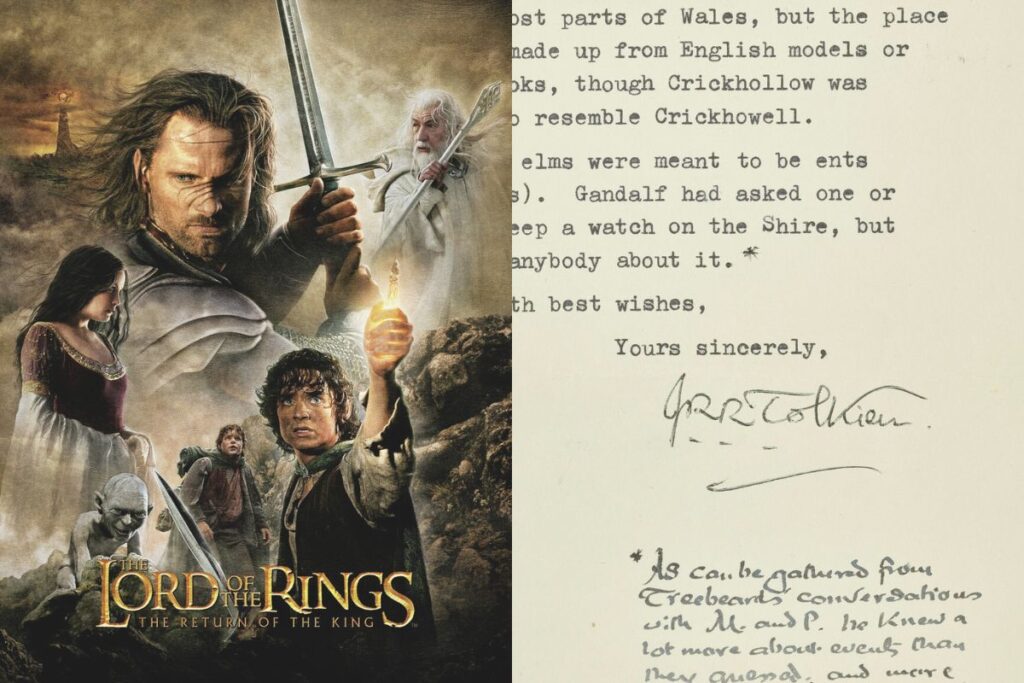
A typed and signed letter written by J R R Tolkien is heading to auction next month, which mentions how a charming Welsh town’s name provided the inspiration for one of the locations used in the Lord of the Rings.
The letter from 1966, which is being auctioned by Christie’s, is addressed to Jenny Hall, Hillcrest, Hatfield, and in it he shares that Crickhowell, Powys but then in Brecknockshire, gave rise to the name Crickhollow, writing: ‘I have been in most parts of Wales, but the place names I use are made up from English models or borrowed from books, though Crickhollow was actually meant to resemble Crickhowell.”
Fearing that the letter could, again, get lost to time, local business owner Frank Ady has launched an online fundraiser with the hopes that the precious letter can find a final resting place in the charming Powys town and perhaps act as a draw for future visitors.
The fundraiser shares: “We have all heard a lot of stories passed down through the last few generations that Tolkien spent a lot of time holidaying and visiting Crickhowell, with inspiration for his characters and places in his wonderful literature actually coming from this special town where we live.
“A letter written by Tolkien back in 1966 has emerged which directly mentions Crickhowell as an inspiration for Crickhollow in the Lord of the Rings Trilogy books. This letter is now up for auction with Christies and I though it would be lovely to purchase the original and display in the town for visitors and locals to view.
“Please help us raise funds to purchase this lovely piece of history which recognises our town for what it is, an absolute place of wonder and imagination!”
Ady told Nation Cymru: “Obviously I’m a bit of a Tolkien fan, having set up a bar in Crickhowell called ‘Treebeards’ I am currently reading Lord of the Rings for the 15th time.
“I’ve always been told that Tolkien spent a lot of time in Crickhowell and the surrounding areas and got much inspiration for his books from the landscape and features here.
“There is an amazing totally out of place Redwood tree just across the bridge in Llangattock which was supposed to be his inspiration for the character Treebeards who happens to be my favourite of course.”
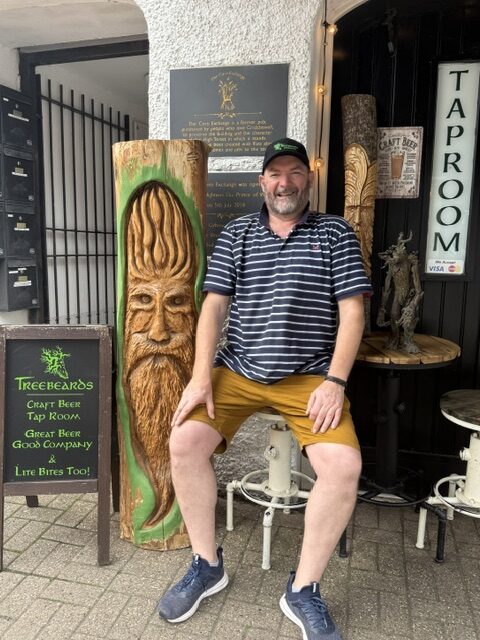
He added: “When we spotted this amazing letter up for auction that Tolkien wrote to a fan in 1966 that corroborates that Crickhowell was his inspiration for Crickhollow in the books we thought it has to come and live here in Crickhowell for locals and visitors to be able to see.
“It’s now just such an important part of our town history. The go fund me page was set up immediately to try and raise the guide price for the letter is between £5k & £7k.
“We would love to bring the letter here to rest amongst the beautiful and inspirational mountains and forestry that Tolkien found so wonderful.
“I hope to write to Christie’s next week to ask if the item could be sold to us privately as a piece of our history but if not we re just going to go for it and try and win it the hard way.”
Crickhollow
In the seminal novels, Crickhollow is a location, perhaps a small settlement, in Buckland, located a short way to the north-east of Brandy Hall.
Its most notable spot was an isolated house standing back from the lane in the middle of a wide lawn. It was surrounded by low trees inside an outer hedge, and there were no other dwellings nearby. The house was occasionally occupied with Brandybuck Hobbits who grew tired of the often crowded Brandy Hall.
Tolkiengateway discussed its etymology previously, writing: “Tolkien noted that the first element is obsolete and of obscure meaning. A hollow is a small depression in the ground.
“Based on this, David Salo has suggested a speculative Old Hobbitish form *Crycholh from which Crickhollow derives. The obscure element cryc could represent, as can be expected in Stoorish, a Celtic (Old Brythonic) word for “hill”. The placename would therefore mean “low place by the hill”.
“It is not clear in The Lord of the Rings whether Crickhollow was a village or a region occupied by a solitary house. The Encyclopedia of Arda mentions Crickhollow as a village. Robert Foster describes Crickhollow as a “place in Buckland” whereas Karen Fonstad believes that Crickhollow is just the name of Frodo’s house.”
Letter
Bidding for the one of a kind letter starts in just over a fortnight days, with an estimate of £5,000 – £7,000, but anything could happen on the day.
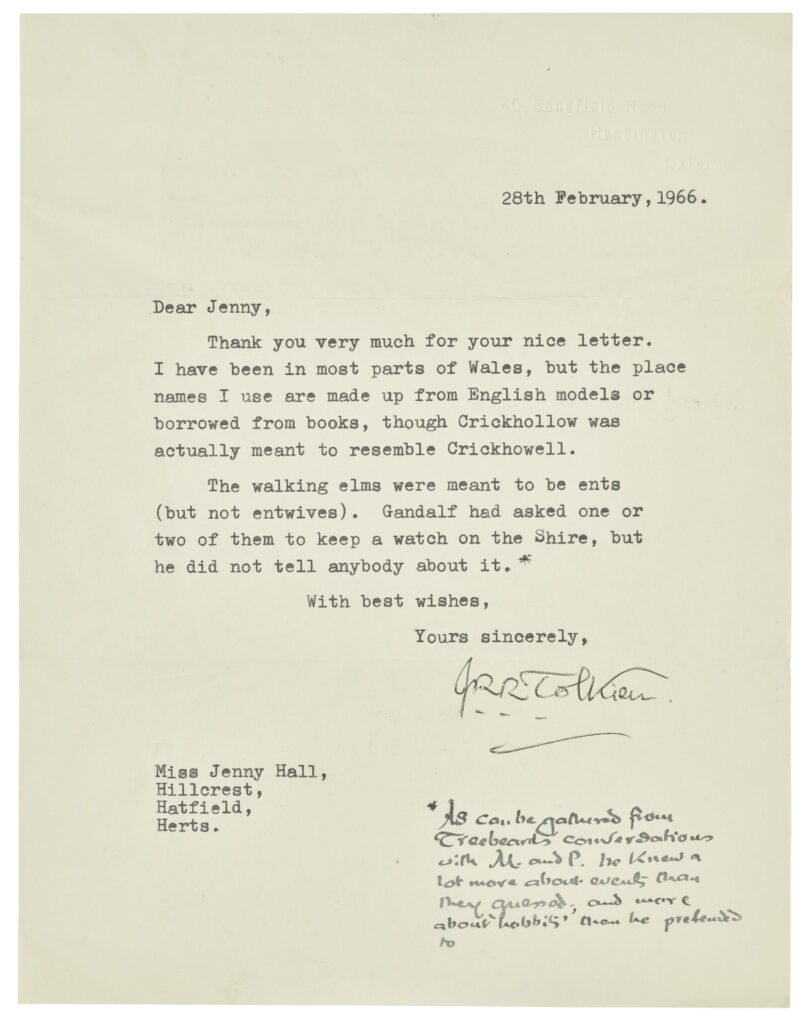
The listing shares: “John Ronald Reuel Tolkien (1892-1973)
“Typed letter signed (‘J.R.R. Tolkien’) to Jenny Hall, Hillcrest, Hatfield, 28 February 1966.
“One page, 228 x 177mm, with an autograph insertion of six lines. Envelope. Provenance: from the recipient.
“On place names and walking elms: ‘Gandalf had asked one or two of them to keep a watch on the Shire…’. A thoughtful and engaging reply to an attentive reader, in which Tolkien addresses the relationship between real and imagined locations in The Lord of the Rings.
“‘I have been in most parts of Wales, but the place names I use are made up from English models or borrowed from books, though Crickhollow was actually meant to resemble Crickhowell.
“The walking elms were meant to be ents (but not entwives). Gandalf had asked one or two of them to keep a watch on the Shire, but he did not tell anybody about it. As can be gathered from Treebeard’s conversations with M[erry] and P[ippin] he knew a lot more about events than they guessed, and more about “hobbits” than he pretended to’.
“Tolkien’s imaginative world was fundamentally linguistic in origin, stories were created to bring his invented languages to life. The sound of Welsh, for example, shaped Sindarin, while Old English and Old Norse influenced the cultures of Rohan and the northern kingdoms. Letters of this kind exemplify Tolkien’s generosity to readers during the 1960s, when his growing fame brought an increasing volume of correspondence. Despite the pressures of revision work and the demands of his mounting fame, his replies remain intellectually engaged, offering rare and personal insights into his imaginative world.
“Written between 1937 and 1949, The Lord of the Rings was published in three volumes across 1954–55, when Tolkien was a philologist professor at Oxford. The trilogy became an overnight cultural phenomenon. By the time he retired from academia in 1959, the work’s immense global success had already transformed him from a private scholar into an international celebrity, thrusting him into a frantic world of fame of whose disruptive effects he not infrequently complained.”
Welsh and Tolkien
J.R.R. Tolkien had a lifelong love of language, and he was a champion of the Welsh language long before many others outside of Wales.
He famously said: “Welsh is of this soil, this island, the senior language of the men of Britain; and Welsh is beautiful.”
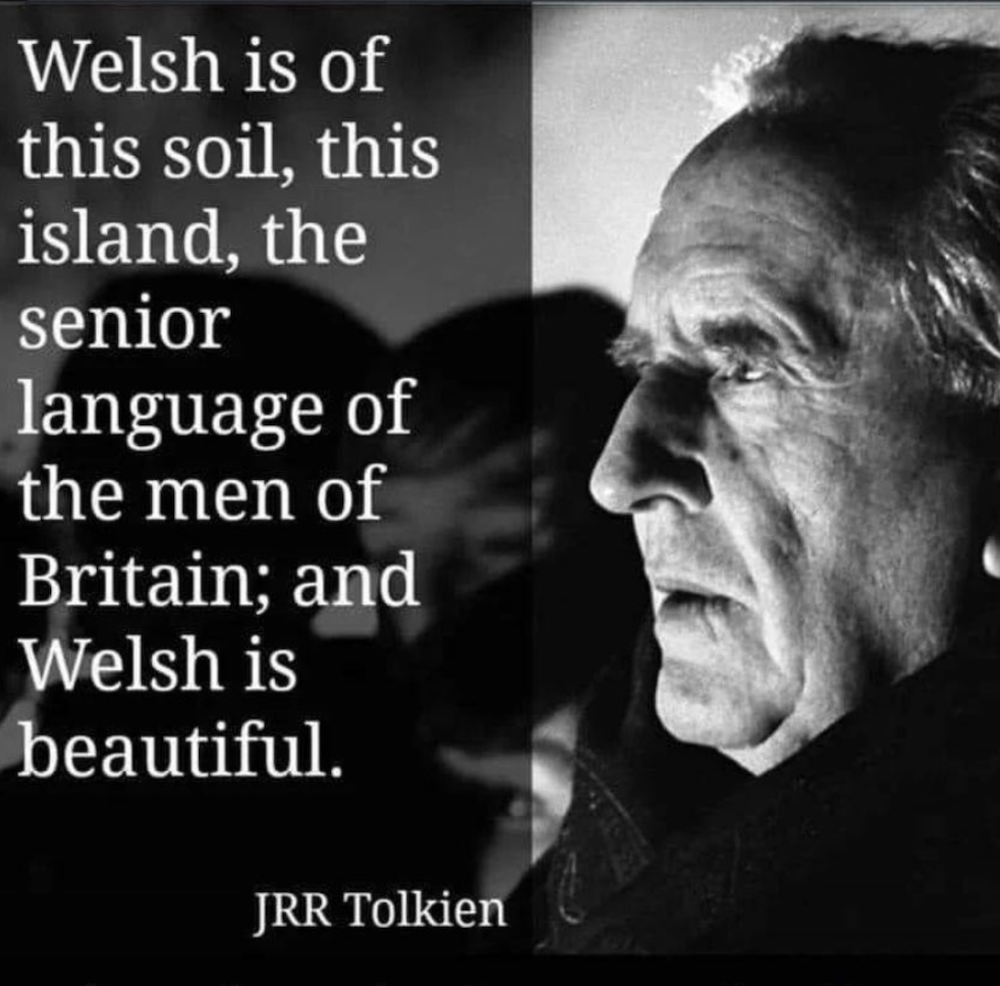
Ceinwyn’s online blog shares: “Tolkien’s love for Welsh was rooted in its sound. He spoke of it as “beautiful,” and that word for him had weight. He believed languages could evoke emotion the same way music could.
“He studied Welsh – both ancient and modern forms – though he never became fully fluent. What mattered most to him wasn’t mastery, but melody. The lilting rhythm and soft consonants inspired him so deeply that he built one of his own invented languages, Sindarin, around similar patterns. If you’ve ever noticed that Elvish names like Lothlórien or Celeborn have a musical, almost liquid quality, that’s Tolkien’s love of Welsh showing through.
“So when he called Welsh beautiful, he didn’t just mean it was pleasant to the ear. He meant that its structure, its flow, and its long memory were art in themselves. A natural poetry shaped by centuries of belonging to one place.”
For Tolkien fans, and Welsh speakers and learners, Welsh publisher Melin Bapur has released a Welsh version of J.R.R. Tolkien’s classic fantasy novel The Hobbit in Welsh.
One of the most popular and most-translated books of the twentieth century and the prelude to The Lord of the Rings, The Hobbit was originally published in 1937 and has since been translated into dozens of languages, including other Celtic languages such as Irish and Scottish Gaelic.
Until recently, however, the celebrated novel has never before been available in Welsh—perhaps surprisingly, given author J.R.R. Tolkien’s own interest in the Welsh language, upon which he drew for some elements of the fictional languages he invented in his works.
Support our Nation today
For the price of a cup of coffee a month you can help us create an independent, not-for-profit, national news service for the people of Wales, by the people of Wales.
Get more trusted Welsh news
Choose Nation.Cymru as a preferred source in Google News to see more of our journalism.


