


George Monbiot calls out Wales’ ‘extractive’ economy and rail and road channels into England
Stephen Price
George Monbiot has been praised for his ‘stunning incisive analysis’ of the legacy of Wales’ extractive economy and transportation networks on a recent episode of BBC’s Question Time.
The episode, which aired on Thursday 15 October, saw Fiona Bruce present an hour of debate from Brecon. On the panel were Stephen Kinnock, Mims Davies, Delyth Jewell, James Evans and George Monbiot.
In a segment aimed at Reform’s James Evans and Secretary of State for Wales Stephen Kinnock who has so far shown little support for further powers for Wales, Monbiot shared: “The truth is that whoever is in charge in Wales has got a mountain to climb.
“In 1971 the Uruguayan author, Eduardo Galeano published The Open Veins of Latin America, and in it, he said, ‘You can tell the economic character of a nation by the way infrastructure works’.
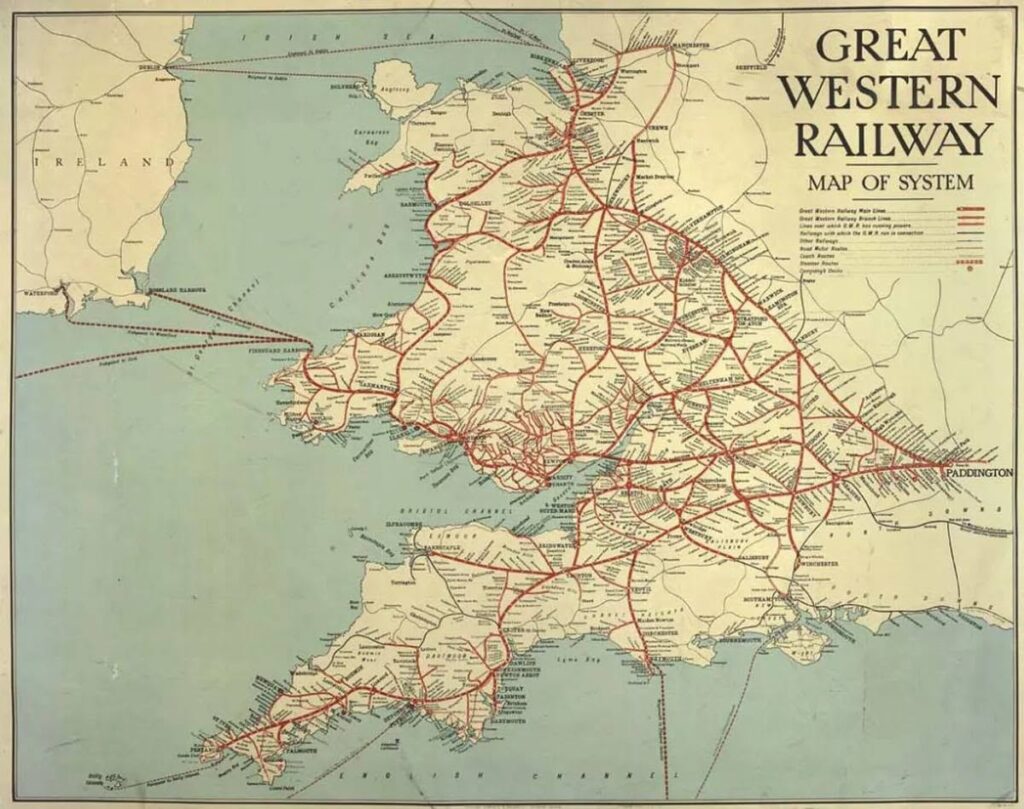
“If the roads and railways drain down towards the ports, and if the major trunk roads and railways lead not connecting region to region but to the colonial capital, you know you’re looking at an extractive economy.
“If you look at the infrastructure map of Wales, this is exactly what you see. If you look at the map of Cardiff, all the old roads go straight down to the docks, built by the Marquess of Bute to extract coal while leaving as little wealth behind as possible.
“The main roads, the main railways, they go to London.
“If you want to go north south, through Wales by rail, you have to go into England and do most of the journey there.
“What we’re looking at is an extractive economy – it has been that way since 1284.
“The wealth which could have enriched Wales – and this was potentially the richest part of the United Kingdom because of the immense amount of coal, slate and other resources – that was instead extracted, leaving Wales in poverty, leaving Wales with a resource curse.”
He added: “The reason these statistics which James so gleefully cites, of the poor educational performance, of the waiting lists of the NHS, of the horrendous deprivation – 6 of the 10 most deprived boroughs in Britain are in Wales. And they’re all in places from which enormous wealth was extracted.
“The reason is that for so many centuries, the economy was run not for the benefit of the Welsh, but for the benefit of the English.
“Whoever is in charge now, has to try reverse some of that, try to reverse that legacy of centuries. And it is a huge job.
“When Welsh politicians call for more funding from England, they’re not calling for charity, they’re calling for restitution.
“And when Welsh politicians and the Welsh people call for more powers, powers to set their own income tax bands, powers to escape the fiscal straitjacket on borrowing, they’re calling for justice.
“The Welsh economy should work for the Welsh.”

The video was shared to the Welsh Politics Facebook page following its broadcast, where it garnered wide praise.
One commenter added: “The most accurate and honest socio-economic summary of our country by an Englishman I have ever seen.”
While another shared simply: “Parity with Scotland is the baseline. Show this to anyone and everyone that dares say we don’t at least deserve some simple chwarae teg.”
Plaid
Plaid Cymru has consistently challenged Andy Burnham to match his promise of a “new politics” with more powers for Wales.
Responding to the Prime Minister’s Labour conference speech, the party’s Westminster leader Liz Saville Roberts welcomed plans to reform Westminster’s voting system but questioned what his proposals would mean for the devolved nations.
Mr Burnham’s first conference address as Labour leader included plans for free social care in England, changes to state pension increases and closer ties with the European Union.
Ms Saville Roberts said: “On many issues, there is clear common ground between Andy Burnham’s plans for England and what the Plaid Cymru Welsh Government is already delivering in Wales, and we stand ready to work constructively where that can benefit the people of Wales.”
The Prime Minister promised greater powers for English mayors during his speech in Liverpool.
Ms Saville Roberts said: “While much of the Prime Minister’s speech focused on England, including giving mayors greater powers and control, there was far less detail on what his vision of rewiring the British state means for the devolved nations.
“If that vision is genuinely about improving the lives of people in every postcode, it must also be about shifting power from Westminster to Wales.”
Ms Saville Roberts said Plaid would support UK Government measures that benefit Wales, adding: “But constitutional renewal cannot simply be about reforming Westminster. It must also be about shifting power from Westminster to Wales, strengthening our democracy, and equipping our nation with the tools it needs to build a stronger economy.”
Watch the full episode of Question Time on iPlayer here.
Support our Nation today
For the price of a cup of coffee a month you can help us create an independent, not-for-profit, national news service for the people of Wales, by the people of Wales.
Get more trusted Welsh news
Choose Nation.Cymru as a preferred source in Google News to see more of our journalism.



George Monbiot – a candidate for president of the Welsh republic!
George Monbiot is factually correct and I have never understood why any Welsh politician pretends otherwise.
Monbiot wrote a stunning article for the Guardian on this issue about 18 years ago: https://www.theguardian.com/commentisfree/2008/dec/30/comment-and-debate
Yes. The whole economy needs to be de-colonized.
Wales and Patagonia are both fortress economies. Wales has a high number of people living along the English border which came from the desire to stop a future English invasion – so a thinly spread population has more difficulties in job creation.
When the Welsh settled Patagonia, the population spread from Puerto Madryn through the valley towards Chile – to ensure if the English followed, Patagonia could be defended and the Welsh language saved.
What did Kinnock Ltd. have to say?
Back in the day George got short shrift on here,
Not just coal and slate but soldiers too,
Add the reinforcement of Ireland via North and South, for 800 years or so…
“6 of the 10 most deprived boroughs in Britain are in Wales”
Citation required because I don’t believe it. While I agree that Wales is a victim of an extractive economy this is a result of centuries of imperial government in Whitehall that’s treated the whole of this island as an extension of the empire to plunder which impoverished much of England, Scotland and Ireland too. The article panders to an English narrative that the job of Wales in the union is to make England feel better about itself.
Try this: uk-most-deprived-areas
These are wards not councils. The quoted text refers to boroughs which are council areas, especially for a London journo.
And how does that list not include Jaywick, officially the most deprived area in England according to the ONS.
I wouldn’t call him a london journo, for many years he lived down the road from me here in North Powys, and moved to devon around the start of the pandemic. I used to sell him veg in the local organic veg shop.
The Guardian is a London rag, and so by extension are all its journalists no matter where they have a second home. I have a lot of time for their international work but they have a London-centric blind spot when it comes to the UK often demonstrating the same sort of latent imperialist attitudes towards the regions and nations as the Telegraph although the tone is different, with the Telegraph opting for outright aggressive and obnoxious while the Guardian prefers pity, obscurity, patronising paternalism or simply pandering to old assumptions without challenge as George’s article does. It’s telling they manage… Read more »
He may have been referring to the deprivation index where 6 of the most deprived neighbourhoods are in Wales. Go further down the list to see how Welsh areas dominate. Bear in mind that if Wealth was equally distributed Welsh areas should represent only 5% of those areas, not 36 out of 50.
https://area360.uk/analytics/uk-most-deprived-areas
I’m not saying there isn’t a deprivation problem. I’m challenging the lazy assumption that Wales is uniquely problematic within the UK. That data isn’t from a reliable source. It blends two different datasets that are calculated in very different ways and weren’t designed to be comparable. Census data paints a different picture: https://www.ons.gov.uk/census/maps/choropleth/population/household-deprivation/hh-deprivation/household-is-deprived-in-one-dimension
That surely is how empires have always maintained their existence…through wealth extraction from areas and peoples on the fringes of or outside the empire. Western capitalism is no different. Without the constant flow of resources essentially robbed from less powerful nations outside the loop, the economic system fails. It can’t be self sustaining as wealth migrates towards and concentrates in the centre leaving insufficient to keep the cycle going. Wealth needs to be recycled from the top to the bottom. Ring any bells ?
Not merely to England but overwhelmingly to London. The only major motorway in Wales was built to connect to London, as does the main railway line. While it’s true that some water is supplied cross border (and the way some reservoirs were pushed through was a disgrace), that’s more to do with the common catchment, especially on the Severn, Dee and Wye. London however might demand a water transfer outside of catchment. London thinks of itself as the economic powerhouse that funds the rest of us. What that fails to appreciate is we want to fund ourselves. London does this… Read more »
George Monbiot hit the nail on the head. It was by far the most incisive contribution on the programme. His point about infrastructure is particularly important. Wales still has transport networks that often make it easier to travel east-west into England than north-south within Wales, a legacy of an economy designed to extract wealth rather than connect Welsh communities. For decades Wales has too often been treated as a political football by both Labour and the Tories. When in opposition they talk about “standing up for Wales,” but when in government they give us crumbs and expect us to be… Read more »
I’m not trying to be difficult, but I never get why people get so upset about they’re having to go to England argument regarding travel. If we had a line from Cardiff to Bangor, it would barely be used north of Merthyr. There’s no population masses in the middle of Wale. Sad reality is there is also not many people up north who need to get to Cardiff regularly apart from the public sector (who don’t really count in my view) The principal reason why we have the railway and road structure we have is because Wales is incredibly mountainous… Read more »
Exactly, and building WHS1 from Cardiff to Llandudno is never happening.
I don’t think anyone is suggesting we should just build a railway straight from Cardiff to Bangor or Llandudno. My point is more about how the network developed. A lot of our infrastructure was historically designed to move resources and connect Welsh industrial areas with English markets and ports, rather than to create an integrated Welsh transport network. Geography may be part of the explanation, but so is economic history. Improving north-south connectivity does not necessarily mean building an entirely new railway through mid Wales either. It could mean improving existing rail routes, roads and bus/coach connections. The wider point… Read more »
all fair points. but worth pointing out Welsh industrial areas were never really connected to English ports? We had our own ports in Wales! The railways which survived are still in tact today are the ones which make any money I think it’s far stronger reason for transport infrastructure today is that Wales is a relatively small country, and geographically constrained. North wales South Wales have never been strongly economically intertwined. Possibly you could argue during the Roman period. That’s why on the train down from North Wales to South Wales, you don’t see any private sector, it’s just civil… Read more »
Mountainous? Much of Europe not just Switzerland is far more mountainous yet their engineers drove road and rail routes round or through them. And they are still doing it. Our lot are entrenched in the ” if it ain’t flat, don’t bother” camp.
Sorry, that’s wrong. Integration by rail builds a nation. At one stage there was nothing much between the east and west coasts of American but a railway was built connecting the two anyway. Railways still bring investment and connecting mid Wales with north and south of the country would open our country up – as it did with the States – which by the way has at least three mountain ranges to pass along route!
Sadly, I can’t see much changing. It took EU money to connect the southern valleys of Cymru along the improved A465 – the UK government was not interested in doing so – no financial benefit. Now there is still no commitment, no interest and crucially there is no money now too. Ultimately, the only way out of this mess is – independence – and the restructuring of our land by our own hands.
One should be careful about the false dichotomy being presented here. It wasn’t the English who were/are the “baddies”, it was/is the social and economic elite, who, naturally, migrated to the centre of power, which was and remains London. Most were or became Englished as a result of this, as one might expect. So we have a correlation, and not necessarily causation. If Wales became independent, we might as well rename it Llundain Newydd, because that’s what it would become.
But the reason we have that elite is because we were invaded and have a foreign elite imposed upon us. If Wales developed as a free country the infrastructure would connect the whole of Wales to its capital.
Not really, our own Tudor elite could not wait to lord it over the rest of the population, same in the sixties, 8% went to Uni…no need to blame others…
There were two panelists on Question Time last night who were fighting for justice for Wales. They were Plaid’s Delyth Jewell and surprisingly English journalist George Monbiot, who is a man of great wisdom and understanding. Watching the programme, I found that the likes of Labour Welsh Secretary Stephen Kinnock, his Conservative shadow Mims Davies, and Reform MS James Evans, all patronised Wales and talked it down continually. Those British unionists featured were hostile to Wales having more devolution and control over our natural resources out of narrow-minded ideology. A poverty-stricken dependent Wales is a price worth paying in their… Read more »
Not just MPs, you have to go through every professional in receipt of the initial 10-15% of funding for every rejected project…
M4, case in point but 7 years down the line it might just show fruit again for the Bowties eh! Drakeford and Waters, another dollop for your mates…
Hooray for Jesus College…
Comments critical of George Monbiot not accepted? reCATCHA used as a barrier to participation?
Remember when they chased him out of Machynlleth on here…
Feb 01 2022 you start the comments…
I can’t access the back history. Pop a link on here if that’s doable.
They certainly don’t like counter argument!