


Giant climate warning to PM painted on wildfire-scorched Welsh mountainside
Mark Mansfield
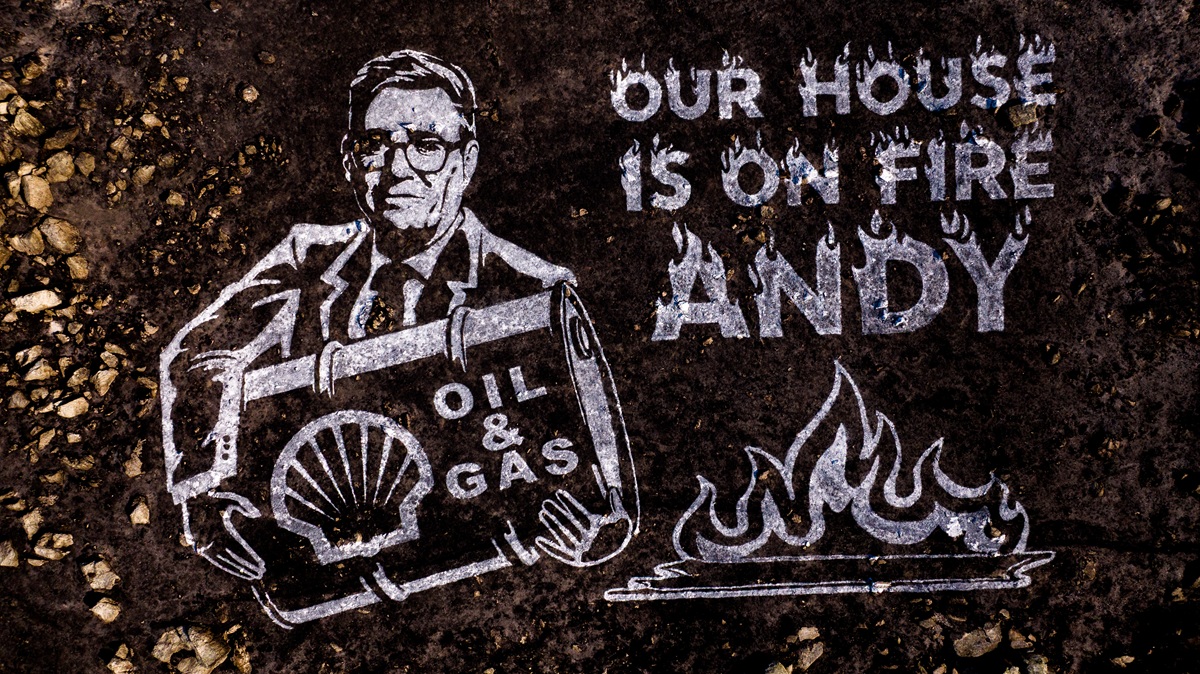
A giant message warning Prime Minister Andy Burnham of the consequences of climate change has been painted across a Welsh mountainside devastated by wildfires.
Greenpeace activists created the 1,120-square-metre artwork on scorched land at Sychnant Pass in Conwy, within Eryri National Park, following fires that burned large areas of the landscape.
The message reads “Our house is on fire Andy”, alongside an image depicting the Prime Minister preparing to pour oil and gas onto flames.
Greenpeace said the artwork was created using eco-friendly, plastic-free paint and was inspired by climate activist Greta Thunberg’s 2019 warning to world leaders that “our house is on fire”.
The protest comes after a summer of successive heatwaves and widespread drought conditions, which have contributed to a series of major wildfires across Wales and elsewhere in the UK.
It also coincides with the closure of a public consultation on the proposed Rosebank oil field, around 80 miles west of Shetland.
A consultation on the Jackdaw gas field off the coast of Aberdeen closed a week earlier, leaving decisions on both projects in the hands of UK ministers.
Greenpeace is calling on Mr Burnham’s government to reject both developments, arguing that allowing further oil and gas extraction would undermine efforts to tackle climate change.
Molly Robson, of Greenpeace, said: “The PM wants to be pragmatic, but there is nothing pragmatic about watching communities be battered by climate chaos while the Prime Minister flirts with expanding the very industry driving it.
“This summer has been an endless showreel of fossil-fuelled disasters playing out across the country. As the Conwy community reels from their own, we’re urging Andy to see through the self-serving promises of Big Oil and take an honest look at the real world consequences of more North Sea drilling.
“More drilling means more heatwaves, more droughts, more wildfires, and more suffering for the communities Burnham represents. The climate crisis is already hitting working people hardest — firefighters on the front line, bus drivers exposed to inhumane conditions, nurses collapsing on the job.
“Does the Prime Minister really want to stand with the oil companies making billions, rather than the millions already paying the price? Our message is simple: be brave – say no.”
However, Adura, the company behind both Rosebank and Jackdaw, argues the developments would bring substantial economic and energy benefits to the UK.
The company says the two projects would generate £10.8bn of investment, with more than three-quarters expected to be spent in the UK.
It estimates they could support 3,500 jobs at the peak of construction and 880 over their production lifetimes.
Rosebank alone is projected by the company to produce around 69,000 barrels of oil a day at its peak, equivalent to roughly 10% of anticipated production from the UK Continental Shelf, while Rosebank and Jackdaw together could account for 10% of domestic natural gas production.
‘Economic benefits’
Adura chief executive Neil McCulloch described the closure of the Rosebank consultation as “a major step before a decision on a project that can deliver real economic benefits for the country”.
He said: “Together, they can provide more domestically produced energy, support high-quality jobs and apprenticeships, generate substantial economic activity and tax revenues, and give the UK’s world-class energy supply chain confidence for the future.
“We look forward to continuing to work constructively with the regulator as it completes its consideration of these two important projects.”
Greenpeace claims Rosebank would generate more than 250 million tonnes of CO2 over its lifetime, equivalent to around 70% of the UK’s total annual emissions in 2024.
Campaigners also argue that allowing Rosebank to proceed would have little impact on household energy bills or Britain’s energy security because much of its oil would be exported and sold at international market prices.
Production at Rosebank and Jackdaw had been approved by the previous Conservative government, but those decisions were quashed following a legal challenge by Greenpeace, leaving the current UK Government to decide whether drilling should go ahead.
Merits
Scottish First Minister John Swinney said individual applications should be considered on their merits, including their carbon emissions and the alternative of importing oil and gas.
He said: “Obviously, we’re going to be using oil and gas for some years to come.”
Mr Swinney said the government needed to consider whether exploiting domestic resources was compatible with the transition to net zero while also taking energy security into account.
A spokesperson for the UK Department for Energy Security and Net Zero said: “The North Sea remains a vital national asset, supporting jobs, growth and the UK’s energy security.
“We are clear that oil and gas will continue to play an important role in our energy system for decades to come, alongside transitioning to clean power to protect jobs and tackle the climate crisis.”
Support our Nation today
For the price of a cup of coffee a month you can help us create an independent, not-for-profit, national news service for the people of Wales, by the people of Wales.
Get more trusted Welsh news
Choose Nation.Cymru as a preferred source in Google News to see more of our journalism.



Just follow the money. New oilfields mean more profit and some people just become more wealthy. Some things are very profitable for a select few and sod the rest of us.
Fossil fuel production and wars are just two.