


Independence supporters ‘wasting time’ on legal routes to second vote, MSPs told
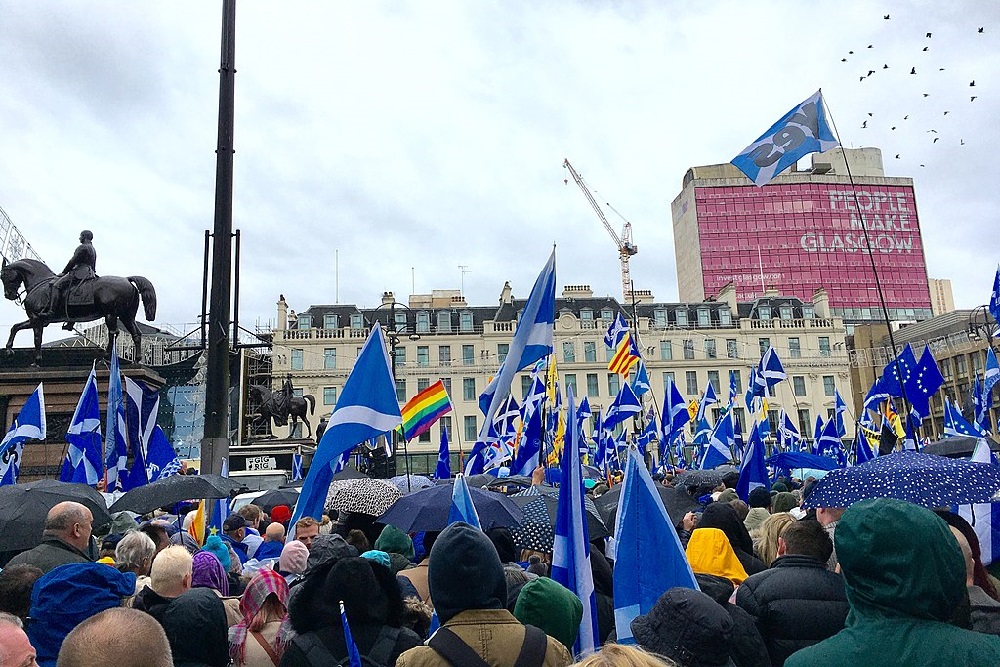
Scottish independence campaigners are “wasting their time” trying to find a legal route to a second referendum, an expert has said.
Professor Aileen McHarg, an expert in public law at Durham University, said those who want to see Scotland leave the UK should instead focus on persuading a “significant majority of the people that that is the best constitutional route”.
She argued a second independence vote could be held “if it becomes impossible to deny that is what the people of Scotland want”.
SNP leader and First Minister John Swinney is focused on his winning a majority in next May’s Holyrood election as a means of getting the UK Government to allow a fresh vote on independence.
But Prof McHarg told MSPs: “That’s not very likely to happen.
“It doesn’t seem to me to be very sensible if you want another referendum to tie yourself down to something like that.”
Experts appearing before the Constitution Committee, which is examining the mechanism for securing any second referendum, insisted that claims at the time from former first minister Alex Salmond and Nicola Sturgeon that the 2014 vote would be a “once in a generation” event were campaign “rhetoric”.
“Rhetoric”
Adam Tomkins, a former Tory MSP who is a professor of public law at Glasgow University, said such remarks were “political rhetoric, not constitutional convention”.
Noting there have been two referendums on the UK’s membership of the European Union, and two devolution votes in Scotland, he added: “It is self-evidently not the case in the United Kingdom that once you have had a referendum you cannot have another referendum on the same issue some time later.”
Similarly, Prof McHarg said the “once in a generation” comments were “campaign rhetoric” rather than being “any sort of intention to create a promise you wouldn’t seek another one for a generation”.
Instead, she said any second referendum is “simply a question of when the time is right”.
Prof McHarg told MSPs: “I don’t think we will get a second referendum of the nature of the 2014 referendum, which was really very much a process of opinion forming. That was a unique and one-off situation.
“But I think we might get to the situation where a second referendum, a confirmatory referendum, as the 1997 devolution referendum was a confirmatory referendum of an already established and clearly evidenced will for the people of Scotland to have their own Parliament.
“I do think that is where the energies of independence campaigners should be directed.
“They are, in my view, wasting their time looking for a legal route to independence – if they want Scotland to be independent they need to be persuade a significant majority of the people that that is the best constitutional route.”
Prof Tomkins, who stressed he was not appearing before the committee in a party political capacity, suggested a “better way of doing an independence referendum than what we did in 2014” would be to have such a vote “only after we have pretty much determined what the answer is going to be”.
Also highlighting the 1997 devolution vote, he said: “It is what happened in 1997, and I think if we want to learn from our experience we might want to emulate 1997 more than we want to emulate 2014.”
As it stands, he said there “doesn’t seem to be a great deal of evidence” that support for independence is the “settled will” of Scots.
Prof Tomkins said: “Settled will is a reflection of the fact that momentum is now behind an idea or a project or a reform or a change.
“It would clearly be contrary to the settled will of the Scottish people for anybody to take independence off the table.
“But equally it seems to me to be only a minority position at the moment that independence should be pursued as a matter of pressing priority right now.
“It seems to be the case that people want independence on the horizon, but no closer than that, thank-you very much.”
Support our Nation today
For the price of a cup of coffee a month you can help us create an independent, not-for-profit, national news service for the people of Wales, by the people of Wales.



Exactly. Get a majorityof pro indy. MSPs and declare UDI. The will of the people is sacred and, in a democracy(?) cannot be denied. The London parliament will not aquiese to Welsh and Scottish INDY any other way
Instead of organising a controversial referendum perhaps they could organise an invite-only informal opinion poll restricted to those with a Scottish tax id.
The Scottish people, and they alone, should have the power to decide if and when referendums on Scottish independence occur. It’s a moral outrage that – with 84% of MPs being English – these decisions are effectively made by England. Thus, Scotland is a captive nation, comparable to a shotgun wedding with divorce not permitted. In contrast, the Good Friday Agreement (1998) decrees that Northern Ireland’s people decide on referendums for it to leave the UK. This blatant discrimination against Scotland is indefensible. Wales is in a similar position.