


Indigenous people from Brazil visit Wales to discuss links between food consumption and deforestation
Martin Shipton
Two charities have produced a report showing the global impact of consuming five everyday food products in Wales.
Building on a 2021 report, WWF Cymru and Size of Wales have published new data showing that, despite global commitments to halt and reverse deforestation, the situation has worsened.
Wales and Global Responsibility II traces the global impact of our consumption of soy, beef, palm oil, cocoa and coffee – identifying where they come from and their links to forest and habitat loss, greenhouse gas emissions, child or forced labour, and the abuse of indigenous peoples’ rights.
Producing Welsh imports of these five commodities required an average overseas land area equivalent to Pembrokeshire and Ceredigion combined between 2011 and 2025. The emissions linked to deforestation and land conversion for these commodities have risen to 1.40m tonnes of CO2e, from 1.37m in 2011–18 – one quarter of Wales’ annual transport emissions.
Brazil accounts for Wales’ largest overseas land footprint through imports of soy, beef and coffee. It is also home to the Guarani indigenous people, whose ancestral territories lie in the threatened Atlantic Forest – one of the five global hotspots. The report identifies UK imports of soy and beef from municipalities containing Guarani territories, highlighting a realistic risk of connections to Welsh supply chains.
Shea Buckland-Jones, Head of Policy and Advocacy at WWF Cymru, said: “At COP26 in 2021 Wales was among 140 countries pledging to halt and reverse deforestation by 2030. Yet in 2026, we’re still contributing to catastrophic deforestation, habitat loss and associated social impacts. The Welsh Government must use every lever at its disposal to help eliminate these harms from its supply chains.
“This report sets out the solutions – such as aligning the Sustainable Farming Scheme with deforestation-free goals and supporting farmers to produce high-quality food without relying on imported soy and palm-based feed.”
Imported beef still has the largest overseas land footprint of the commodities highlighted in the report, but imports have fallen since 2011–18. The share from Brazil has dropped from 26% to 14%, with more beef now sourced from lower-risk EU countries.
Soy is the main growing concern. Wales imported an average of 186,000 tonnes annually between 2011 and 2025, requiring land equivalent to the size of Conwy. Only around 9% is eaten directly by people. The rest is fed to livestock, with over half consumed by poultry on intensive farms. As the number of poultry housed in intensive poultry units in Wales rises, so too does the demand for soy. Most of it comes from countries at high risk of deforestation and/or social harm, such as Brazil, Paraguay and Argentina.
Palm oil and coffee are most likely to come from countries rated as posing a high or very high risk of deforestation and/or social harm. Yet soy’s footprint is so vast that its high-risk production area is nearly twice that of palm oil.
For the Guarani people in southern Brazil, expanding soy cultivation threatens forests, their ancestral territories, livelihoods and culture. Through their partnership with Size of Wales, Guarani people are protecting and restoring the Atlantic Forest while defending their rights and way of life.
Three Guarani leaders working to protect and restore their ancestral territories have visited Wales, bringing first-hand testimony of how global supply chains affect their communities and environment.
Soy production
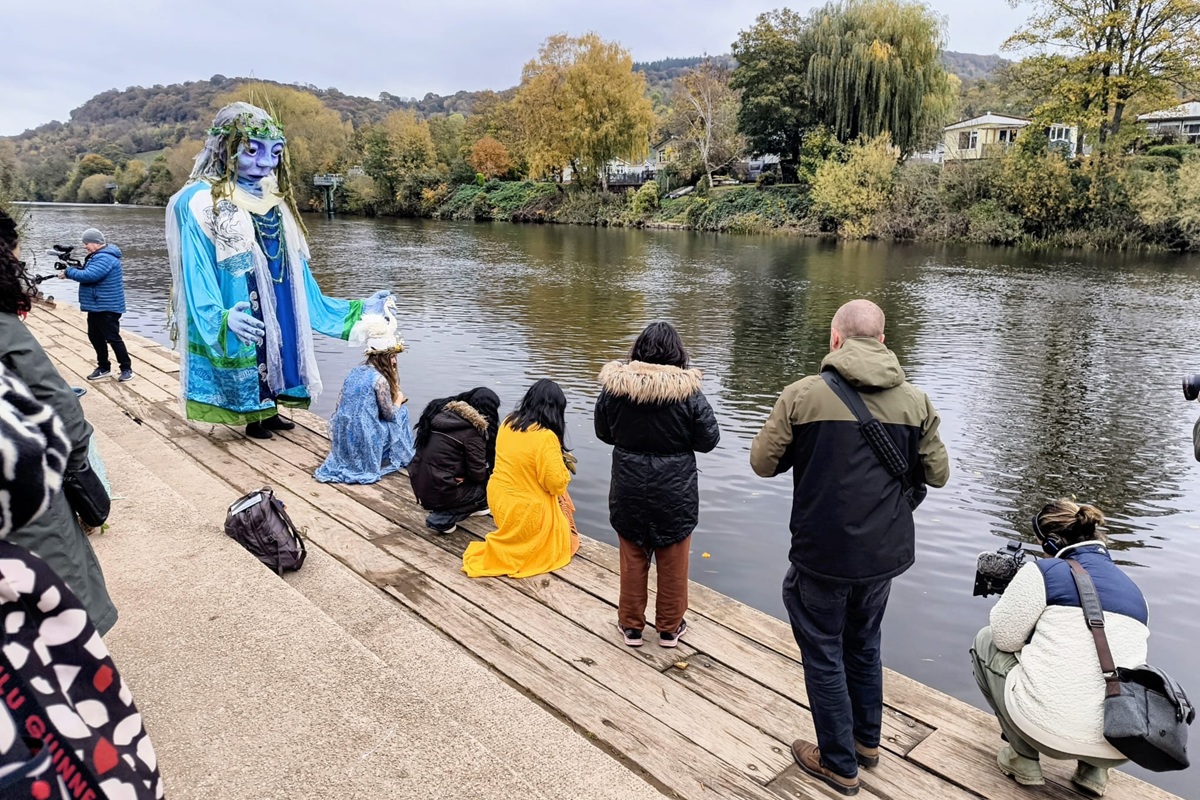
On the banks of the River Wye, they shared the impact of soy production on their region and met young people and others who are campaigning for sustainable school dinners and taking part in citizen science. Together, they explored the connections between livestock feed, pressures on Welsh rivers and threats to forests in Brazil – sharing knowledge and identifying action to protect nature and communities in both places.
Barbara Davies-Quy, Deputy Director of Size of Wales, said: “Our partnership with the Guarani and their visit to Wales show how food and farming decisions here can affect forests, rights, culture and livelihoods thousands of miles away.
“Everyone in Wales can help protect forests through the food we eat and the changes we ask for. Eating less but better-quality meat, dairy and eggs from nature-friendly farms, choosing more beans and pulses, and cutting back on ultra-processed foods can make a difference.
“We can also encourage schools and councils to become Deforestation Free Champions and ask businesses to show how they are keeping deforestation and human rights abuses out of their supply chains.”
Global responsibility
A joint statement from the two charities said: “Global responsibility is no longer optional – it’s critical to protecting people’s lives, livelihoods, and economic security at home. A recent UK Government National Security Assessment shows that biodiversity loss and ecosystem collapse pose a threat to national security, food supply and economic stability. Under the Well-being of Future Generations (Wales) Act 2015, Wales has a legal duty to consider the global impact of decisions made at home. But the clock is ticking. In 2025, 4.3 million hectares of primary tropical forest were lost, roughly equivalent to 11 football pitches every minute. The impact of such destruction is also felt at home, contributing to rising food prices, unstable supply chains and increased costs for households across Wales. When crops fail or global markets fluctuate, the price of everyday essentials, from bread to coffee, rises.
“At the same time, this environmental catastrophe is accelerating climate change, fuelling more frequent and severe extreme weather here in Wales with storms, flooding and droughts damaging homes and disrupting our communities.
“Progress is already under way in Wales. Monmouthshire County Council and Caerphilly County Borough Council have built deforestation-free standards into food procurement and school meal sourcing. The Future Generations Commissioner has recommended that the Welsh public sector become fully Deforestation Free by 2028.
“More than 30 schools have become Deforestation Free Champion Schools. Pupils are auditing menus, tracing the impact of ingredients and developing more sustainable recipes. Welsh partnerships are also supporting tree growing in Uganda and Indigenous-led forest protection in the Peruvian Amazon – proof that action in Wales can drive change worldwide.”
Support our Nation today
For the price of a cup of coffee a month you can help us create an independent, not-for-profit, national news service for the people of Wales, by the people of Wales.
Get more trusted Welsh news
Choose Nation.Cymru as a preferred source in Google News to see more of our journalism.


