


Interactive ammonia map launched highlighting crisis caused by intensive farming
Stephen Price
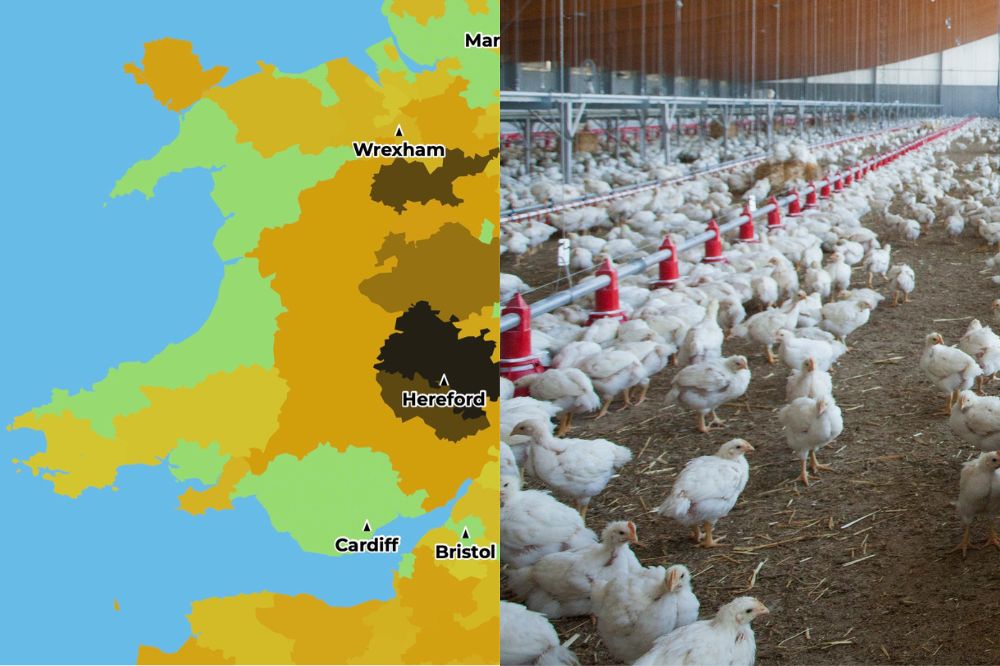
A new interactive ‘Ammonia Map’ has been launched which shows vast amounts of ammonia emissions from intensive chicken and pig farms in location across Wales – particularly in Welsh counties bordering England.
Compassion in World Farming and Sustain recently released their ‘Ammonia Map’ which, for the first time, indicates the vast amounts of ammonia emissions from intensive chicken and pig farms in the UK.
These emissions are fuelling a growing crisis that is impacting the welfare of the animals trapped in factory farms, our environment and our health.
Ammonia, a nitrogen based gas, may be essential for food production, but the UK’s industrialised agricultural system is now releasing it beyond levels our ecosystems can absorb.
The interactive map details the impact of intensive farming which is particularly concentrated in counties bordering England such as Powys and Monmouthshire – with neighbouring counties across the border such as Shropshire and Herefordshire producing some of the highest across the UK, impacting Welsh communities and water courses such as the Wye and Usk rivers.
Welsh locations of note include:
- Factory farming in Montgomeryshire and Glyndwr can produce up to 807 tonnes of ammonia every year.
82 is released directly from farms and 725 is emitted after manure is spread on fields. - Factory farming in Ynys Môn can produce up to 493 tonnes of ammonia every year.
48 is released directly from farms and 445 is emitted after manure is spread on fields. - Factory farming in Brecon, Radnor and Cwm Tawe can produce up to 935 tonnes of ammonia every year.
91 is released directly from farms and 844 is emitted after manure is spread on fields. - Factory farming in Monmouthshire can produce up to 735 tonnes of ammonia every year.
72 is released directly from farms and 663 is emitted after manure is spread on fields.
However, a number of English counties are having an even greater impact which is being felt on both sides of the border – in both the atmosphere and in our water courses:
- Factory farming in North Shropshire can produce up to 2071 tonnes of ammonia every year.
358 is released directly from farms and 1713 is emitted after manure is spread on fields. - Factory farming in South Shropshire can produce up to 1708 tonnes of ammonia every year.
211 is released directly from farms and 1497 is emitted after manure is spread on fields. - Factory farming in North Herefordshire can produce up to 2992 tonnes of ammonia every year.
305 is released directly from farms and 2687 is emitted after manure is spread on fields. - Factory farming in Hereford and South Herefordshire can produce up to 1965 tonnes of ammonia every year.
209 is released directly from farms and 1756 is emitted after manure is spread on fields.
UK agriculture is responsible for 89% of national ammonia emissions according to Compassion in World Farming (CiWF)’s report, The Ammonia Pollution Problem, which reveals that as factory farming has intensified, so has the scale of the harm.
Once released into the air, ammonia reacts with other pollutants to form fine particulate matter (PM2.5) – one of the most dangerous forms of air pollution. These tiny particles penetrate deep inside our lungs and bloodstream, and have been linked to serious health issues, from heart disease and strokes to lung cancer and asthma, and long-term exposure is increasingly linked to type 2 diabetes and dementia.
Compassion in World Farming (CiWF) Patron and NHS doctor, Dr Amir Khan, said: As a GP, I see firsthand the toll that air pollution takes on people’s health – and ammonia from intensive farming is a major, yet often overlooked, part of that problem.
The fine particulate matter formed from ammonia exposure drives heart disease, stroke, asthma and chronic lung conditions, and it is our most vulnerable patients who pay the price.
Reducing these emissions is not just an environmental issue; it is an urgent public health priority, according to CiWF.
Under assault
The environmental impacts are equally severe. Excess nitrogen from ammonia deposition acidifies soils, fuels algal blooms, and degrades ancient woodlands, grasslands, wetlands and freshwater habitats. Intensively farmed animals suffer too. Inside industrial livestock units, high ammonia concentrations irritate eyes and respiratory systems, increasing stress and susceptibility to disease.
For many rural residents, the crisis is already taking its toll. One resident who lives in the shadow of a large poultry operation and suffers as a direct result of the ammonia. She said: When the chicken sheds are cleaned out, the smell and the polluted air hits me straight away – my chest tightens, my eyes sting, and I have to shut every window in my house just to cope.
“I’m asthmatic, and for days I can’t even step into my own garden. This isn’t just a countryside smell – it’s a serious health risk, and it’s getting worse.”
Whilst communities living nearest to factory farms may face higher exposure to ammonia and PM2.5 pollution, it can reach far into towns and cities across the UK.
Nationally, agriculture contributes up to 39% of urban particulate pollution, underscoring the clear link between farming practices and public health.
Anthony Field, Head of CiWF’s UK office, said: “The spread of industrial factory farming must stop. Factory farming sits at the heart of the UK’s ammonia crisis.
“By cramming large numbers of animals into confined spaces and relying heavily on fertilisers, these intensive systems release far more ammonia than the environment or our bodies can cope with.
“The result is a cascade of harm – to the animals living in these conditions, to the people breathing the polluted air, and to the ecosystems absorbing the excess nitrogen.
If we are serious about protecting public health and restoring the natural world, we must confront the role of industrial livestock production and rethink how we produce food.”
Call on your MP to support action to end the expansion of factory farming and reduce ammonia pollution.
Support our Nation today
For the price of a cup of coffee a month you can help us create an independent, not-for-profit, national news service for the people of Wales, by the people of Wales.
Get more trusted Welsh news
Choose Nation.Cymru as a preferred source in Google News to see more of our journalism.



When they say “particularly in Welsh counties bordering England” perhaps they didn’t check the map they published. See links. It should read “particularly in English counties bordering Wales.” A lesson in geography. Herefordshire is not in Wales. At issue is intensive poultry. Bird poo. The double agricultural subsidy is the problem, one payment to grow the grain and another payment to feed it to chickens. It what makes chicken so cheap in the supermarket. A good change is to reduce the subsidy paid to grain farmers and switch it to free range organic husbandry like cattle and sheep, who graze… Read more »
Chicken and eggs make meals affordable. Really I would love to change it for lamb and beef, but they are simply unaffordable to someone on a budget.
And as for the claim that the ammonia cannot be taken in by the environment is simply bull. It readily dissolves in rainwater destroying any acidity immediately and absorbed as free fertiliser by the soil
Indeed, the major contributor to ammonia emissions in the UK is cattle farming . A number that is more than double that of the aggregate of all other forms of livestock farming. Whilst the emissions from cattle farming have been steady for the last 35 years that from the other livestock producers has halved. re Accredited official statistics Emission of air pollutants in the UK – Ammonia (NH3)
AI Overview +11 Ammonia ( N H 3 𝑁 𝐻 3 ) does dissolve in rainwater and can act as a fertilizer, but the claim that it simply destroys acidity and acts as a harmless “free fertilizer” is not supported by environmental science. While it can neutralize acids in the air, ammonia deposition often causes significant long-term soil acidification and ecological damage. TBIJ TBIJ +4 Here is a breakdown of the chemistry and environmental impact: Atmospheric Interaction: Ammonia is a basic (alkaline) gas. It readily dissolves in rain and reacts with atmospheric acids, such as sulfuric acid and nitric acid,… Read more »