


Landfill inquiry due to report back by Christmas
Alec Doyle, local democracy reporter
The Senedd Petitions Committee is expected to publish its report on Hafod landfill site’s nuisance odour problems before Christmas having heard evidence from all sides of the dispute.
The committee of Senedd members, chaired by Carolyn Thomas MS, heard the final instalment of evidence from lead petitioner Steve Gittins evidence on Monday.
Mr Gittins laid out residents’ case for the closure of the site, detailing 20 years of odour complaints and challenging data supplied by site operators Enovert, Natural Resources Wales and Wrexham County Borough Council.
The committee quizzed those three parties about residents’ claims and their desire to see the landfill site closed for good.
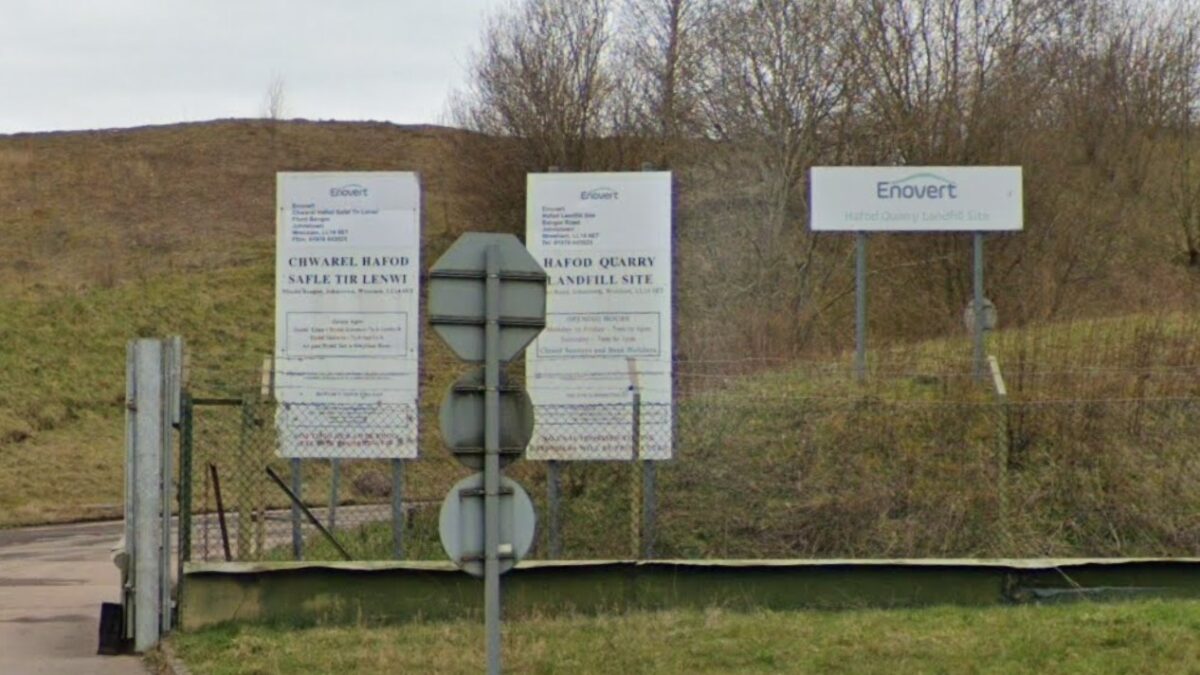
Situated between Johnstown and Ruabon, Hafod landfill takes in solid waste and non-hazardous biodegradable industrial commercial waste. Around 54% of that comes from England with the rest transported from other areas of Wales.
It siphons off the landfill gas generated and turns it into electricity. But some of that gas is regularly escaping, causing a terrible smell and potential health problems according to nearby residents.
In his evidence NRW Senior Adviser James McClymont said visits to the area had increased significantly since odour complaints began to rise two years ago.
“In October 2023, we started getting a rise in complaints,” he said. “We did visit the site and found areas that needed improvement.
“We issued an enforcement notice which required the operator to undertake certain actions, including increasing temporary capping at the site, and look at adding new gas wells to extract the landfill gas.
“We gave them a long list of actions and the operator complied with that notice. If they hadn’t undertaken those tasks it would have led to a prosecution.
“Since then we’ve inspected the site on a regular basis We’ve conducted 16 site inspections since November 2023. Ordinarily for a site with poor management we would visit four times a year, so we’ve gone above and beyond to check the actions.”
Hydrogen sulphide
According to residents the issue is the emission of hydrogen sulphide, a smelly gas produced by waste as it breaks down.
Residents complain that the repeated escape of this gas has blighted their lives for two decades, and that cannot face another 15 years of it under the current waste licence.
That is why Mr McClymont said NRW has been has been sending inspectors to Johnstown and Ruabon almost weekly since 2023 to monitor the situation.
Enovert CEO Mark Silvester opened his evidence by admitting that trust needed to be rebuilt with the community following incidents of increased odour over the past few years.
“Given recent criticism of the site through odour complaints I think it’s clear that further engagement with the communities around the site could only be of benefit to us and the community,” he told the committee.
But he went on to state that there had not been too many complaints about nuisance odours coming from the site by the community.
“Historically the site has had quite low numbers of odour complaints,” he said. “It seemed to peak in 2023 after some of our works were delayed due to weather.
“To mitigate that we brought works forward and started to use plastic capping, which is not weather dependent.”
Rainfall
On the key issue raised by residents of whether rainfall made the odours coming from the site worse – there was uncertainty.
Mr McClymont said: ” We’ve got complaints data going back to 2007 and there’s no evidence that odours are worse in the winter months. There is a link between leachate levels (contaminated liquid that runs off the surface) and fugitive emissions of odour. That’s why we are asking the operator to focus on leachate management.”
Mr Silvester meanwhile said that the correlation had not been recognised by Enovert.
“I don’t think we’ve particularly noticed that on site,” he said. “We have a weather station on site so it wouldn’t be hard to do a comparison based on weather patterns.
“There is certainly no link between that and gas extraction. From a waste odour perspective it could be an influence much like rain falling on a manure pile increasing the smell, but we have not looked into that.”
Monitoring data collected by sensors around Hafod landfill and in the community has been challenged by residents since the spring, when additional community monitoring began.
At the enquiry, Mr Silvester claimed Enovert had been pressed to release data too early and that equipment was now being properly calibrated to ensure more reliable data is published in future.
“When Wrexham Council Public Health issued the initial data set in March/April it was published on the basis that it wasn’t to be relied upon,” he said.
“There was pressure externally to provide it before we’d had a chance to collect enough data to undertake the calibration of monitoring equipment.
“I think that’s why we’ve found ourselves in the position where the data has been questioned.”
Data
Despite this Mr Silvester insisted that all data gathered to date shows hydrogen sulphide levels below the health risk threshold.
“Alongside the primary monitoring has used diffusion tubes to measure air quality,” he said. “That data has come back to show all the readings are below the ATSDR (Agency for Toxic Substances and Disease Registry) and USEPA (United States Environmental Protection Agency) relevant limits.
In terms of leachate management Enovert are installing 5000m sq of capping and a fully automated pumping system to extract leachate. They have also undertaken a CCTV camera survey to ensure its leachate wells are working as they should be and they are reviewing their leachate management plan.”
Evidence given by Mr Gittins on behalf of residents claimed levels of hydrogen sulphide in the atmosphere were harmful to health.
Wrexham County Borough Council’s Toby Zorn, the Public Health Team’s Environmental Health and Housing Standards Team Lead, agreed with Mr Silvester’s claim however that hydrogen sulphide levels remain below the level of health risk.
“The data has indicated that there has on some occasions been breaches of the odour threshold,” he said. “But absolutely nothing on any health indication standards, for instance the World Health Organisation standard of 150 parts per billion over 24 hours. we’ve never been near that standard.”
Addressing residents’ desire for Wrexham Council to shut down the landfill site, Mr Zorn admitted they had the power, but the process was complex.
“We do have the power to serve an abatement notice under section 80 of the Environmental Protection Act for specific nuisances,” he said. “To determine a statutory nuisance you must look at the frequency, the level of nuisance and to determine if we are satisfied there is a statutory nuisance.
“The problem is at the point of serving the notice we have to specify what works are required to abate the nuisance.
“If that work is underway, there wouldn’t be anything further we could add to that.
“In addition we wouldn’t be able to take further legal action, such as prosecution for non-compliance, without the permission of the secretary of state because the enforcing authority is NRW.”
Support our Nation today
For the price of a cup of coffee a month you can help us create an independent, not-for-profit, national news service for the people of Wales, by the people of Wales.


