


Migration fuels second largest annual jump in population in over 75 years
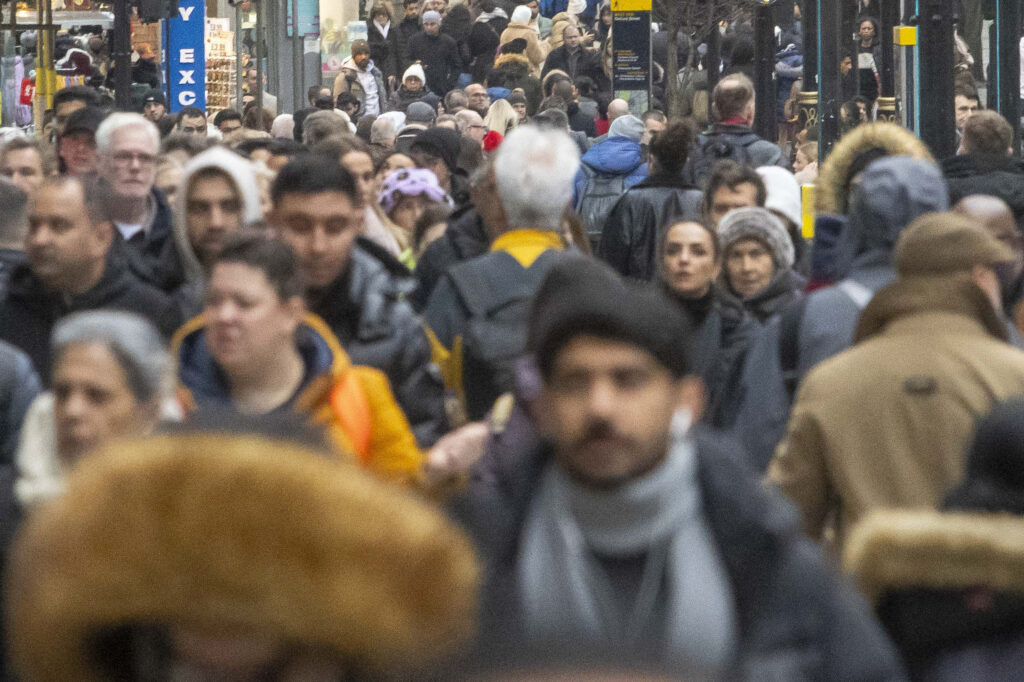
The population of England and Wales is estimated to have jumped by more than 700,000 in the year to June 2024, the second largest annual numerical increase in over 75 years, figures show.
Almost all of this rise was due to international migration, with natural change – more births than deaths – accounting for only a small proportion.
There were an estimated 61.8 million people in England and Wales in mid-2024, up 706,881 from 61.1 million in mid-2023, according to the Office for National Statistics (ONS).
Net international migration – the difference between people moving to the country and leaving – was the “main driver” of the jump in population and accounted for 98% (690,147) of the increase, the ONS said.
The number of people living in England and Wales has risen annually since mid-1982, with migration contributing most to population growth every year since mid-1999.
Before then, increases were caused mainly by natural change.
Jump
The rise of 706,881 in the 12 months to June 2024 is the second biggest year-on-year numerical jump in population since at least 1949, which is the earliest comparable ONS data.
It is behind only the rise of 821,210 that took place in the preceding 12 months from mid-2022 to mid-2023.
This means the population is estimated to have grown by 1.5 million between June 2022 and June 2024: the largest two-year jump since current records began.
Nigel Henretty of the ONS said: “The population of England and Wales has increased each year since mid-1982.
“The rate of population increase has been higher in recent years, and the rise seen in the year to mid-2024 represents the second largest annual increase in numerical terms in over 75 years.
“Net international migration continues to be the main driver of this growth, continuing the long-term trend seen since the turn of the century.
Change in rules
Some 1,142,303 people were estimated to have immigrated to England and Wales in the 12 months to June 2024, while 452,156 were likely to have emigrated, giving a figure of 690,147 for net international migration.
This is lower than the equivalent figure for the previous year to June 2023, when net migration is estimated to have been 833,696.
The drop is likely due to a fall in 2024 – previously reported by the ONS – in the number of foreign nationals from outside the EU coming to the UK on work and study visas, along with a rise in students leaving at end of their courses.
Changes in migration rules introduced in early 2024 by the previous Conservative government included restricting the ability of most international students to bring family members with them to the UK, as well as banning overseas care workers from bringing dependants.
There were slightly more births (596,012) than deaths (566,030) in England and Wales in the year to June 2024, which added 29,982 to the population.
By contrast, internal migration from the two nations to elsewhere in the UK was higher (at 56,300) than the number of people moving in the other direction (42,693), meaning there was a net decrease in internal migration of 13,607.
Overall, the size of the population of England and Wales grew by an estimated 1.2% in the year to June 2024, down slightly from 1.4% in the previous 12 months but above 1.0% in the year to mid-2022.
It is also higher than levels in the previous decade, which averaged 0.7%.
England saw a faster rate of growth in the 12 months to mid-2024, 1.2%, than in Wales, 0.6%.
Regionally, annual growth ranged from 1.4% in north-west England to 1.0% in London.
Natural change in the year to mid-2024 increased the size of the population in four regions: London, south-east England, the West Midlands and eastern England.
The other regions had negative natural change, which reflects “a long-term decline in fertility and an increasing number of deaths because of the growing proportion of older people”, the ONS said.
London had the highest rates of natural change and net international migration, but these were partially offset by net outward internal migration to other UK countries or regions in England.
Across the 10 years from mid-2014 to mid-2024, the East Midlands has seen the highest level of growth at 9.1%, while north-east England has seen the lowest at 5.8%.
The total population of England and Wales is estimated to have grown by 7.6% over these 10 years, an increase of nearly 4.4 million people.
Support our Nation today
For the price of a cup of coffee a month you can help us create an independent, not-for-profit, national news service for the people of Wales, by the people of Wales.



Please note that all the figures quoted are estimates. The UK does not record people leaving the UK – you do not go through passport control when you leave, so there is no identification of those who leave to count UK holiday-makers, foreigners going home, Visa-holders returning to their country, those leaving for long-term residency elsewhere, or for any other reason. They can’t even count people arriving in the UK properly because there are no border checks between Northern Ireland and Eire. The error in the estimated population count is probably greater than the alleged 700,000 increase. Overall, the numbers… Read more »
To save money.
I suspect the population is nearer 70 million. Regardless of where these people come from or why it is unsustainable. We do not have the infrastructure to cope with this volume of people. The Greek minister for immigration put it very well today explaining that he had a responsibility to the Greek people. We need to restrict immigration to licensed people required by the economy and regulate the whole thing better. That means immediately or rapidly deporting illegal migrants making it clear that their cases will not be considered if they enter illegally. We need to introduce identity cards for… Read more »
“cases will not be considered if they enter illegally”
The asylum system requires people to get here before lodging their claim. If you want to stop this you’ll need a way to lodge asylum claims from outside of the UK, perhaps at embassies.