


National Trust misses deadline in coast path access row
Martin Shipton
An extraordinary dispute between the National Trust and an adventure company over access to part of the Wales Coast Path has taken a new turn, with the charity failing to meet a deadline to respond to points made by the company.
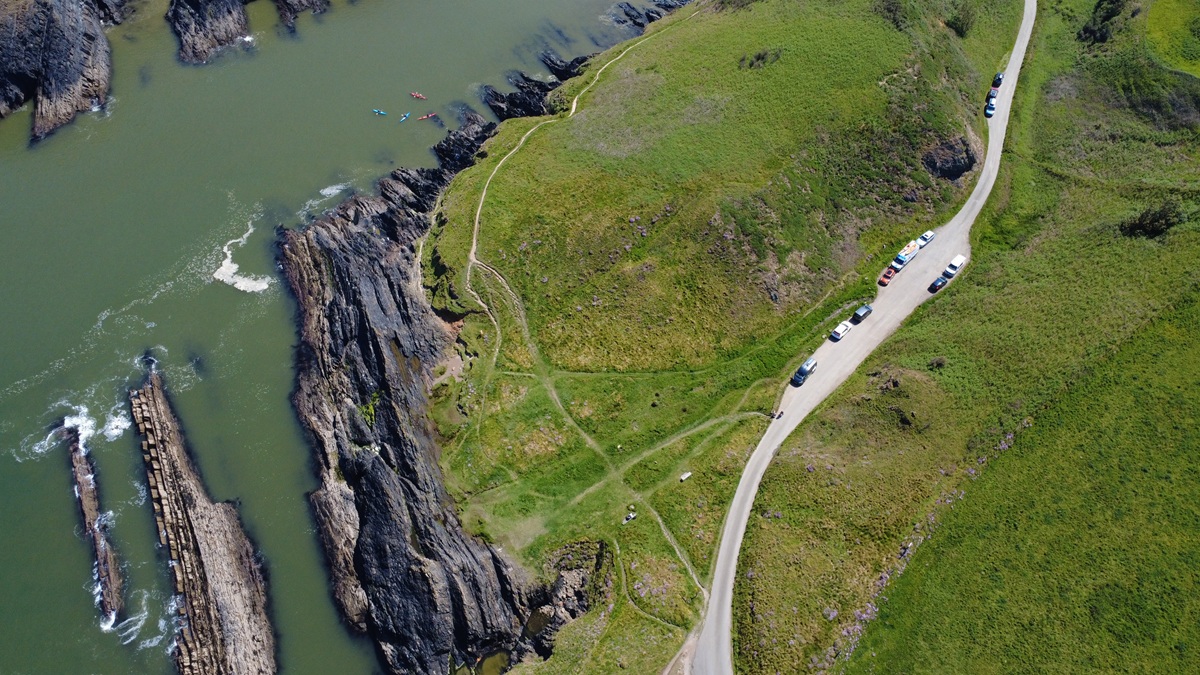
Last month Nation.Cymru reported how Adventure Beyond Ltd, a family “coasteering” and sea kayaking business at Ceibwr Bay in north Pembrokeshire that has operated for more than 30 years, had been issued with a trespass notice by the National Trust.
Now Adventure Beyond has issued a statement making three points that undermine the charity’s claim in the trespass notice that it has a legal right to restrict access to the path: the
National Trust’s own spokesperson told news outlets that the public’s legal rights on the same path are unrestricted; its own information board names the Wales Coast Path as a feature of the land; and Wales’’s statutory environmental regulator has confirmed in writing that the path is signed across it.
On June 2 2026, Natural Resources Wales (NRW) — the statutory body responsible for access to land and the Wales Coast Path — confirmed in writing that the path is signed across the land in question, and that this is verifiable on Google Streetview.
On the same day, 11 days after the trespass notice was issued, a National Trust Cymru spokesperson told The Times: “We are in no way restricting the public’s legal rights to use the Wales Coast Path.” That statement’s recognition of the public’s right of way directly contradicts its solicitors’ assertion that no statutory public right of access exists over the same land. The company points out that the National Trust cannot maintain both positions simultaneously.
Thirdly, the National Trust’s own information board identifies the Wales Coast Path on the land in question. The board, erected by the Trust at the entrance to the land at Ceibwr Bay, carries a map on which the Wales Coast Path is explicitly named, in both English and Welsh, as a feature of the land. The board directs visitors to enjoy the site and invites everyone to keep it special. It contains no suggestion that any visitor requires permission to be there.
Erected on the land the National Trust’s solicitors claim is accessible only by permission, the bilingual header reads: “Bae Ceibwr / Ceibwr Bay.” The accompanying text identifies the Wales Coast Path as a named feature, while a map detail on the same board shows a red dotted line depicting the Wales Coast Path’s walking route along the cliff edge.
A “You are here” dot is placed at the junction of the path and the route from the road around the headland to the shore, precisely on the land the National Trust’s solicitors assert is accessible only by permission.
‘Captured’
Peter Ainsworth, a resident of the adjacent village of Moylegrove and a spokesperson for Adventure Beyond, said: “I live in Moylegrove. I want this place to be enjoyed by everyone — which is exactly what Jet Moore [of Adventure Beyond] has been helping people do for 30 years. The National Trust has been captured by a small number of residents who want public coastal land to function as their private amenity.
“The evidence for that is in their own words. Dagmarr Moore, founder of the Moylegrove Mermaids swimming group, was reported in the Tivy-Side Advertiser as saying: ‘Visitors who speak to us when we’re in the bay say what a beautiful, quiet place it is. Then the adventure providers descend and the peace has gone.’
“And a resident quoted anonymously in The Times said: ‘Lots of people come here to appreciate the quietness and to see the wildlife. It’s wild and remote. It has no parking and no facilities. It’s one of the last unspoilt tiny pieces of the Pembrokeshire coast that you can access and enjoy the views.’
“Neither resident mentions harm to birds. One speaks of personal peace and quiet. The other speaks of parking and unspoilt views. This has always been about privacy, not conservation.
“NRW — the body with statutory responsibility for wildlife in Wales — commissioned an independent scientific survey of the birds at Ceibwr Bay. It concluded that there was no evidence that coasteering affects breeding success. It found that razorbills, guillemots, herring gull, fulmars and choughs — the majority of the species the residents named — are either not designated features of the protected site or do not nest in the survey area at all. The conservation case was always without foundation.
“The National Trust holds Ceibwr Bay as custodian of a gift made to the nation in 1983. Its own signs show the path. Its own spokesperson told the UK-wide press that the public’s legal rights are unrestricted. Wales’s statutory regulator has confirmed the path is there.
“The Trust needs to apologise, withdraw this notice, and follow the science rather than those whose concern was always privacy, not conservation — and let Jet Moore get back to helping the wider public experience this extraordinary place.”
The land at Ceibwr Bay was presented to the National Trust by writer and broadcaster Wynford Vaughan-Thomas and his wife in 1983. A dedication stone bearing their names remains on the land.
Support our Nation today
For the price of a cup of coffee a month you can help us create an independent, not-for-profit, national news service for the people of Wales, by the people of Wales.
Get more trusted Welsh news
Choose Nation.Cymru as a preferred source in Google News to see more of our journalism.



The headline suggests this is simply a coast path access dispute. It isn’t. For years, local residents have raised concerns about the impact of increasing commercial adventure activity on the protected wildlife and habitats of Ceibwr Bay. More than 100 residents wrote to the National Trust asking it to restrict commercial coasteering access across its land in order to help protect this sensitive Marine SAC and SSSI. This has always been about conservation and protecting wildlife for future generations. Unfortunately, that important context is largely missing from the article. * Ceibwr Bay is a protected Marine SAC and SSSI. *… Read more »
But it sounds like the response to those concerns was an actual scientific survey by NRW that found there was NO measurable disturbance. So explain please as the article and your comment suggest this timeline:
1. 100 people are worried about wildlife disturbance
2. NRW conduct a scientific survey to assess wildlife disturbance
3. Survey finds no disturbance
???
Do you acknowledge the survey results? Are you reassured?
Thanks Carl, you have put your finger on it.
The NRW bird report key findings showed that disturbance was seen in herring gulls and that actions were seen that could be detrimental to breeding success of seabirds. It is also important to note that coasteering activity was only observed in close proximity to nesting sites on two occasions during the survey period. This could be considered to be a limited observation window to record disturbance. The NRW report states; “There was no evidence that the productivity or nesting success of breeding seabirds was affected by coasteering group activities, though actions were observed that could be potentially detrimental. In particular… Read more »