


Nearly one in three would vote for Welsh independence, poll finds
Mark Mansfield
Almost a third of likely voters in Wales would vote for independence if a referendum were held tomorrow, according to a new poll.
The Survation poll for YesCymru puts support for independence at 32%, against 68% who would vote No, after undecided and refused respondents are removed.
However, the detailed results show considerably higher support among younger voters, with Yes ahead in each of the three age groups below 45.
Among likely referendum voters aged 18 to 24, 59% said they would vote Yes, compared with 41% who would vote No.
Support stood at 54% among those aged 25 to 34 and 57% among 35 to 44-year-olds.
It then fell to 27% among both 45 to 54-year-olds and 55 to 64-year-olds, and to 15% among those aged 65 and over.
The poll of 1,023 people aged 16 and over in Wales was conducted online between August 13 and 24.
The referendum figures were calculated among respondents likely to vote, factoring in their stated likelihood of doing so and excluding undecided and refused respondents.
A separate question asked all respondents to place themselves on a scale from zero to 10, with zero representing strong opposition to Welsh independence and 10 strong support.
Some 34% placed themselves between six and 10 on the pro-independence side of the scale, while a further 20% chose the midpoint of five.
That meant 54% placed themselves at the midpoint or above, although the figure should not be interpreted as 54% supporting independence, as one in five respondents chose the neutral midpoint.
At the two ends of the scale, 27% chose zero, indicating they were strongly opposed to independence, while 14% chose 10 and said they were strongly in favour.
There were also differences between regions.
Support for independence among likely referendum voters was highest in South Wales West at 42%, followed by South Wales Central at 39%.
It stood at 33% in North Wales, 26% in Mid and West Wales and 25% in South Wales East.
Economy
The poll also asked what respondents believed was the biggest barrier preventing Wales from becoming independent.
Economic fears were by far the most common response, identified by 46%.
Government and political factors were cited by 20%, while 15% said they did not know or had no opinion.
British identity was identified as the biggest barrier by 5%, with the same proportion citing public opposition or a lack of desire for independence.
YesCymru said the findings showed that while almost a third of likely voters were currently prepared to vote Yes, there was a wider section of the public that could potentially be persuaded to support independence.

YesCymru chair Rob Hughes said: “These figures show why we believe a majority for independence is within reach. They also show clearly where the challenge lies. We have to build confidence in Wales’ economic future and make the case for how independence can deliver a better country.
“We do not accept that this is as good as it gets for Wales. We believe our country can do better, and we are determined to make the case for an independent Wales that improves the lives of everyone who calls Wales home.
“That is what our campaign for an independence referendum by 2032 is about. There is substantial support to build on, but a majority will not happen by itself.
“Our task over the next six years is to build that majority, and to give the people of Wales the opportunity to choose their own future.”
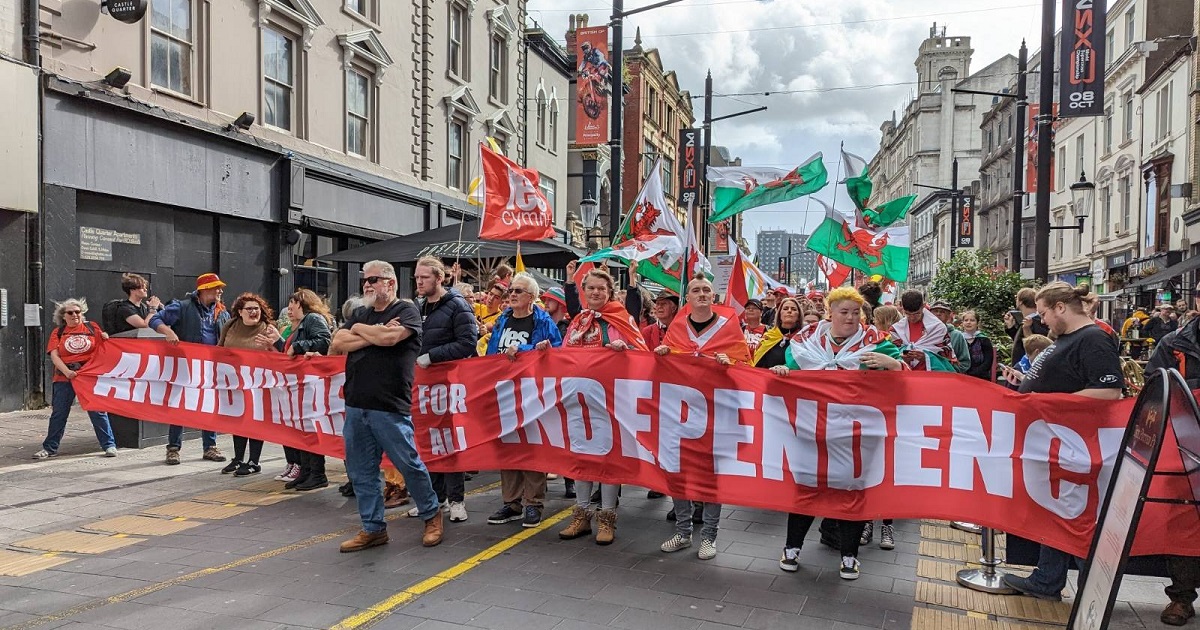
YesCymru launched its 2032 campaign in August, calling for a referendum on Welsh independence by that year. Its next March for Independence is due to take place in Aberystwyth on September 26.
Plaid Cymru
The same Survation poll also puts Plaid Cymru narrowly ahead in Senedd voting intention.
Plaid was on 33%, two points ahead of Reform UK on 31%, with Labour on 14%.
The Conservatives were on 9%, the Greens 6%, Liberal Democrats 5% and other parties 2%.
Those figures are also based on respondents likely to vote, factored by likelihood to vote and with undecided and refused responses removed.
Survation conducted the poll through an online panel on behalf of YesCymru. The data was weighted to the profile of adults in Wales by age, sex, region, highest level of qualification, 2024 general election vote, 2026 Senedd election vote and 2016 EU referendum vote.
Support our Nation today
For the price of a cup of coffee a month you can help us create an independent, not-for-profit, national news service for the people of Wales, by the people of Wales.
Get more trusted Welsh news
Choose Nation.Cymru as a preferred source in Google News to see more of our journalism.



Misleading headline I think. We have seen these polls before but it’s reasonable to assume that the vast majority of the undecided or “refused” wouldn’t vote for independence. Thus the real level of support is no higher than the mid twenties.
But you don’t know that though. Many may just not vote in a referendum. Stop being so pesimistic.
No, I don’t know for sure; but I do know that polling which consistently excludes the undecided cannot logically be accurate.
Am I surprised by this poll? No. Encouraged? Yes – especially when you consider where Wales has come since the failure of devolution in 1979 and the shaky start in 1997. We all know that devolution was deliberately sabotaged by New Labour, which intended to kill it at birth. See devolution was never really meant for Wales, given that Neil Kinnock, Paul Murphy and Lew Smith – all of whom harboured a pathological hatred of Wales and of devolution – shaped whatever devolution, if any, Wales was allowed to have. But if those against independence educated themselves, rather than automatically… Read more »
Here, here. You’re also forgetting an independent Wales will not being paying for nukes on submarines never to be used and a royal parasite family etc.
Yes, you’re right. Trident is a weapon that can never be used. The cost of upgrading it over its 30-year lifespan is estimated to be between £100 billion and £205 billion. Yet we wonder why the cupboard is bare when it comes to the Army, Royal Navy and Royal Air Force.
So we wouldn’t have an army, military hardware, security service?
That would be awesome,at least Cymru would then have no Involvement with the Genocide of The Palestinian people and any involvement with American War Crimes.
Blimey, what mental gymnastics did you do to make that statement?
It seems to me that Wales’ constitutional journey is around 15 to 20 years behind Scotland. In 1979, Wales overwhelmingly rejected devolution, whereas Scotland narrowly voted in favour, although the proposals were blocked because of the turnout requirement. Wales’ narrow Yes vote in 1997 mirrors where Scotland was in 1979. By 2011, Wales delivered a much more convincing endorsement of devolution, similar to how Scottish devolution became increasingly accepted in 1997. In the 2000s, support for Welsh independence was generally below 10%, yet support for Scottish independence was around 32% mark. Likewise, the SNP becoming the largest party in the Scottish Parliament… Read more »
Which means that nearly 70% would not…
Hahaha, Nice try English Nationalist.
I remember about 20 Years ago the number of people wanting Indy was around 3%.Since Brexit the number has only been going one way Onwards and Upwards.
Now go back to watching Daubney and Chrystys on G Crybabies News.