

New Counsel General for Wales faces questions in the Senedd for the first time
Ella Groves, ICNN Senedd Reporter
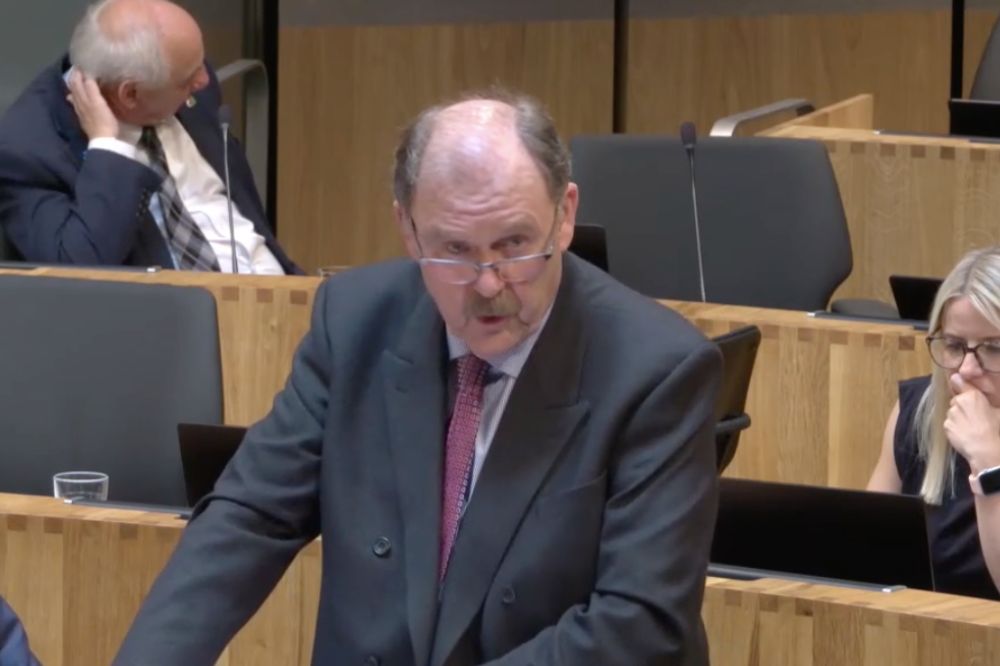
Wales’ new counsel general made his first appearance at Senedd questions, defending his political impartiality while facing scrutiny over grooming gangs, the deteriorating state of court buildings and cross-border NHS care.
Elfyn Llwyd, a former Plaid Cymru MP, was quizzed by Senedd Members on Tuesday June 30.
The counsel general is the Welsh Government’s law officer, as well as the government’s chief legal advisor and representative in the courts – and takes questions from MSs once every four weeks.
“Public interest”
His opposite number on the Reform benches, Adrian Mason, questioned Mr Llwyd on political ambition, impartiality, and transparency.
Addressing Mr Llwyd, shadow counsel general Mr Mason said: “Your duty is not to party line, or to political ends, but to law and public interest. As shadow counsel general, my task is to test the law that this government brings forward.
“I hope our dealings can be serious, fair, and based on law, as opposed to party point-scoring.”
Mr Mason asked Mr Llwyd if he will be guided by the law on matters where “the law and political ambition point in opposite directions”.
Noting that he would be “pleased” to meet with Mr Mason to discuss his shadow brief “at any time”, the counsel general told the Siambr that he would not be “drawn into any political, oblique legal matters at this stage”.
Mr Mason also questioned the counsel general on Plaid Cymru’s constitutional aims, particularly that of independence.
He said: “I remain concerned about your party’s constitutional direction. Changes to the law, the courts, or the powers of this place must be judged by plain tests: what issues will they address, what will they cost, who will be in charge, and have the people of Wales clearly supported them?
“So, will you accept that any major change must be clear, costed, and put to the people in a way they can understand?”
Mr Mason called on the counsel general to ensure he will not support “change by legal or political stealth” and will instead be “fully open with the Welsh people in the transparent way they’re entitled to expect”.
Responding, the counsel general said: “I am here to advise government, without fear or favour.
“That is what I shall do. I shall do my best to give them the best possible legal advice, and it’s for others to decide on future policy, on the constitution, and everything else.”
“Absolutely appalling”
Mike Hedges – who is Labour’s legislation spokesperson – questioned the counsel general for his views on the standard of court buildings in Wales.
He asked if Mr Llwyd had spoken with Lady Chief Justice Carr – the head of the judiciary of England and Wales – and with the Lord Chancellor, to discuss the state of court buildings in Wales.
Describing the state of court buildings as “absolutely appalling”, Mr Llwyd said: “It is a reserved matter, since the Lord Chancellor sends the odd pound or two to repair a leaky roof every now and then. The state of the court buildings are appalling.”
The counsel general confirmed he will be meeting with Lady Chief Justice Carr and will raise the issue in their discussion.
“Awful experiences”
Welsh Conservative leader Darren Millar told the Siambr that just last week, the UK Government’s grooming gangs inquiry identified the first locations that it intends to look at – none of which were in Wales.
Mr Millar described this as “very very disappointing”, noting that previous inquiries have found grooming gang activity in the Swansea area.
He called on the counsel general to reveal what discussions he has had with those responsible for the inquiry “to make sure that no stone is left unturned in identifying the scale of these problems in Wales”.
Mr Llwyd said: “I believe that the way forward for me to answer this question properly is to say that I will engage with my colleague, who has responsibility for negotiations with the bodies that decide where inquiries take place, and that those matters can be properly and deeply investigated, and an answer forthcoming before long.”
Mr Millar highlighted the experiences of victims, sharing the story of Emily Vaughn. He said: “[She] has spoken powerfully about her awful experiences, having been raped hundreds of times by individuals involved in these gangs and having been trafficked from one place to another, and from Wales into other parts of the United Kingdom, in order to suffer that abuse that she experienced.”
Mr Millar called on Mr Llwyd to reach out to grooming gang victims to find out how they want the Welsh Government to influence the inquiry.
The counsel general replied: “The whole chamber has heard what he said, and the whole chamber is disgusted and concerned about what’s happening to these young people – there’s no question about that. But my remit does not extend to what he asks me to do.
“However, he’s been heard loud and clear, and I hope that this could be the beginning of a conversation with colleagues who are able to take it further.
“The matter that he raises is important, but I can tell him this: if I were ever asked to give any legal advice in connection with this, then it would be without fear or favour, always.”
“Routine and essential”
The counsel general was also quizzed on cross-border healthcare arrangements between Wales and England.
Reform MS Andrew Griffin pressed Mr Llwyd to share what legal advice he has provided to the Welsh Government on “the extent to which cross-border healthcare arrangements between Wales and England are underpinned by administrative agreements, or by enforceable statutory or contractual obligations”.
Admitting he is aware of the problems that sometimes occur cross-border, Mr Llwyd described cross-border healthcare as a “routine and essential part of NHS delivery.”
Mr Griffin demanded clarification on whether the counsel general is “satisfied that current cross-border healthcare arrangements would withstand a change in legislative competence without requiring renegotiation”.
Mr Llwyd replied: “There is legislation in Wales and also in England that expressly allows services to be provided and also commissioned across territorial boundaries.
“NHS bodies also have powers and duties to co-operate and work jointly, supporting integrated cross-border provision, and, in practice, these statutory foundations are complemented by structured commissioning and service agreements between organisations.”
Plaid Cymru’s Elwyn Vaughan noted the financial pressures which can arise from cross-border care.
He told the Siambr that, last year, NHS England undertook a “revaluation of emergency care costs” – which led to increased fees above normal inflationary costs which are underwritten by the government.
Mr Vaughan said: “This led to an additional cost of £3.8 million last year, and it’s likely to be an extra £4 million in 2026/27.
“On top of that, Wye Valley NHS Trust is classified by NHS England as a rural area, and gets a premium. However, they then automatically expect Powys to also pay them a premium, which results, to date, to a £13 million bill.”
The counsel general reiterated that the commissioning of NHS services, including cross-border, is a matter for local health boards.
He continued: “Welsh Ministers are aware of the financial pressure facing health boards, including those arising from periodical changes to the NHS England pricing system, which is the agreed tariff for cross-border service provision.
“Decisions taken to recognise specific pressures outside the agreed cross-border mechanisms are not enforceable across borders, and are matters for Wales and England respectively, separately.
“But we continue to engage with NHS organisations and health boards on those pressures, but individual commissioning decisions between NHS bodies are matters for the organisations concerned.”
Jane Dodds, leader of the Welsh Liberal Democrats, also acknowledged the difficulty facing patients in Powys who deal with cross-border care.
She said: “You’re talking about frameworks, you’re talking about seamless services. These words mean nothing to Powys patients who are waiting to have their operations, which will relieve them of pain.”
Ms Dodds called on the counsel general to “change and challenge” the statutory frameworks that underpin cross-border care to allow Powys patients to access English hospitals in the same waiting time as English patients.
Mr Llwyd responded: “What needs to be done, in my submission, is there has to be some form of discussion and/or an official inquiry into the whole issue to see what can be done, because I am aware that it is a serious issue, and I’m aware it needs addressing.”
He continued: “I’m not batting this question away. It’s an important one. All three are. Something needs to be done. But it’s not for me, as counsel general, to say what should be done.
“Plans could come on my desk and I’d be asked whether the legality is okay or whatever – yes, fine, but there has to be some kind of a discussion leading to a new policy framework, maybe on both sides of the border.”
Support our Nation today
For the price of a cup of coffee a month you can help us create an independent, not-for-profit, national news service for the people of Wales, by the people of Wales.
Get more trusted Welsh news
Choose Nation.Cymru as a preferred source in Google News to see more of our journalism.




Reform – always a little paranoid and always wanting to play the victim. So predicable, so sad.