


New hope for critically-endangered Welsh angelsharks
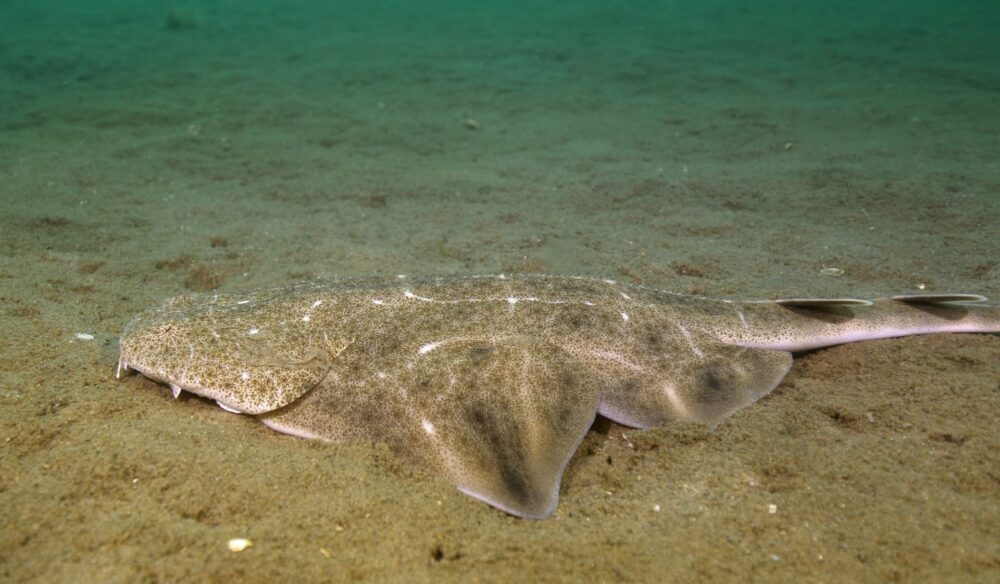
Previous estimates for the decline of critically endangered angelsharks in Welsh waters may have been overestimated, according to new research.
A report from the Zoological Society of London (ZSL), Natural Resources Wales (NRW) and Welsh fishing organisations reveals how a series of changes within the Welsh fishing sector have reduced the likelihood of fishers encountering angelsharks.
This finding comes as the team confirmed how new techniques could help them build a more accurate picture of angelshark numbers around the coast of Wales.
Sightings
Monitoring the DNA left by angelsharks in the water, known as environmental DNA (eDNA) through the shedding of dead skin cells or blood loss from a wound, allows scientists to identify their presence without relying on chance sightings.
This could revolutionise understanding of the species, which was once widespread in the coastal waters of the northeastern Atlantic Ocean, by reducing the reliance on chance encounters with the fish.
Using the expertise of fisherman who have been working across Wales’ coastline for over half a century, the paper’s authors analysed previous estimates of angelshark populations, which suggested numbers have declined by 70% since 1970.
Angelsharks are speckled, caramel-coloured flattened sharks that can grow up to 2.4m long. They are normally spotted either slowly swimming along the seafloor or buried underneath its sandy surface, waiting for smaller fish to swim past for them to catch.
Due to the challenges with monitoring the hard-to-spot species, much of the current scientific understanding comes from fishing reports of accidental catches.
With the new study finding that the chances of fishers encountering angelsharks has decreased due to changes in fishing practices since the 1960s, these estimates could be a reflection of the challenges involved in monitoring angelsharks in Welsh waters, which are believed to be one of the last strongholds of the species.
Hope
Francesca Mason, lead author and ZSL researcher at the Institute of Zoology’s Ocean Predator Lab, said: “This finding offers hope for this critically endangered native species.
“Angelsharks globally have been pushed to the brink of extinction due to damage to their underwater habitat – and although once widespread in waters around the British Isles, this charming yet shy shark is now a rare sight.”
The team from ZSL and Natural Resources Wales (NWR) worked with the Welsh Fishermen’s Association/Cymdeithas Pysgotwyr and Angling Cymru Sea Anglers to interview 27 fishers about their perceptions on ecological, legislative and socio-economic factors that influenced fishing efforts for boats operating in Welsh waters between 1968 and 2019.
While a handful of the 45 factors identified by the team are likely to have increased the chances of angelshark sightings, the majority of factors – such as changes in target species altering where fishers operated, new commercial fishing regulations, and an increase in usage of species-specific gear – mean that it is now less likely fishers will interact with angelsharks, leading to fewer sightings.
Ms Mason added: “Identifying how changes to fishing practices over the last 51 years have impacted our ability to monitor them indicates that there may be more angelsharks swimming off the Welsh coast than we previously thought – we’re just having a harder time spotting them.
“While this is a good sign if less angelsharks are being caught accidentally, it also means we now need new ways to monitor them to build a more accurate picture of how these sharks are doing.
“The work also highlights why conservation works best when we bring people together and combine the knowledge of those living alongside these creatures with cutting-edge research and science.”
Red List
Angelsharks have been listed as Critically Endangered on the IUCN Red List since 2006, and are the fifth most Evolutionarily Distinct and Globally Endangered (EDGE) shark species.
Led by ZSL and NRW, Angel Shark Project: Wales is leading work with Welsh fishers and communities to safeguard the species, as part of the wider work of Project SIARC (Sharks Inspiring Action and Research with Communities) collaborating with fishers to better understand sharks, skates and rays in Wales.
Charlie Bartlett, a charter fisher from Gwynedd and co-author on the study said: “I’ve spent over 50 years working along the Welsh coast, and over the years I’ve come to know these waters inside out. With their large, flat fins, Angelsharks are unlike any other shark we see here – and over the years I’ve been fortunate to encounter the species a number of times.
“Ever since I started working out on the boats, I’ve been interested in understanding more about the marine life in the area – where being part of Angel Shark Project:Wales has been beneficial in understanding more about this unique shark species in the area.
“It’s been great to share personal experiences, pictures and logbook information that have helped to better understand Angelsharks over the years. This information not just being important for the species itself but also inspiring the next generations to learn more about fishing heritage in Wales and the local marine environment.”
‘Excellent camouflage’
Jake Davies, Technical Specialist for Project SIARC at ZSL and NRW, said: “With their excellent camouflage, one of the hardest challenges we face studying angelsharks is simply finding them. eDNA allows us to study species without having to spot them.
“By studying eDNA in Cardigan and Carmarthen Bays, we’ve confirmed the presence of a range of native sharks, skates and rays – including angelsharks – in these more turbulent waters where other monitoring methods aren’t as effective.
“Fishers today may be less likely to come across angelsharks than they were 50 years ago, but through combining this technique with local knowledge, we can continue building a stronger picture of their status and distribution along the Welsh coast.”
Support our Nation today
For the price of a cup of coffee a month you can help us create an independent, not-for-profit, national news service for the people of Wales, by the people of Wales.


