


New poll projects dramatic transformation of Wales’ political map

Mark Mansfield
Wales could be heading towards an extraordinary new political landscape in which Plaid Cymru and Reform UK dominate its representation at Westminster while Labour is reduced to just two MPs, a major new poll suggests.
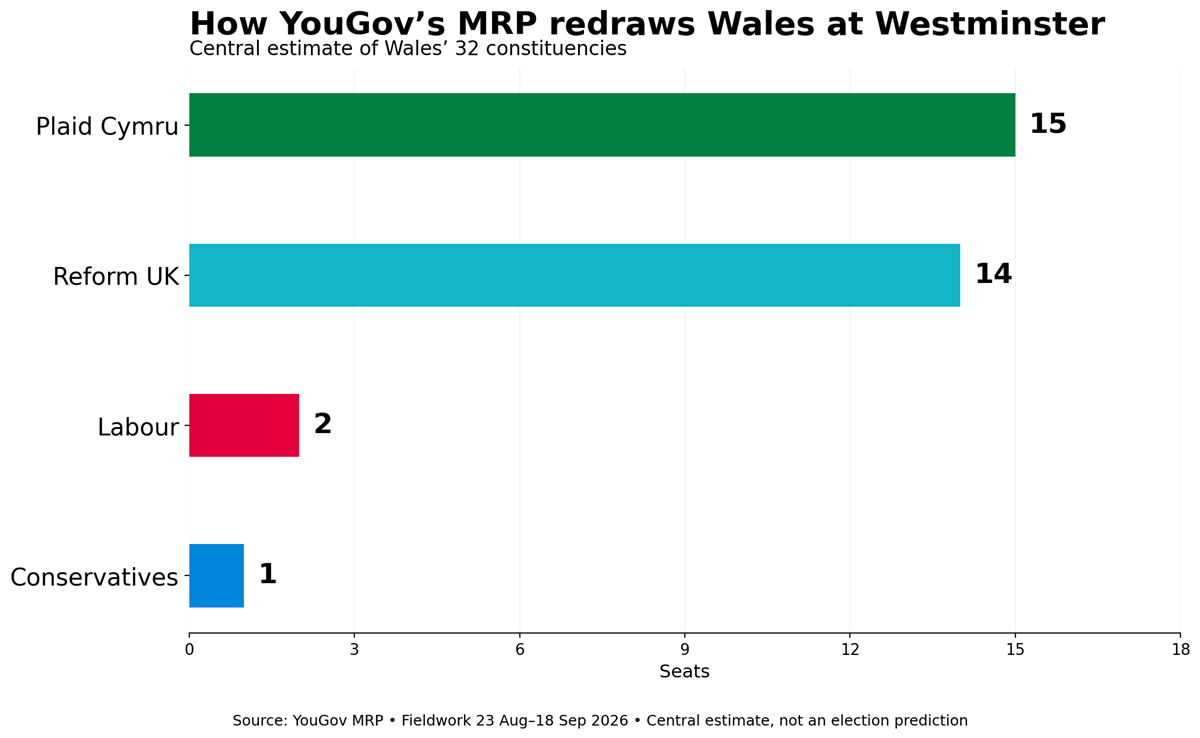
YouGov’s first constituency-by-constituency Multilevel Regression and Post-stratification (MRP) model since Andy Burnham became Prime Minister gives Plaid a central estimate of 15 of Wales’ 32 Westminster seats – a record for the party – with its projections extending as high as 18.
MRP uses a large national polling sample together with demographic and other information to estimate how people are likely to vote in individual constituencies. It allows pollsters to produce seat-level estimates without conducting a separate conventional poll in every constituency.
Reform UK leads in 14 Welsh constituencies in the central estimate, while Labour – which won 27 seats in Wales at the 2024 general election – is left with just two. The Conservatives take the remaining seat.
But Reform’s apparently strong position in Wales comes despite a significant decline in its Westminster support since May.
The latest Barn Cymru/YouGov Westminster polling put Reform on 19%, down seven points from 26% in May, while Labour climbed 10 points to 18%. Plaid was comfortably ahead of both on 27%.
That fall had already taken place before the turmoil which subsequently engulfed Reform’s Welsh operation, including Dan Thomas standing down as Welsh leader and Sarah Cooper-Lesadd defecting to Plaid Cymru.
There is not yet polling evidence showing what effect, if any, those events have had on Reform’s support.
The new MRP nevertheless has Reform ahead in 14 of Wales’ 32 Westminster constituencies.
But many of those projected victories are precarious.
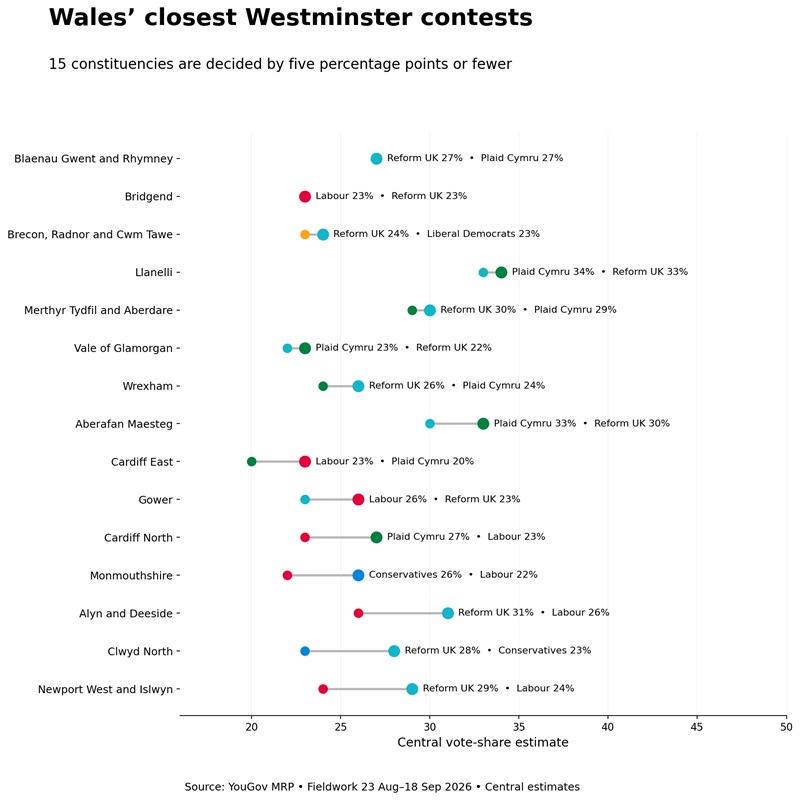
Seven of Reform’s 14 Welsh leads are by five percentage points or fewer.
Bridgend is effectively tied in the central estimate, while Reform leads by only one point in Brecon, Radnor and Cwm Tawe and Merthyr Tydfil and Aberdare.
Its advantage is two points in Wrexham and five in Alyn and Deeside, Clwyd North and Newport West and Islwyn.
The pattern is also evident across Britain. YouGov’s central estimate gives Reform 123 seats, but 67% of those victories are by margins of five points or fewer.
That leaves many of its projected gains exposed to relatively small movements in support between now and an election.
Tactical voting could add another complication.
YouGov’s separate research found that, in a constituency seen as a Labour-Reform contest, between 63% and 68% of Liberal Democrat and Green voters would be prepared to switch to Labour to stop Reform winning.
The picture in Wales is more complicated because several of the closest contests involve Plaid rather than Labour.
Plaid leads Reform by just one point in Llanelli and the Vale of Glamorgan, while the two parties are level on 27% in Blaenau Gwent and Rhymney.
So while the central MRP produces an eye-catching near-even division of Wales between Plaid and Reform, relatively small changes in voting intention could produce a substantially different result.
Map
Under YouGov’s central estimate, Plaid would win Aberafan Maesteg, Blaenau Gwent and Rhymney, Caerfyrddin, Caerphilly, Cardiff North, Cardiff South and Penarth, Cardiff West, Ceredigion Preseli, Dwyfor Meirionnydd, Llanelli, Pontypridd, Rhondda and Ogmore, Swansea West, Vale of Glamorgan and Ynys Môn.
Reform would lead in Alyn and Deeside, Bangor Aberconwy, Brecon, Radnor and Cwm Tawe, Bridgend, Clwyd East, Clwyd North, Merthyr Tydfil and Aberdare, Mid and South Pembrokeshire, Montgomeryshire and Glyndŵr, Neath and Swansea East, Newport East, Newport West and Islwyn, Torfaen and Wrexham.
Labour would retain only Cardiff East and Gower, while Monmouthshire would go to the Conservatives.
Plaid’s gains would extend deep into territory traditionally associated with Labour, including parts of the south Wales Valleys, Swansea and Cardiff.
Reform, meanwhile, would lead across much of north-east Wales, but also in seats stretching from Pembrokeshire to Newport.
Labour
One of the most notable features of the MRP is the contrast between Labour’s recovery across Britain and its position in Wales.
YouGov’s central UK estimate puts Labour on 241 seats, compared with the 144 it was projected to win in the company’s MRP a year ago.
The model uses data from nearly 17,000 people questioned from August 23 to September 18.
But the improvement since Andy Burnham entered Downing Street is much less apparent in Wales.
Labour’s central estimate of two Welsh seats would be its worst Westminster result in Wales since 1906. It is also one fewer than the three Welsh seats Labour was projected to win in YouGov’s MRP last September, despite that model being considerably worse for the party across Britain as a whole.
That follows the pattern identified in the Barn Cymru/YouGov polling.
That poll showed a substantial recovery for Labour when Welsh voters were asked about Westminster, with the party climbing from 8% in May to 18%.
But that recovery was much less apparent in Senedd voting intention, where Labour stood at 13%.
The latest figures suggest Labour’s Westminster recovery has yet to rebuild the electoral coalition which allowed it to dominate Welsh general elections for generations.
Pressure
The constituency estimates also put some of Labour’s most prominent Welsh MPs behind both Plaid and Reform.
Wales Secretary Stephen Kinnock’s Aberafan Maesteg constituency has Plaid on 33%, Reform on 30% and Labour on 20% in the central estimate.
In Rhondda and Ogmore, represented by Northern Ireland Secretary Chris Bryant, Plaid is on 35%, Reform 29% and Labour 18%.
YouGov highlights both Cabinet ministers among those trailing Plaid and Reform.
Even Labour’s two remaining seats are close.
In Cardiff East, Labour leads by only three points in the central estimate, while its advantage in Gower is also three points.
Plaid
Plaid’s projected 15 seats would represent by far its best-ever performance at a Westminster election, with YouGov describing the central estimate as a record and its projections extending as high as 18.
The party won a record four seats at the 2024 general election, when it secured 14.8% of the vote across Wales.
Its latest Westminster polling figure of 27% is therefore almost twice the share it achieved at the last general election and puts it eight points ahead of Reform and nine ahead of Labour.
Under the MRP’s central estimate, Plaid’s representation would spread well beyond its traditional heartlands in the west and north-west.
It leads in Cardiff North, Cardiff South and Penarth and Cardiff West, as well as former Labour strongholds including Blaenau Gwent and Rhymney, Pontypridd and Rhondda and Ogmore.
Some of those projected victories are extremely close.
As well as the dead heat in Blaenau Gwent and Rhymney and one-point leads in Llanelli and the Vale of Glamorgan, Plaid leads by three points in Aberafan Maesteg and four in Cardiff North.
Five of Plaid’s 15 central-estimate victories are by five points or fewer.
Both of Labour’s remaining seats have three-point margins and the Conservatives’ lead in Monmouthshire is four.
In all, 15 of Wales’ 32 constituencies are decided by five points or fewer in the central estimate.
Choices
The MRP also reinforces the significant differences already apparent between the choices Welsh voters make at Westminster and Senedd elections.
Plaid won 35.4% of the vote and 43 seats at May’s Senedd election, with Reform taking 29.3% and 34 seats.
The subsequent Barn Cymru poll put the parties on 32% and 27% respectively in Senedd voting intention.
But the same polling showed a significantly different Westminster contest, with Plaid on 27%, Reform on 19%, Labour on 18% and the Conservatives on 16%.
The latest MRP shows how that fragmented Westminster vote could translate into individual constituencies under first-past-the-post.
That is very different from the closed-list proportional system now used for Senedd elections and helps explain why relatively small changes in support can have a large impact on the Westminster map.
Limitations
There are important limitations to the figures.
MRP estimates are not conventional constituency polls and there is considerable uncertainty around individual seats, particularly where the projected margins are small.
YouGov also warns that constituency-specific factors can be harder to model and advises greater caution where local circumstances or prominent candidates could affect the result.
That is particularly relevant in Wales, where almost half the constituencies in the central estimate have a margin of five points or less.
A movement of only a few percentage points could therefore substantially change the number of seats won by each party.
But four months after an election which ended Labour’s longstanding dominance of the Senedd, the MRP provides further evidence that the political changes in Wales extend beyond devolved politics.
Plaid is competitive in parts of Wales where a Westminster victory would once have appeared highly unlikely, while Reform leads across a broad range of constituencies despite its recent fall in support.
And despite Labour’s wider recovery under Andy Burnham, its position in Wales remains considerably weaker than it was at the 2024 general election.
Support our Nation today
For the price of a cup of coffee a month you can help us create an independent, not-for-profit, national news service for the people of Wales, by the people of Wales.
Get more trusted Welsh news
Choose Nation.Cymru as a preferred source in Google News to see more of our journalism.



Disgusting a racist party is so strong in Wales. Shame on the voters.
Khumri voters have forgotten their khumri roots ,voting for Reform will rnd in disaster for the do called welsh ,like lemmings running headlong unto their demise.
any chance you could redo this post, maybe in English so that people can understand what point you’re trying to make?
Hopefully tactical voting will prevent them from winning so many seats. Hopefully it would mean Plaid making even more gains.
Then support Plaid. They are the only party that can defeat Reform.
Reform are not much better either!
There will be no gain for the working class people in Wales by voting for Reform ,the only gain will be for the oligarchs and far right ,.
Are you suggesting the Pensioner Poverty party may be losing its older base?
https://www.theguardian.com/politics/2026/sep/23/thinktank-reform-uk-abolition-state-pension
So the forecast is half of the MPs from a single party that the vast majority oppose. Why isn’t the voting system urgently in the spotlight. If Andy wants an early election change the voting system first then immediately call it.
Why would Andy want an early election when he has inherited an enormous majority from 2024?
If he wants to deviate from the manifesto. Perhaps to rejoin the Single Market.
This is significantly less unbalanced than most results in Wales this century.
You don’t hear Kermit calling for PR much these days.Hmmm I wonder why?
Delighted to see Labour ousted in Wales, and I hope this poll reflects what will happen in the next GE. Their MPs and MSs have learned nothing from the drubbing they got in the Senedd elections on May 26. Kinnock, the Secretary of State for Wales, is even worse than his predecessor. He has nothing to say about what he is meant to be doing, other than that he doesn’t like more devolution. He likes having a Cabinet seat but has no idea what he wants Wales to become. A terrible appointment by Andy Burnham. Welsh Labour too, under the… Read more »
It’s obvious what Kinnock wants. He wants Wales to remain a vassal state of the union.
A nice result for the Media, they wouldn’t would they !
I think the Welsh public have finally realised that voting for both Labour and the Conservatives has not benefited Wales one iota. All they see is England being the main beneficiary when it comes to UK Government infrastructure spending, while Wales continually gets the dregs. The only people who financially benefit are those self-serving Welsh Labour and Conservative MPs not the voters they suppose to represent.