


New research confirms Gower cave art as the ‘oldest in the UK’
Nation.Cymru staff
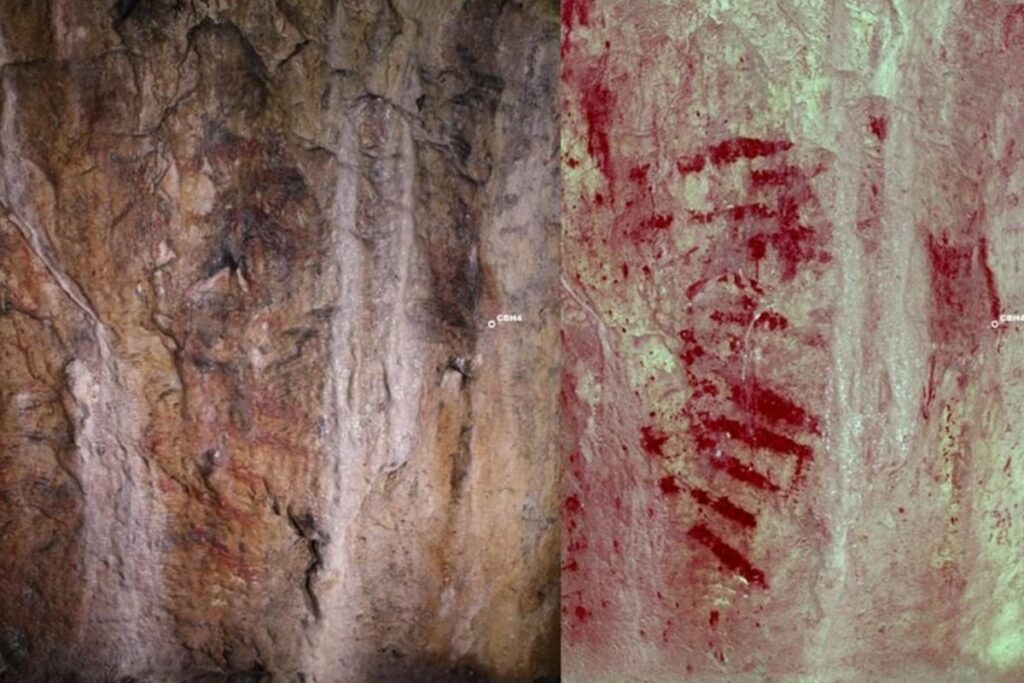
Distinct stripes painted in a cave on the Gower Peninsula in Wales have been revealed as the earliest known rock art in Britain by archaeologists.
The international team who conducted new research at Bacon Hole cave, cared for by National Trust Cymru, confirmed that the art was created by humans 17,100 years ago.
Overlooking the Bristol Channel the cave has long been known for its painted rock panel and is renowned as one of Wales’s most significant ‘bone caves’, named as such because of the ancient animal bones uncovered there.
However, after being discovered in 1912 the rare creation made using a naturally occurring mineral, red iron oxide (haematite), was widely dismissed throughout the 20th century as ‘natural staining.’
Now, following re-examination and new scientific analysis, the true significance of the Palaeolithic cave paintings has been confirmed. This makes Bacon Hole, a designated Site of Special Scientific Interest, one of the most important prehistoric sites in Europe.
The international team of scientists undertook the renewed investigations between 2022 and 2024 consisted of the First Art team from the University of Coimbra (Portugal), alongside researchers from Universities including Swansea, Southampton, Liverpool and Najing Normal University, China. The group have recently published a full scientific report on their findings.
Dr George Nash, an Archaeologist & specialist in Prehistoric and Contemporary art at Liverpool University who headed up the research added: “This discovery rewrites what we knew about the social and ritual lives of our early Welsh ancestors in the early prehistory of the British Isles.
“Predating all previously identified rock art sites in north-western Europe by at least 1,500 years, the intriguing artwork is a find of international significance.”
A combination of up-to-date archaeological science including high-resolution digital photography, uranium-series dating and Ramn spectroscopy, all aimed to look at the composition and age of the pigments used in the artwork.
All visible painted surfaces in the cave were re-examined, later confirming that the rock art pigments were deliberately applied by human fingers in lines, finger dots and splashes.
Transforming places they lived
David Thomas, Archaeologist for National Trust Cymru said: “We always knew Bacon Hole was an extraordinary Palaeolithic site – but to discover that the oldest cave art in Britain lies here in Wales is very exciting.
“To imagine people standing in this cave over 17,000 years ago, making their marks on the rock and transforming the places they lived through art, is profoundly moving.
“We’re hugely grateful to Dr Nash and the First Art team for revealing this hidden chapter of our past and deepening our understanding of the remarkable places we care for on Gower.”
The Bacon Hole cave art is one example of the wide collection of prehistoric art the Trust cares for across Wales, Northern Ireland and England as part of the 90,000 archaeological sites they look after.
National Trust Cymru has taken conservation measures to protect both the fragile archaeology and rock art and the rare bat population that roost in the cave, by installing a protective metal grille at the entrance.
Due to the precarious location of Bacon Hole on coastal cliffs, it is not safe for the public to access the cave.
The recent research at Bacon Hole cave was supported and funded by the National Trust and the Bradshaw Foundation.
Support our Nation today
For the price of a cup of coffee a month you can help us create an independent, not-for-profit, national news service for the people of Wales, by the people of Wales.
Get more trusted Welsh news
Choose Nation.Cymru as a preferred source in Google News to see more of our journalism.



