


New study backs concerns about economic impact of onshore wind turbines
Martin Shipton
Campaigners say a recently published international study has validated their concerns that intrusive wind turbines can damage rural economies.
Jenny Chryss, campaign lead of the group RE-think, which opposes plans for large scale wind turbines in mid Wales said: “When tourists visit rural Wales, it’s often to enjoy the beauty of the landscapes. It’s therefore worrying that research on the effect of visible wind turbines on local economies in Italy, with its own beautiful landscapes, found that tourism numbers dropped by 20% and tourist spend by 19%.
“The study, Beauty and the Blades: The Local Economic Impact of Wind Turbines, published in July 2026 also recorded a 19% reduction in tourism spending along with a 4% drop in house prices and a fall in population numbers of 1%. The greatest impact was in rural areas, and peaked seven years after the turbines were installed.
“Seven years is a long time for a rural business to suffer an increasingly detrimental downturn. Then, even if it survives, the impact will dissipate, it won’t bounce straight back to where it was before. So, where does this leave rural Wales? And what does it say to those prospective wind farm developers who claim that turbines make no difference to tourism, the economy or house prices?
“Most research published to date was conducted at a time when wind turbines were a fraction of the height or blade size of the modern, industrial scale versions being proposed across Wales today. Even this latest research uses data collected between 1998 and 2019, when turbines were far smaller than they are now.
“In fact, one of the paper’s authors led research published in 2021 which showed that in the Netherlands taller turbines had a greater impact on house prices than smaller ones. Using data gathered between 1985 and 2019 it stated: “For example, a tall turbine (>150m) decreases house prices within 2 km by 5.4%, while a small turbine (<50m) has an effect of maximally 2% and the effect dissipates after 1 km.
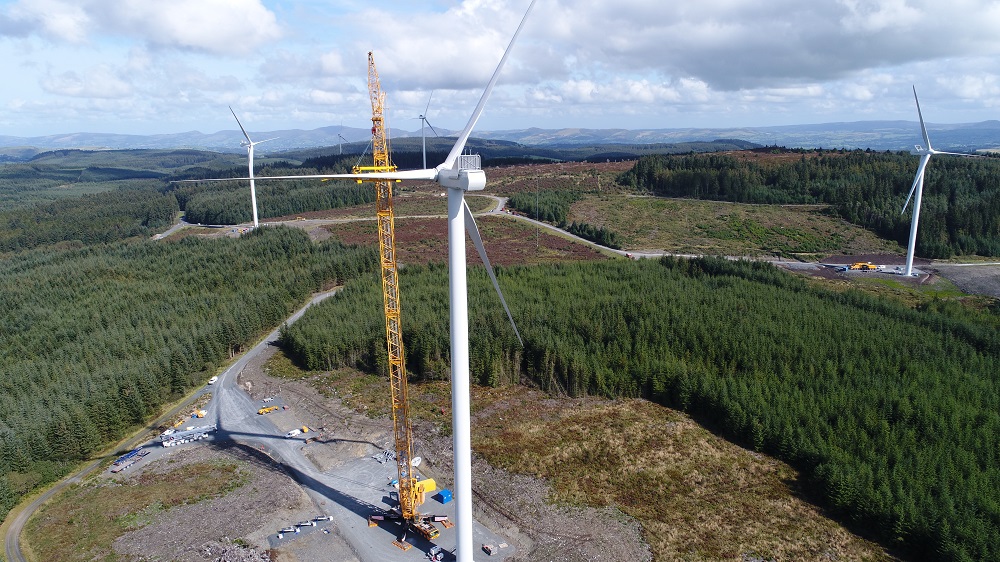
“The turbines now being proposed in Wales are generally between 180m and 220m or even 230m tall. In addition, many of the proposed wind farm sites are in close proximity to others, sometimes even adjoining, which creates a level of cumulative impact rarely encountered in the past.
“Powys County Council has already called for a moratorium on further wind farm development until a promised national energy strategy is put in place. The new Plaid Cymru-led administration is considering its options. But the message from rural communities is clear: it’s high time that the impact on landscapes, tourism and local economies is properly taken into account during the planning process for major renewable energy development.”
CPRW, The Welsh countryside charity, also said the new research should be considered urgently as Wales faces a rapid expansion of onshore wind development.
‘Research matters’
Dr Jonathan F Dean, Energy Spokesman for CPRW, said: “This research matters enormously for Wales. Our landscapes are not simply scenery; they are economic infrastructure supporting tourism, businesses and rural communities.
“Wales needs renewable energy, but location matters. Decisions about industrial-scale wind development must properly account for the cumulative economic cost of transforming landscapes on which rural prosperity depends.
“The evidence strengthens the case for a genuinely strategic approach: put the right infrastructure in the right places, rather than asking rural Wales to absorb the consequences of poorly planned development.”
The study found impacts were particularly pronounced in rural mountain and coastal communities.
CPRW is calling for tourism, landscape and cumulative economic impacts to be given substantially greater weight in Welsh energy and planning decisions.
Support our Nation today
For the price of a cup of coffee a month you can help us create an independent, not-for-profit, national news service for the people of Wales, by the people of Wales.
Get more trusted Welsh news
Choose Nation.Cymru as a preferred source in Google News to see more of our journalism.



Fine. Build a coal power station.
not sure recent events made it through.
wonder where the money comes from to drive this thinking.
While the research team is independent, the press coverage in Wales is being driven by RE-think and CPRW (Campaign for the Protection of Rural Wales), both of which actively oppose onshore wind proposals in mid-Wales. The anti-wind groups selectively present the paper’s highest figures to suggest wind turbines universally cause economic collapse. When reading their claims, keep these critical nuances in mind: A. A Working Paper / Empirical Model (Not Absolute Truth) The paper uses econometric modeling on historical Italian data from 1998 to 2019. In economic studies of visual landscape impacts: Results depend heavily on the specific baseline landscape… Read more »
It stands to reason that if visitors to Wales come because of the beautiful countryside and that countryside is ruined by turbines (that are by no means ‘green’) then they won’t come, will they. It’s like taking all the attractions from Disneyland and saying visitors will still come to the hotels!!
Clearly it doesn’t stand to reason, because the evidence doesn’t support your assertion.
Please do some homework about our infrastructure and the fact we cannot cope with the wind farms we have at the moment yet alone more. Fix our infrastructure before approving anything else or put the farms close to cities. 😴🥴 isn’t over £1 billion In curtailment payments enough evidence to suggest we need to fix things first?
As I read this I was reminded of the fact that wind energy is one of the cleanest and cheapest forms of electricity generation available and a vital tool in our battle against climate catastrophe that is posing such a threat to our children’s future.
Is it? By August we have paid over £1 billion in curtailment payments for this year alone because we don’t have the infrastructure to cope with the wind farms that we have at the moment. The damage to the environment is immense and we can’t cope with the energy we are producing right now. It’s not effective or efficient. Why aren’t we fixing our infrastructure before we approve more? Oh, the government heavily subsidizes this industry and most of the new developments are from overseas companies looking to profit and greedy landowners wanting a quick buck. Do some homework please… Read more »