


NHS waiting lists rises for fourth month in a row
Mark Mansfield
NHS waiting lists in Wales have risen for a fourth consecutive month, with more patients facing waits of more than two years.
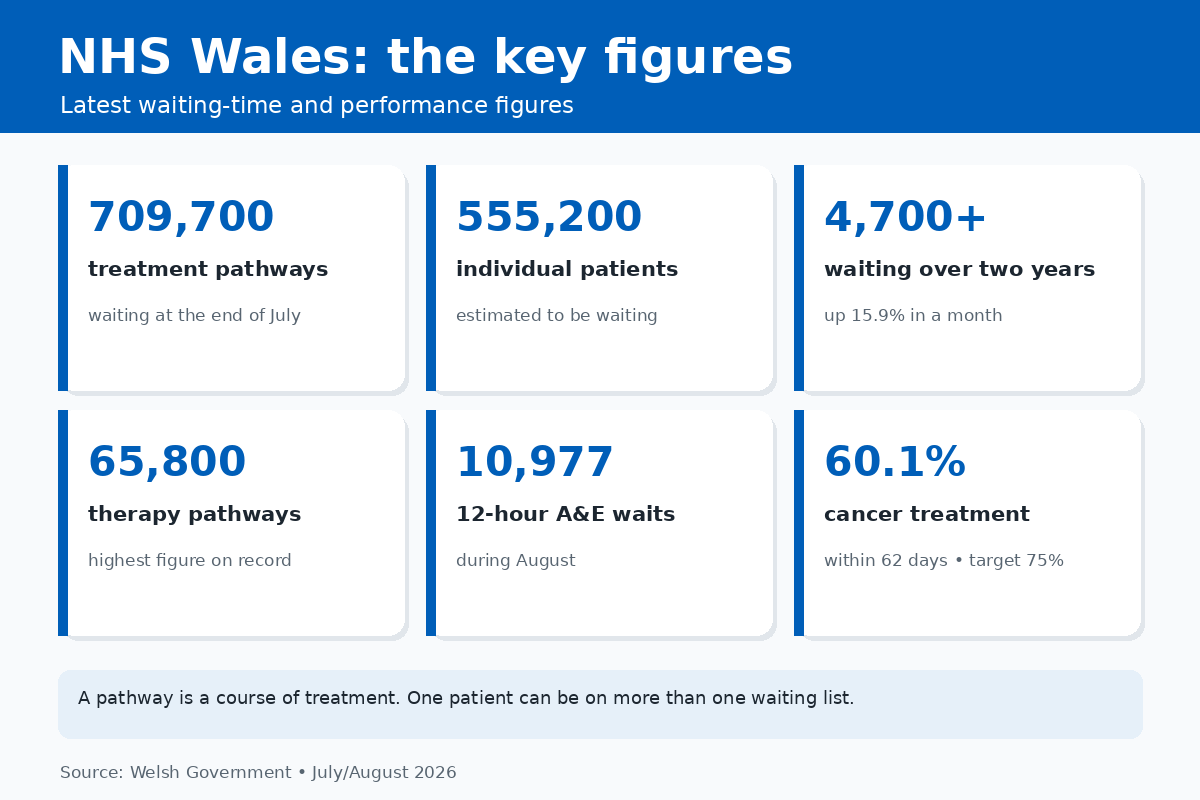
Official figures show there were just under 709,700 patient pathways waiting to start treatment at the end of July, an increase of around 11,300 from 698,400 in June.
A patient pathway represents an individual course of treatment a person is waiting for. It does not represent an individual patient because one person can be on more than one waiting list at the same time.
Management information suggests around 555,200 individual patients were waiting for treatment in Wales.
The number of pathways waiting more than two years rose by 649 in a month to just over 4,700 – an increase of 15.9%.
Provisional figures suggest waiting lists increased again during August, reaching around 714,200 pathways. Of those, 96,200 had been waiting more than a year and 5,100 more than two years.
The latest provisional figure means the number of pathways waiting for treatment has grown by around 15,800 in two months.
Cabinet Minister for Health and Care Mabon ap Gwynfor described the figures as “disappointing” and said performance was not where the Welsh Government wanted it to be.
He said: “The inherited waiting list backlog remains too high, and tackling it remains our top priority.
“This is why we are putting measures in place that will improve waiting times for people on a sustainable basis and ensure nobody is waiting more than two years for treatment.”
The figures show 65.7% of pathways had been waiting less than 26 weeks at the end of July, down from the previous month.
Just over 172,400 had been waiting longer than 36 weeks, an increase of around 3,200, while the average time patients had been waiting rose to 16.3 weeks.
The figures also show significant differences between health boards. Betsi Cadwaladr had the highest proportion of pathways waiting more than one year, at 16.7%, and more than two years, at 1.2%.
Powys and Swansea Bay had no pathways waiting longer than two years.
There was a mixed picture for other services. The number waiting for diagnostic tests fell by 1.4% to just under 118,700 in July, while those waiting longer than the eight-week target fell by 4.2% to just under 37,500.
But the number of pathways waiting for therapy services increased by 2.7% to almost 65,800 – the highest figure on record.
More than 6,800 therapy pathways had been waiting longer than the 14-week target, an increase of 8.4% in a month.
Surgical capacity
Mr ap Gwynfor said the government was taking a “clinically led approach” to clear the longest waits and bring overall waiting lists back to pre-pandemic levels before the end of the current Senedd term.
He said the plans would involve getting people into treatment more quickly, increasing surgical capacity and reforming follow-up appointments so more patients could be seen for the first time.
An additional £145m is being invested in NHS Wales this financial year, including £100m aimed at reducing waiting times, £25m for new surgical and diagnostic hubs and £20m for maintenance.
Mr ap Gwynfor said: “Health boards are now carrying out these plans and we need time for them to filter through the system and have an impact. I expect to see them making progress soon.”
There were signs of improvement in some areas of urgent and emergency care in August.
Emergency departments
Almost 97,700 people attended emergency departments during the month, an average of 3,151 a day and 204 fewer per day than in July.
However, just 63.8% of patients spent less than four hours in emergency departments, down from the previous month and well below the 95% target.
A total of 10,977 patients waited 12 hours or more, although that was 733, or 6.3%, fewer than in July.
Ambulance response times improved for the most serious calls. The median response to a purple call – involving cardiac or respiratory arrest – was seven minutes and 24 seconds, meeting the target.
The median response for red calls fell to nine minutes and two seconds but remained outside the six-to-eight-minute target.
Mr ap Gwynfor said: “I welcome the progress in urgent and emergency care, particularly on ambulance patient handovers, where performance within 45 minutes was the best since May 2021.
“Response times to the most serious incidents and 12-hour emergency department waits have also improved. But the overall position is still not good enough, and I expect health boards and NHS organisations to maintain momentum and deliver further, sustained improvement.”
Cancer
Cancer figures showed 2,248 people started their first definitive treatment in July, 119 more than in June.
A total of 60.1% started treatment within 62 days of cancer first being suspected, an improvement on June but still below the 75% target.
There were also 18,429 new suspected cancer pathways opened during July, the second-highest number since records began, while 15,052 pathways were closed after patients were told they did not have cancer.
‘Focus’
Commenting on the latest statistics, Welsh Conservative Shadow Cabinet Minister for Health and Social Care, Natasha Asghar MS said:
“These figures show that the pressures on our NHS continue to grow under Plaid, with waiting lists and two-year waits failing to improve.
“Patients are waiting longer for treatment, cancer targets are still being missed, thousands are facing waits of more than two years, ambulances continue to miss response targets and almost 11,000 people waited more than 12 hours in A&E in August.
“Yet this week, Plaid Cymru have been focused only on their obsession with constitutional change and independence, spending more time with the SNP and Sinn Féin than with the striking health visitors they promised to help.
“Patients across Wales will expect the Welsh Government’s focus to be on getting waiting lists down and improving outcomes for patients, not on breaking up our country.
“They cannot keep blaming others. Plaid Cymru are now running the Welsh Government and they need to take responsibility for delivering the improvements patients desperately need.”
Support our Nation today
For the price of a cup of coffee a month you can help us create an independent, not-for-profit, national news service for the people of Wales, by the people of Wales.
Get more trusted Welsh news
Choose Nation.Cymru as a preferred source in Google News to see more of our journalism.


