


Nuclear power announcement ‘is not good news for Wales’
Martin Shipton
The billions of pounds to be spent on developing “small modular reactors” at Wylfa on Anglesey would be better spent on insulating Welsh homes and on renewable technologies that can generate electricity cheaper and far quicker, according to the group Nuclear Free Local Authorities.
In a statement the group said: “The UK Government’s nuclear delivery agency Great British Energy – Nuclear recently concluded a competition amongst SMR developers to select a preferred design. Unsurprisingly Rolls-Royce, which had already received a government hand-out of £210m during an earlier development stage, and a government hand-up by being fast-tracked onto the Generic Design Assessment process, won the competition. This was the equivalent of running a race with superior sports footwear, and starting the race much earlier than the other participants. The company will now be awarded a further £2.5bn of hard-pressed taxpayers’ money to build three pilot SMRs.
“Great British Energy – Nuclear also purchased the Wylfa and Oldbury sites off Horizon for £160m for reuse as locations for these new SMRs, almost certainly at nil or minimal cost to the developer, and GNE – N recently advertised for a site manager with proficiency in the Welsh language, letting slip that Wylfa was the preferred site.
“The government’s announcement refers to Wylfa becoming Britain’s first SMR ‘power plant’ with reactors plural, suggesting that the three initial reactors will all be co-located on the island. SMRs are an uncertain and unproven nuclear technology. The Rolls-Royce SMR design has yet to secure all the required regulatory approvals, no Rolls-Royce SMRs have yet been built, let alone operated, and there is no experience of SMR modular assembly.
“Any reactor will not even come on stream until the 2030s and even then will only deliver electricity for customers that is vastly more expensive than that generated by renewables. Nor has any permanent solution to the intractable problem of managing high-level radioactive waste been found, but there has been some academic research which indicates that many SMR designs create more waste per kilowatt generated than traditional gigawatt plants. And as Ukraine has demonstrated, nuclear power plants are obvious targets in any future conflict.
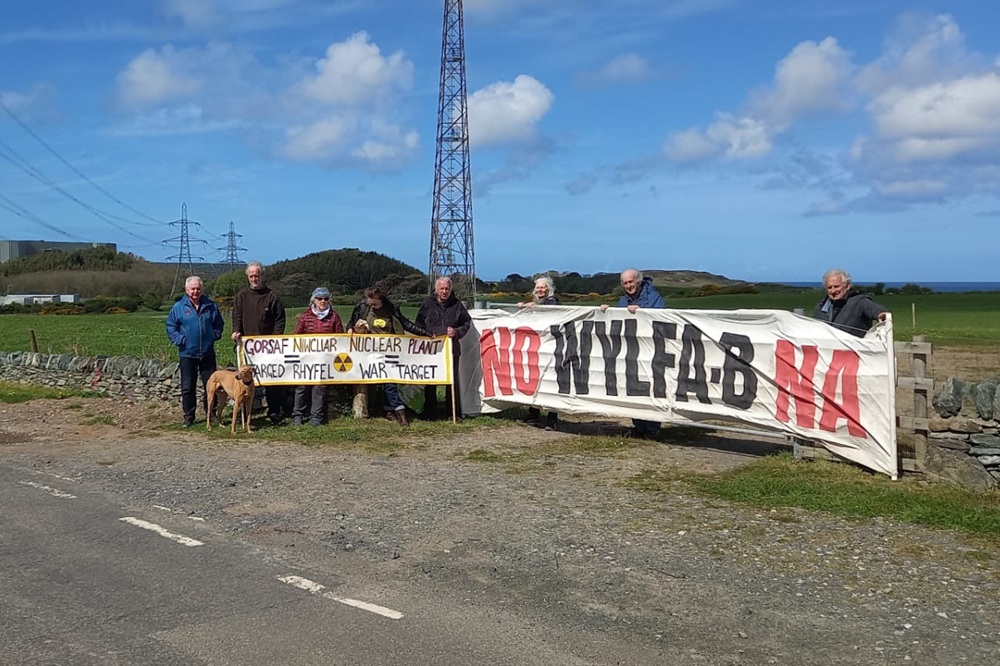
“Wylfa is a particularly problematic location. The Horizon bid was rejected in part because of the damage it would cause to nature and the beautiful environment of Ynys Mon and its impact on the island’s linguistic heritage. But the bid failed largely because the developer felt they were not receiving enough financial support from the taxpayer. How will this be different? The price tag for a single SMR is likely to be at least £4bn. Will a public subsidy of £2.5bn be deemed sufficient to Rolls Royce to incentivise them to proceed with building three?
“How will electricity be transmitted across and out of the island? It is very likely that we shall see a sea of new pylons spring up across the green fields of Ynys Mon and beyond. If parts for a modular reactor are made off-site, how will they be transported onto the island? And with ‘First of a Kind’ experimental SMRs at Wylfa, and a military neighbour at RAF Valley, surely the UK Government is making Ynys Mon an even higher priority target for terrorists or a hostile power in time of war. How will islanders be evacuated quickly and safely should there be an attack or an accident?
“The promised thousands of jobs ‘for the local community’ must also be questionable. Given that Rolls-Royce will wish to build a fleet of SMRS at numerous locations in the UK and beyond, and that the construction will be based on a modular model, it would surely make most commercial sense to engage a major construction partner which can deliver units UK-wide and on the international market.
“This big player is more likely to be able to acquire the expertise needed to build future plants more quickly and cheaper to boost Rolls-Royce’s bottom line. When such a partner comes to Wylfa to build the inaugural plant, they will bring with them their own trusted sub-contractors, and the main contractor and sub-contractors will bring with them their established off-island workforce.
“And once operational, what is to prevent local licensed nuclear workers engaged in decommissioning at the old Wylfa Magnox plant from moving across to work for Rolls-Royce if wages and conditions are better? This transfer will do nothing to boost local employment numbers, but it may jeopardise the decommissioning programme.
“Although the Welsh First Minister, Eluned Morgan, has welcomed the UK Government’s Wylfa announcement, this sentiment runs completely contrary to her own government’s agreed position; for ‘in 2023, the Welsh Government set a target to generate the 100% of Welsh electricity consumption from renewable sources by 2035’. Figures from 2023 also show Wales produced 23.21 TWh of electricity and only consumed 14.3 TWh. Clearly then electricity derived from the Wylfa development is not wanted by the Welsh Government for its citizens, with its policy focus on renewables, and is unneeded, as Wales enjoys an electricity surplus.
Energy bills
The statement concluded: “The Welsh NFLAs would rather see the £2.5bn dedicated to SMR development at Wylfa redirected by the UK Government to reduce the energy bills of Welsh citizens and move closer to making Wales a wholly renewable electricity nation. How? By funding an emergency programme of retrofitting insulation to Welsh homes and into supporting renewable energy projects.
“Such a retrofitting policy would mean more energy-efficient Welsh homes with lower bills for consumers, reducing fuel poverty and improving public health. It would also deliver entry-level jobs which could be allocated to unemployed Welsh citizens.
“It can start now. And focusing upon generation through renewable technologies means cheaper electricity for Welsh consumers delivered far quicker. It will also make Welsh communities more energy independent, and comes without the risks or the radioactive waste which accompanies the nuclear power being generated for England.”
Support our Nation today
For the price of a cup of coffee a month you can help us create an independent, not-for-profit, national news service for the people of Wales, by the people of Wales.



Complete agreement Martin. Well said.
Hello nuclear, goodbye Annibyniaeth
Good points regarding the health and safety of the islanders and given the animosity between Putin and the UK, we’re public enemy No1 in Russia by all accounts so evacuation is a nightmare non-starter…question for the Senedd did you know there is a north to Wales and part of it is an island with a bldy big target in RAF Valley and Holyhead Port…
Sleepy Drakeford…back-up farms for festivals but glaring security issues ignored…
No to Nuclear!
This is a hilariously biased article, as could be guessed by the headline alone. To break down a few of the most egregious points: – This article discusses using Rolls Royce as if it’s a bad thing, not mentioning at all that Rolls Royce is the only UK based company that could build SMR’s, and is indeed possibly the best company in the world to do so. The money spent will stay in the UK economy rather than being paid to a foreign body. – The article discusses nuclear power plants as targets for terrorist attacks, or in war. Despite… Read more »